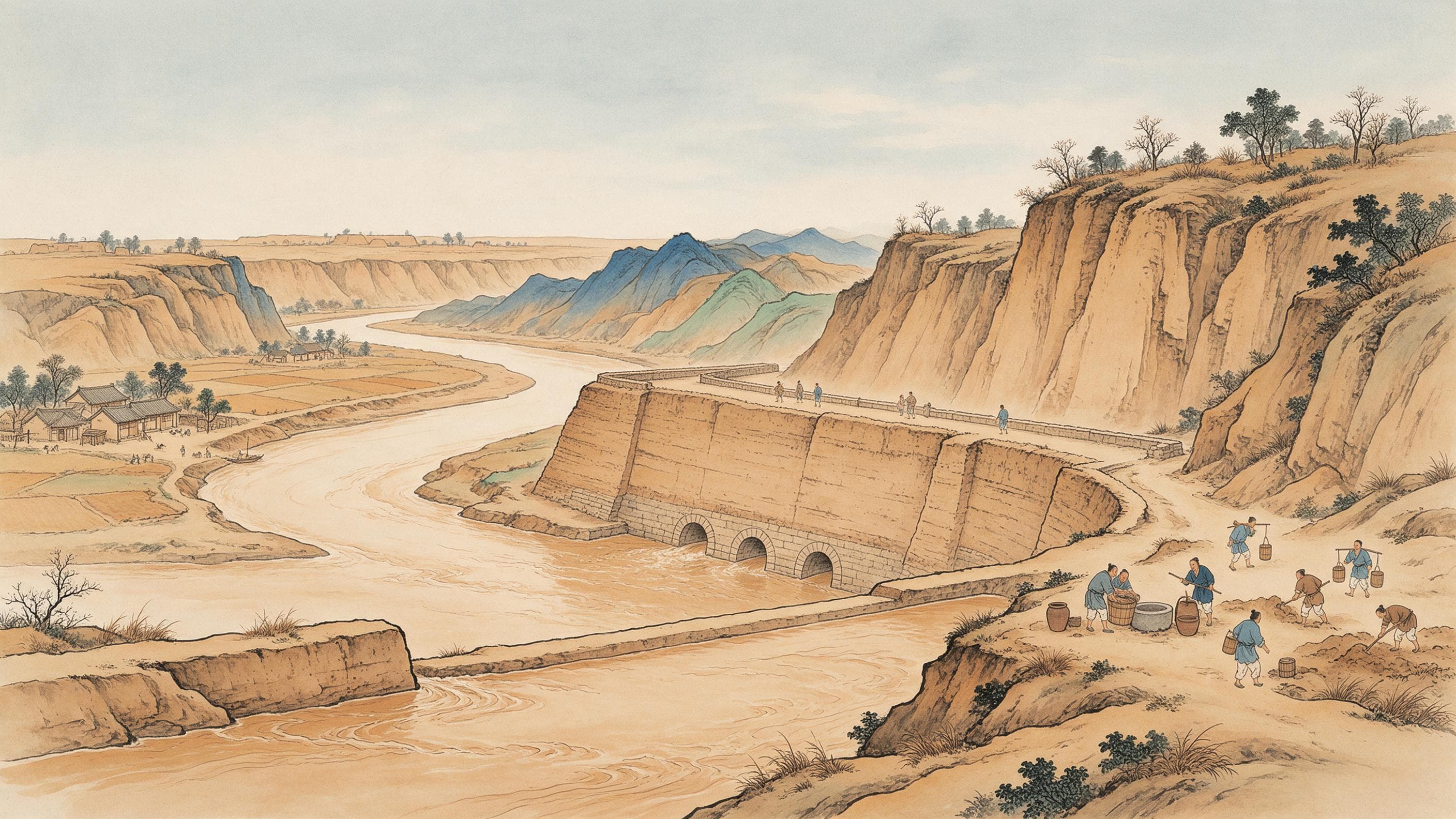
Where the Jing River leaves the mountains it bends. The intake of the Zheng Guo Canal sits on the east bank, at a place the Han histories call Hukou, 'gourd mouth'. The Shiji gives its line in one sentence: the canal was cut from the west side of the Zhongshan hills to Hukou, ran east along the foot of the northern hills, and emptied into the Luo, more than three hundred li away. North of the river the ground rises into a long tableland of pale, alkaline soil — the 'saline and salty land' the texts speak of. The canal is named after a man who was sent to make it fail.
The plot to exhaust Qin
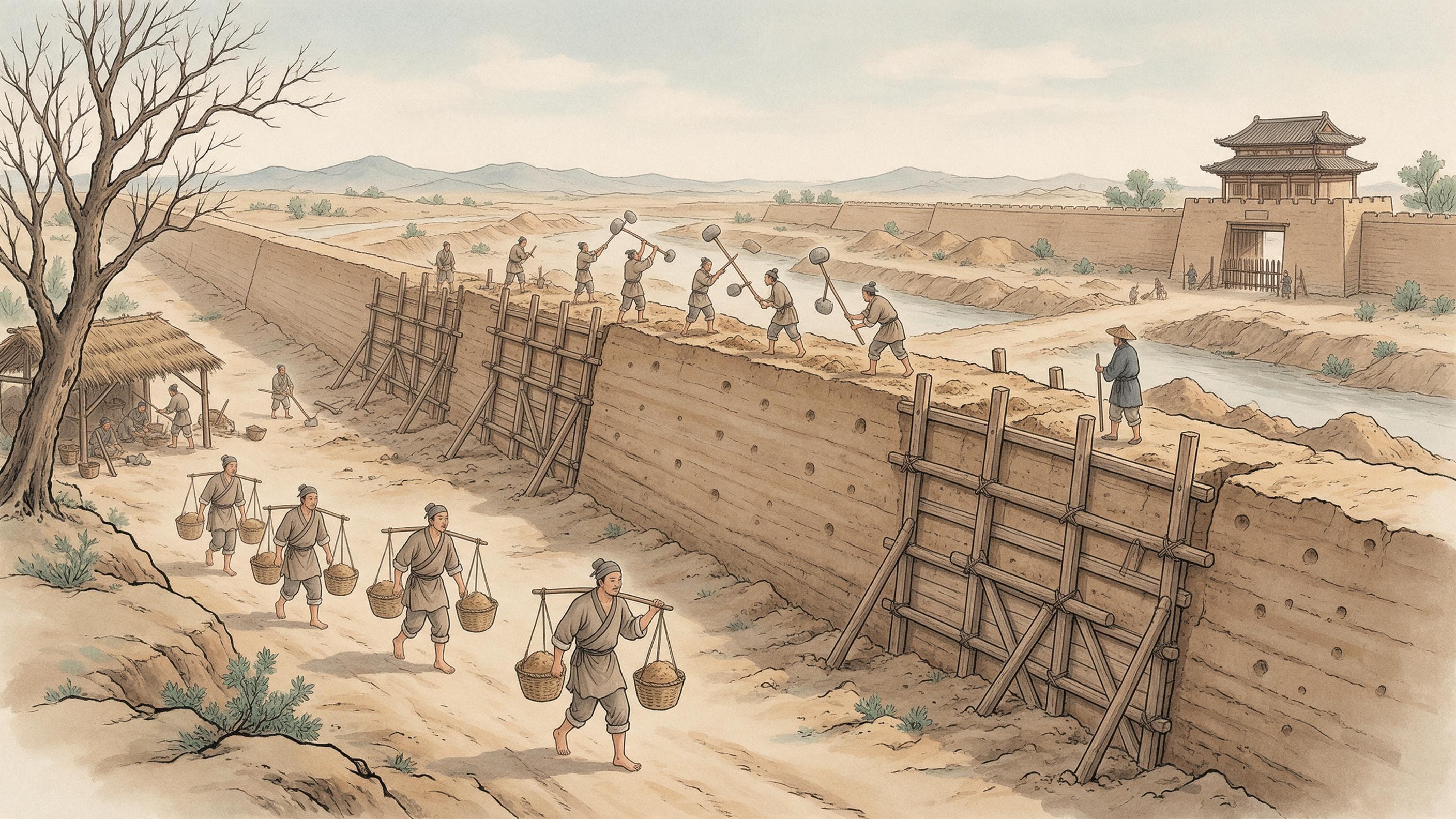
Qin's eastern neighbour was Han. The Han histories give its reasoning: Han 'heard that Qin liked to start great works, and wished to exhaust it, so that it could not march east', and sent a hydraulic engineer named Zheng Guo to persuade Qin to dig. The work began. Halfway through, the deception was discovered, and Qin wanted to kill him. Zheng Guo's answer is the hinge of the story: 'At first I came as a spy, but when the canal is finished it will also be to Qin's advantage.' Qin accepted this and let him finish.
The two books tell it almost identically, with one sentence between them. The Shiji has only the line above. The Hanshu adds another: 'I have prolonged Han's life by a few years, and built Qin a work of ten thousand generations.' Both are Han compositions, one Western Han and one Eastern Han, not Qin records; whether Zheng Guo said it cannot be checked, because the story is already a piece of writing. And after the canal is finished and named for him, Zheng Guo disappears from both books. No office, no reward, no death. He becomes a name on a canal.
What the canal was said to have done
The Shiji says that when the canal was complete, it was used to lead silt-laden water onto the saline ground: 'more than forty thousand qing, and every mu harvested one zhong.' With that, 'within the passes the land became rich and open, there were no bad years, Qin grew wealthy and strong, and in the end annexed the other states; the canal was therefore named Zheng Guo.' The phrase for the water is 'water that fills and blocks'; the mechanism, as modern accounts explain it, is that the silt seals the low ground and holds the salt down.
The figures are Han figures. No Qin document can be set against them; forty thousand qing cannot be checked on the ground, and this article does not turn qing into modern acres or a zhong into kilograms — a zhong is a measure of capacity, and it is left as one. The one checkable thing is a chronological anchor the Hanshu supplies for itself: from the opening of the Zheng Guo Canal to the sixth year of Yuanding was a hundred and thirty-six years. Readers who want a date can work it out; this article only records the two ends the book gives.
It is worth noticing where the story is kept. Both accounts sit in chapters about waterways — Sima Qian's 'Book of Rivers and Canals', Ban Gu's 'Treatise on Ditches and Channels' — not in a history of Qin. Sima Qian ends his chapter with a personal line: 'How great are the benefits and harms of water!' He had carried firewood himself when the Yellow River broke at Huzi, he says, and wrote the chapter grieving over the song sung there. The spy and his canal survive because a chapter on water needed an example of what a canal can do.
Why muddy water was good water
The water in the canal was not clear. The Jing carries loess, and a Han song about the later Bai Canal makes the point better than any agronomic treatise: 'Where are the fields? At Chiyang and Gukou. Zheng Guo went before, the Bai Canal came after. Spades raised like clouds, channels opened like rain. In a shi of Jing water, several dou of mud: it irrigates, and it manures, and it grows my millet and wheat. Food and clothing for the capital, for millions of mouths.' The silt was the fertiliser and the water was the carrier.
The method was repeated. In the second year of Taishi (95 BC) a man named Bai Gong proposed a second canal from the same river: two hundred li long, watering four thousand five hundred-odd qing. Both figures come from the same chapter, and the difference between them is not explained. Earlier, in 111 BC, an official named Ni Kuan asked to cut the Liufu Canal 'to water the high fields beside the Zheng Guo Canal', which suggests the original canal did not reach all of them.
The intake, twenty-three centuries later
The intake is still there. A 2025 newspaper visit describes rammed-earth remains in the loess near Wangqiao in Jingyang, and, along the same east bank, the heads of the canals that came after: the Han Bai Canal, the Song Fengli Canal, the Yuan Wang Yushi Canal, the Ming Guanghui Canal, the Qing Longdong Canal, and the Jinghui Canal built in 1932. In 2016 the site was listed as a World Heritage Irrigation Structure. The reporter also repeats the engineers' explanation of the siting: where the Jing leaves the hills the bed widens into a great S-curve, the fastest water swings against the concave bank exactly where the mouth was cut, and the heavier sand is carried to the opposite side and kept out of the channel. This is a description of the site, not a measurement of the Qin work.
The modern figures belong to the reporter and the engineers he quotes: about eighty metres of fall between the two ends of the canal line, an average gradient of 0.6 per mille; a river bed now some twenty metres below the old canal base, fifteen when measured in 1974; an intake that has moved upstream by about 4.95 kilometres because the river has cut down; and a water level said to be falling 0.7 to 0.9 centimetres a year. These describe a channel that has silted, cut down and been re-cut for two thousand years, not a Qin survey. In 2025 the Shaanxi Academy of Archaeology began formal excavation. No report has appeared.
Three materials, three lines
So the canal exists in three kinds of material, and they do not meet. There is the Han story: a spy, a reprieve, a state made rich. There are Han numbers: three hundred li, forty thousand qing, a zhong per mu. And there is the ground: a silted channel, rammed banks, an intake that has crept upstream as the river cut down. The first two are books written centuries after the event; the third has not yet been published. The intake is still in the loess, and the report is still to come.
Sources & further reading
- 司马迁《史记》卷二十九·河渠书(西汉;维基文库) — Han 'heard that Qin liked to start great works, and wished to exhaust it'; sent the hydraulic engineer Zheng Guo to talk Qin into a canal from the Zhongshan hills at Hukou, along the north hills east to the Luo, more than three hundred li. Halfway through the deception was discovered; Zheng Guo: 'At first I came as a spy, but when the canal is done it will also be to Qin's advantage.' More than forty thousand qing of saline land watered; one zhong per mu; within the passes rich land, no bad years; Qin strong and rich, annexed the other states; the canal named after him.
- 班固《汉书》卷二十九·沟洫志(东汉;维基文库) — Same story with one added sentence: 'I have prolonged Han's life a few years, and built Qin a work of ten thousand generations.' Chronological anchor: from the opening of the Zheng Guo Canal to the sixth year of Yuanding was a hundred and thirty-six years; the Liufu Canal of 111 BC was cut 'to water the high fields beside the Zheng Guo Canal'. The Bai Canal of Taishi 2 (95 BC): two hundred li, four thousand five hundred-odd qing, and the song 'in a shi of Jing water several dou of mud; it irrigates and it manures'.
- 〈探郑国渠遗址 寻千年水脉〉,《华商报》2025-05-09(人民日报客户端转载,记者陈团结) — Site visit, not an excavation report. Intake remains at Hukou on the east bank; successive canal heads (Han Bai, Song Fengli, Yuan Wang Yushi, Ming Guanghui, Qing Longdong, Jinghui 1932) lie along the same bank; listed as a World Heritage Irrigation Structure in 2016; reporter's and engineers' figures: about 80 m of fall, 0.6 per mille gradient, river bed some 20 m below the old canal base, intake moved up about 4.95 km, water level falling 0.7–0.9 cm a year; the Shaanxi Academy of Archaeology began formal excavation in 2025, no report yet. The article's ranking phrases and its 'five years later Qin attacked Han' timeline are not used here.