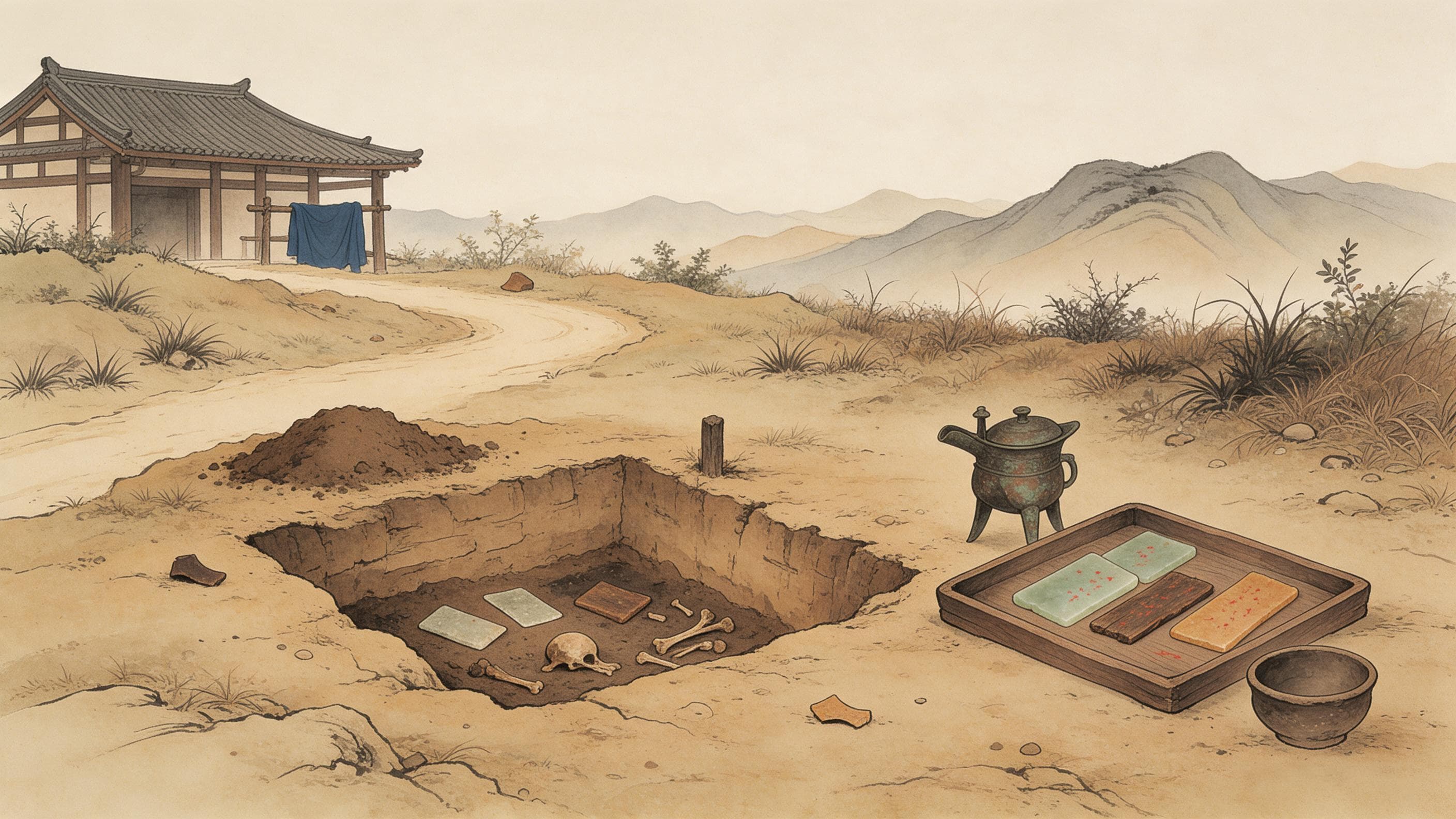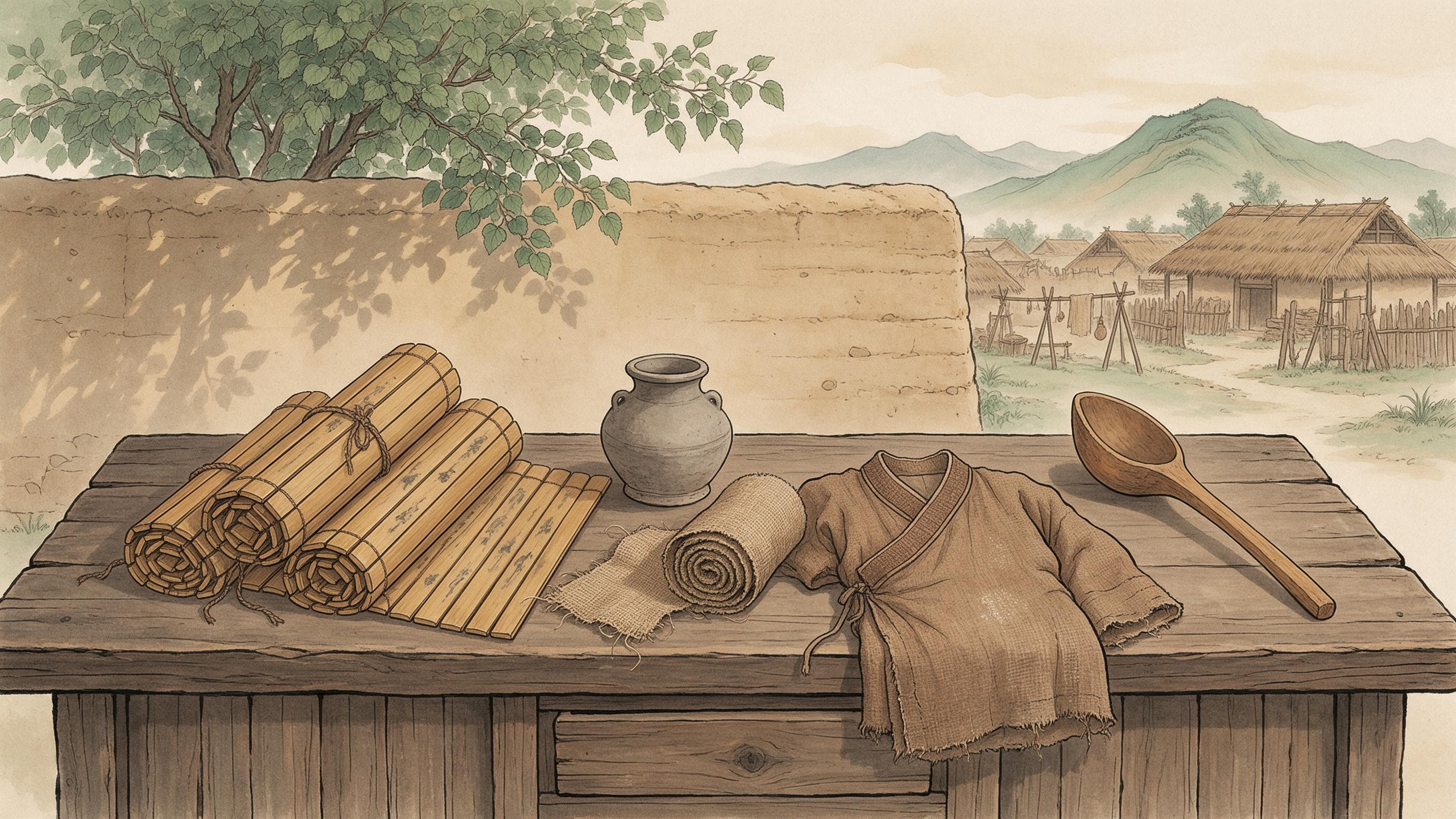
Among the Shuihudi Qin slips is an inventory headed 'sealing and guarding'. It begins: 'The house and persons of Jia: one house with two inner rooms, each with a door, the inner rooms roofed with tile, the timber complete, ten mulberry trees at the gate.' Then the persons: the wife is dead and not to be included in the sealing; a young son, six chi five cun tall; one male slave, one female slave, one male dog. It is an inventory of a household — written by the government, not by the householder.
An inventory of a house
The inventory comes from the Fengzhen shi, a collection of model forms for judicial documents. The parties are placeholders — 'Shiwu Jia of such-and-such a hamlet' — so it is not the file of a real case but a model of how such a document should be written: how to list a house, its people, slaves and livestock, item by item. What matters in it is not what the man owned but that everything was registered.
A boundary first: it cannot be read as the property of an ordinary Qin household. This man has slaves, a dog and ten mulberry trees; he is not among the poorest. The list is what was registered when the property was sealed, not necessarily all he had. The measurements (six chi five cun, seven chi) are left in Qin units and not converted into metres.
The measurements of a room
The burglary form measures even more closely. The victim's wall is 'seven chi high'; a new hole is cut in the middle of the inner room, 'level with the small hall below, two chi three cun high, two chi five cun wide at the bottom, shaped at the top like a pig's wallow'; outside are 'four Qin sandal prints, each a foot and two cun long'. The stolen garment is described too: 'fifty chi of cloth, silk lining, five catties of silk floss for padding, a patterned silk border and edging of five chi'.
The height of a wall, the size of a hole, the length of a shoe print, the material in a robe — all measured. That is how a Qin judicial document reads: the scene recorded as an account. Only the figures bearing on food, clothing and shelter are taken here; the details of the crime and of the deaths are not.
What a person wore
The corpse form records a man: 'a plain cloth skirt and a jacket', one of each; by his feet 'a pair of Qin sandals'; 'a grown man, of fair complexion, seven chi one cun tall, hair two chi long; two old scars on his belly'; the body 'a hundred paces from such-and-such a post station and two hundred paces from the field hut of Shiwu Bing of such-and-such a hamlet'. Clothes, height, hair, scars, distances — all in the record.
Clothing issued by the state had its own prices. The Jinbu lü: hemp garments for issue — 'a large one, eighteen catties of hemp fibre, worth sixty cash; a medium, fourteen catties, forty-six; a small, eleven catties, thirty-six'. Issue had a season: 'summer clothing is issued from the fourth month to the end of the sixth; winter clothing from the ninth to the end of the eleventh; after the time, nothing.' Allowances were graded: 'bondmen, unattached servants without wives and convicts, 110 cash in winter and 55 in summer; the small ones 77 and 44; grain-pounders 55 and 44, the small ones 44 and 33.' The garment had a price and the allowance a standard, both set by the state. (The same statute also fixes cloth at eight chi by two and a half and sets eleven cash to a bolt; those belong to the market article and are not developed here.)
How much a month
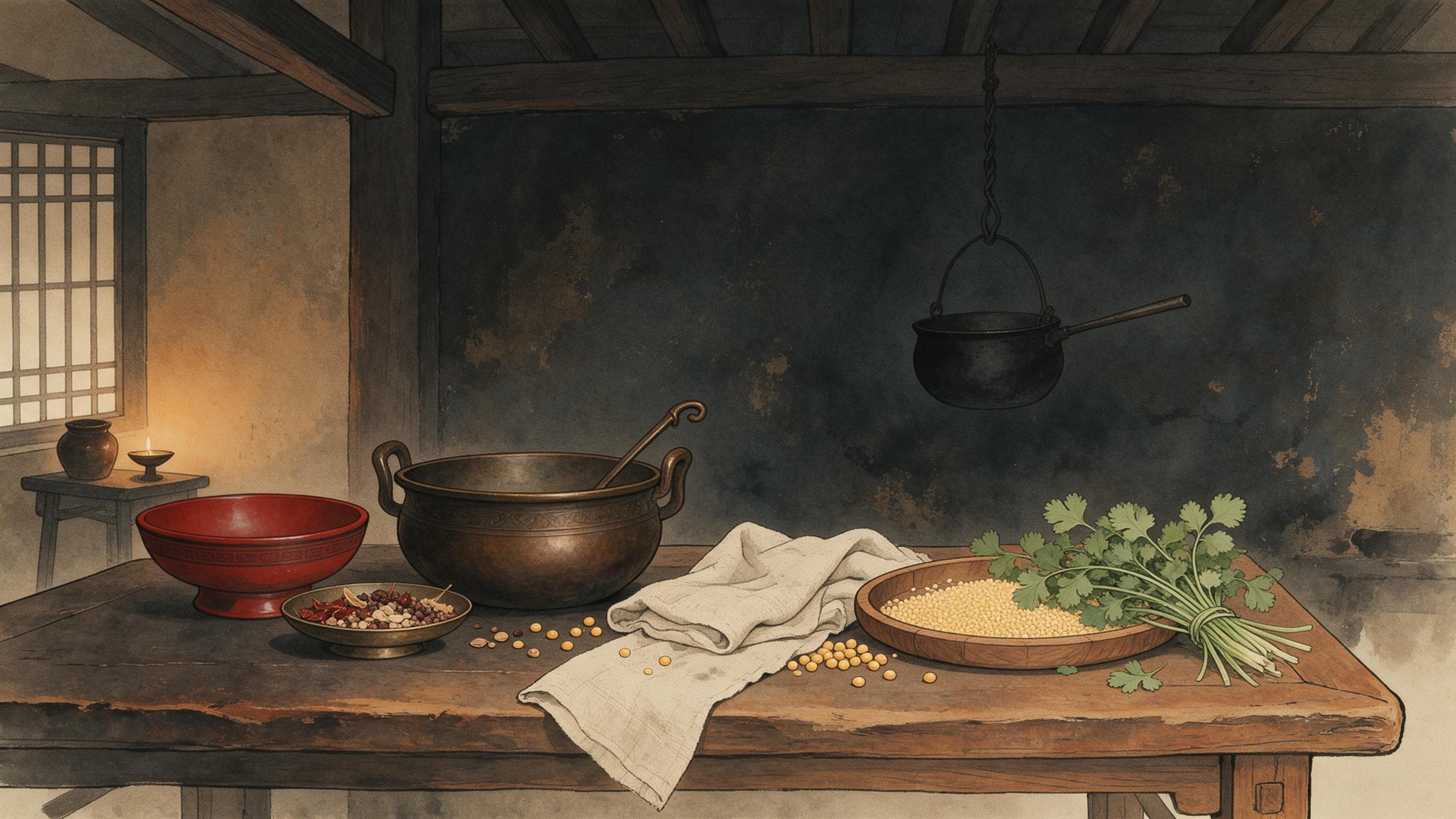
The rations are a table. The Cang lü: 'a bondman two shi of grain a month, a bondwoman one and a half; if not working, nothing. Small convicts or bondmen who work, one and a half shi; those who cannot work, one shi. Small bondwomen and grain-pounders who work, one and a quarter; those who cannot, one shi. Infants without mothers, half a shi each.' There was extra in the farming season: 'a bondman in the fields receives two and a half from the second month, and at the end of the ninth the extra half stops.' Wall-building convicts got 'half in the morning and a third in the evening'; prisoners 'a third of a dou a day'.
Who these rations were for must be stated: the recipients are bond servants and convict labourers fed by the state, not the farming population. So 'a Qin farmer ate two shi a month' cannot be inferred — that is exactly the step the sources forbid.
What the accounts can show
The limits, listed: no 'a day in the life of a Qin person' — statutes and judicial forms contain no hours, no menu, no amusements; the Rishu day-book is not used, since the Wikisource pages are empty shells; the Fengzhen shi is a model, not a case file; the grain rations are for the state-fed; the clothing allowances are official issue, not market prices; measurements stay in Qin units; no slip numbers are invented, since the transcription has none; the cash is Qin cash, and the texts never say 'half-liang'; nothing is converted into modern purchasing power; no judgement that Qin law was harsh is offered; and Han material is not used to fill Qin gaps.
Four things side by side: an inventory (one house with two inner rooms, ten mulberry trees, a son six chi five cun tall), the measurements of a room (a wall seven chi high, a hole two chi three cun), a set of clothes (a cloth skirt and jacket, Qin sandals, garments at sixty, forty-six and thirty-six cash, allowances of 110 in winter and 55 in summer), and a table of rations (a bondman two shi, a bondwoman one and a half, an infant half). Every figure was written by an official; not one was spoken by the person concerned. What can be written is how the state counted a man, not how a Qin man lived — that is the limit of these three documents, and their honesty.
Sources & further reading
- 《睡虎地秦简·封诊式》(维基文库录文) — Model forms for judicial documents, not case files: the parties are placeholders such as 'Shiwu Jia of such-and-such a hamlet'. The sealing inventory lists 'one house with two inner rooms, each with a door, roofed with tile, the timber complete, ten mulberry trees at the gate', a son six chi five cun tall, a male and a female slave and one male dog. The burglary form gives a wall seven chi high, a hole two chi three cun high and two chi five cun wide, four shoe prints a foot two cun long, and a stolen robe fifty chi of cloth with silk lining, five catties of silk floss and a five-chi patterned border. The corpse form gives a plain cloth skirt and jacket, a pair of Qin sandals, a body seven chi one cun tall, hair two chi long, a hundred paces from the post station and two hundred from a field hut.
- 《睡虎地秦简·仓律》(维基文库录文) — Statute on granaries and issue rations; the recipients are the state-fed — bond servants and convict labourers, not the population at large. Bondman two shi of grain a month, bondwoman one and a half; small convicts able to work one and a half, unable one; small bondwomen and grain-pounders able one and a quarter, unable one; motherless infants half a shi. A bondman in the fields gets two and a half from the second month to the ninth. Wall-building convicts get half in the morning and a third in the evening; prisoners a third of a dou a day. Also seed rates and the rate for husking millet.
- 《睡虎地秦简·金布律》(维基文库录文) — Statute on money, cloth and the issue of clothing. Only the clothing-issue clauses are used here: summer clothing issued from the fourth to the sixth month, winter from the ninth to the eleventh, nothing after the time. Coarse hemp garments: large, eighteen catties of hemp fibre, sixty cash; medium, fourteen catties, forty-six; small, eleven catties, thirty-six. Issue allowances: bondmen, unattached servants and convicts without wives, 110 cash in winter and 55 in summer; the small ones 77 and 44; grain-pounders 55 and 44, the small ones 44 and 33. The cloth dimensions and the rate of eleven cash to a bolt are noted only in passing, as that belongs to the market article.