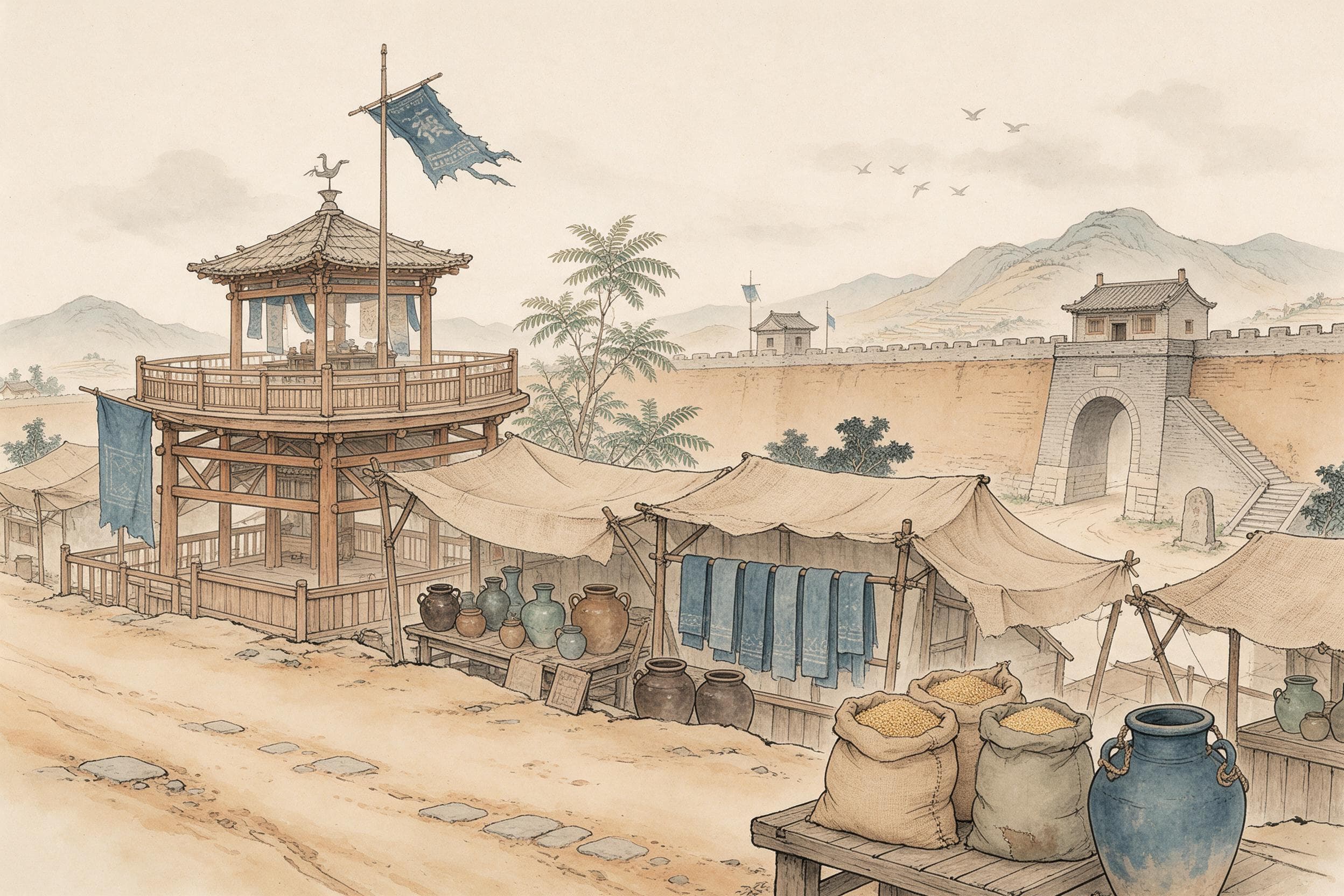
Begin with a square. The Sanfu huangtu, a late topography of the capital region, quotes an older record called the Miaoji on its entry for the nine markets of Chang'an: 'The markets of Chang'an are nine, each 266 paces square. Six markets are west of the road, three east. Every four li make one market. Along the Hengqiao avenue the market towers were all two-storeyed.' These are figures as the text records them, not a modern survey; the locations of the nine markets are still disputed, and this article reports only what the text says. Paces are given as the text gives them; no conversion into metres is attempted here.
How the nine markets were recorded
The same entry adds a building: 'The flag pavilion stands south of the Dumen avenue.' And it names more markets than the number nine — 'there are also the Willow market, the East market and the West market'. A further market, Zhi, stood twenty-five li south-west of the Fuping ford and was founded by Duke Wen of Qin: it took its name from having 'no two prices' for goods, one price and no haggling. What any of these markets sold, the entry does not say. Whether those three are among the nine, or belong to another set, the entry does not say.
The book also quotes Zhang Heng's Western Capital Rhapsody: 'Nine markets opened in the outer city, walls and gates linked, a flag pavilion five storeys high, looking down on a hundred alleys.' A rhapsody is literature, and it builds higher than the record: the topography has 'market towers all two-storeyed', the poem has 'a flag pavilion five storeys high'. The two statements stand side by side here; they are not reconciled, because one is a record and the other is a poem.
Streets, wards and markets
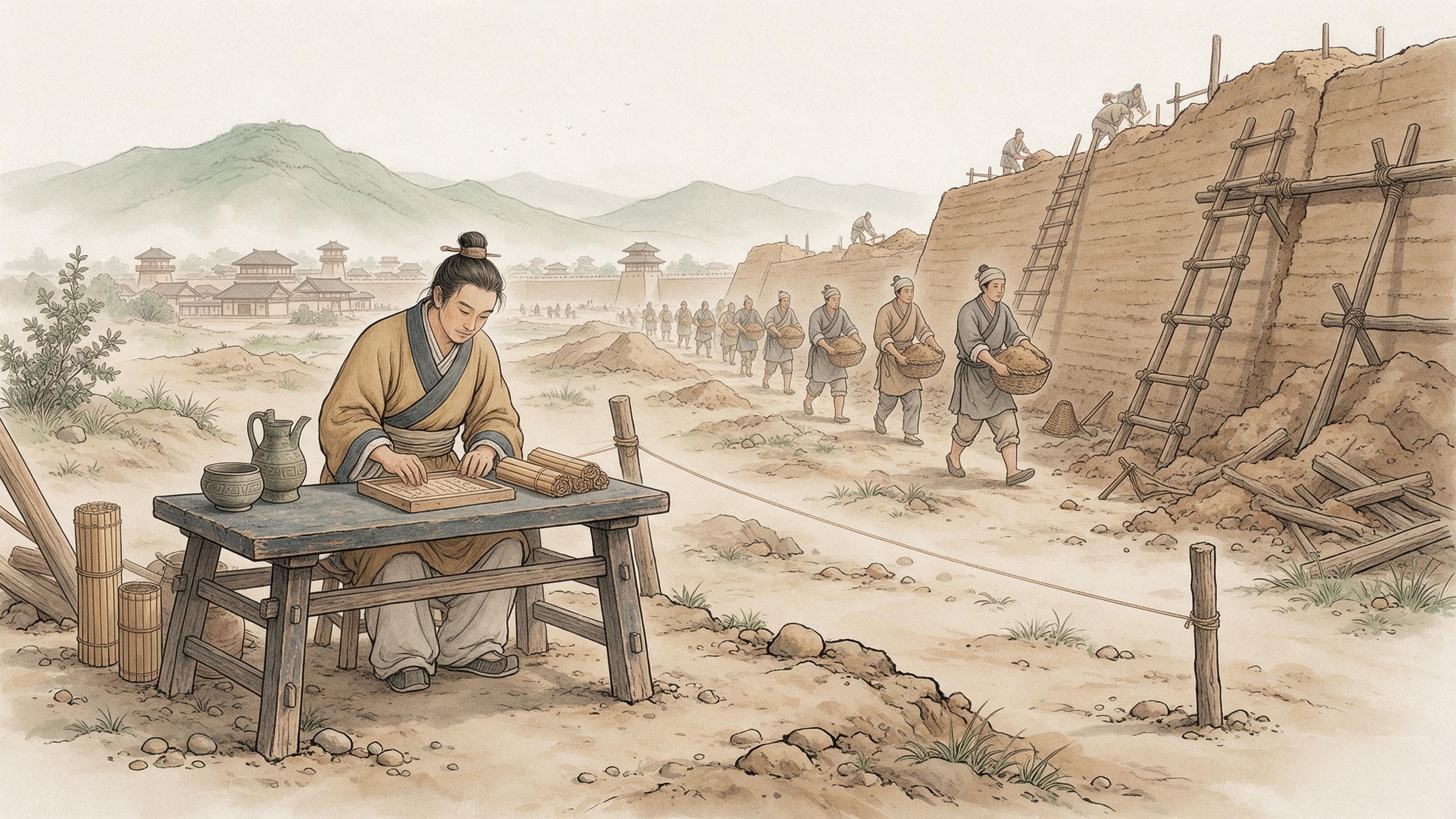
The markets sit inside the city grid. The same book says 'within Chang'an there are eight streets and nine avenues', quoting the Sanfu jiushi; it gives only three street names — Xiangshi, Xiyin and Shangguanqian — as examples, not as a full list. And: 'Chang'an had one hundred and sixty wards, houses packed like the teeth of a comb, gates and lanes straight.' Markets, streets and wards were three kinds of square in one grid. A ward is a walled block, a street the line between blocks, a market a square with its own gate and office.
Who ran the market
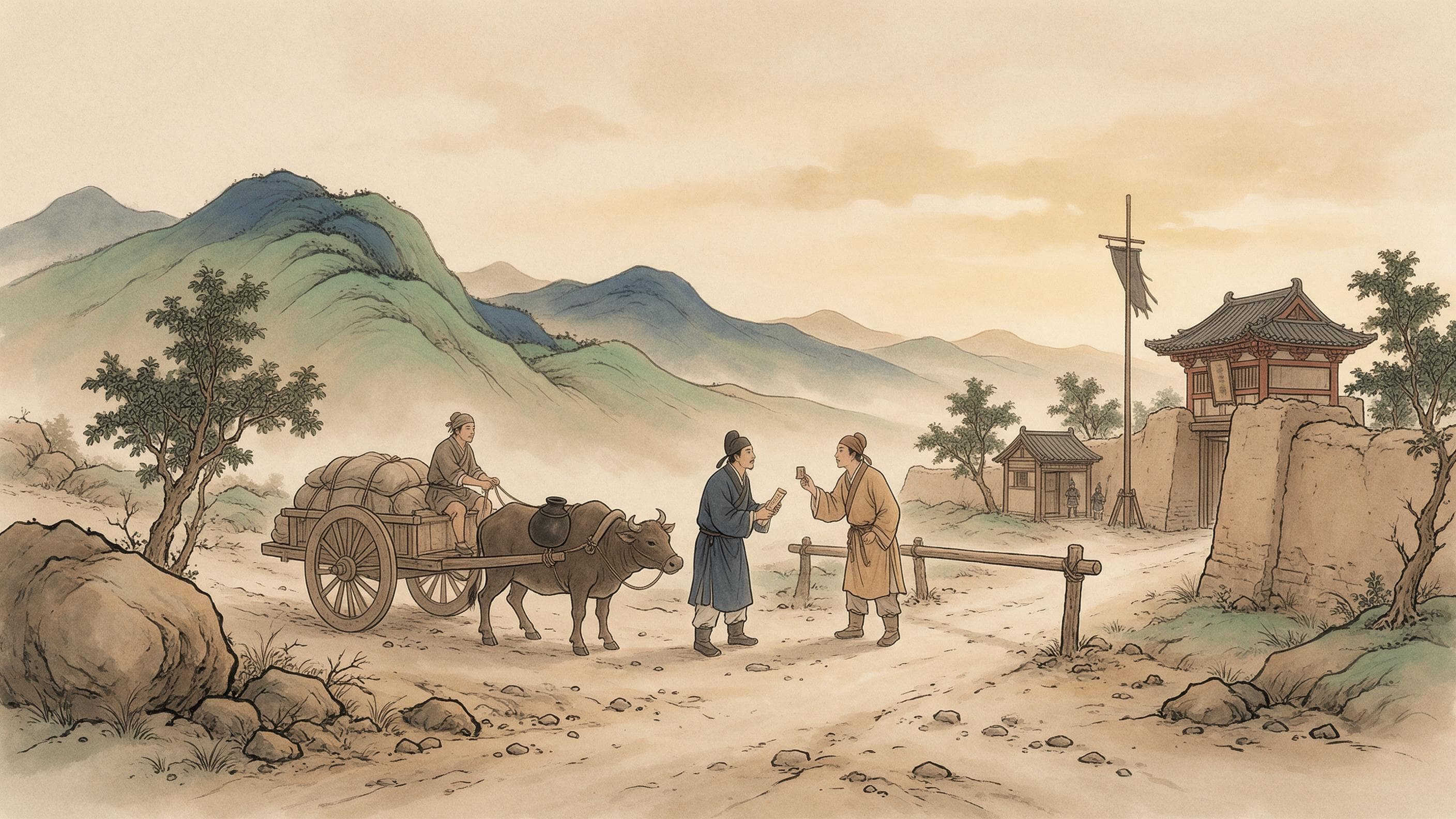
The market was not a free fair. The same entry: 'At the market tower there was an office of command, to watch the goods, money and trade of merchants; the commandant of the Three Auxiliaries controlled it.' So the market had an office and a supervisor — and the supervisor was the military commandant of the capital region, not a merchants' guild. How that office was staffed, what market tax was taken, which clerks served there — the entry says none of it. Market tax, market rent and the range of goods are absent from the material altogether; and the number of merchants in Chang'an, or of names on the market roll, is nowhere given. These gaps are marked here and left unfilled. That the market was held by a military commandant is a fact of the record; what it implies about policing and control is inference, and the text stops short of saying it.
A roll of merchants
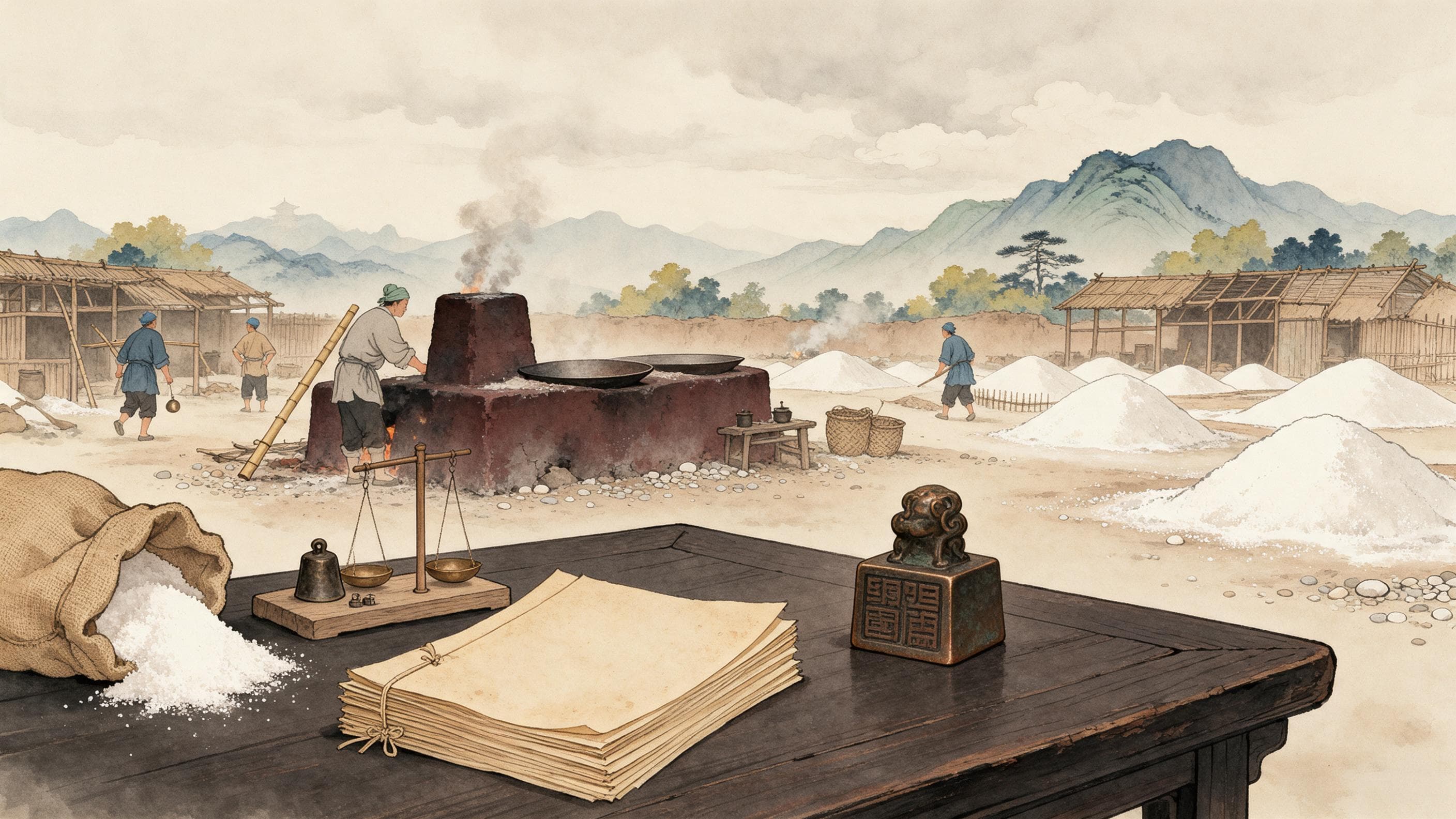
The second document is a rule preserved in the Shiji's 'Treatise on the Balanced Standard', from the reign of Emperor Wu: 'Merchants who are on the market roll, and their families, may not hold land in their own names, so as to benefit agriculture. Those who dare to break the order shall have their fields and servants confiscated.' The wording is terse even for a statute: it names the roll, the family, the land and the punishment, and nothing else.
The sentence does two things at once: it gives the merchant a status — the market roll — and takes a right away from that status, the right to hold land in his own name. The reason is stated in the rule: 'so as to benefit agriculture', which places the merchant outside the agrarian order the state meant to protect. How one got onto the roll, who kept it, and how many names it held, the rule does not say; nor is the roll treated here as a forerunner of the modern household register.
A few lines earlier the same chapter sets a parallel measure: merchants, even those not on the roll, were to declare their goods themselves and pay one suan per 2,000 cash of capital. The two rules stand side by side, but they are not one thing; which came first and how they were enforced together is not recorded. To call them a single policy is inference, not record. The suan here is a unit of assessment rather than a sum of cash; the chapter supplies its own arithmetic, and this article does not convert it.
What can and cannot be said
What can be stated flatly is only what the records give: nine markets, each 266 paces square, six west of the road and three east, four li to a market, two-storeyed market towers, a flag pavilion south of the Dumen avenue, the names of the Willow, East and West markets, the Zhi market with its single price; eight streets and nine avenues, one hundred and sixty wards; an office at the market tower under the commandant of the Three Auxiliaries; and a market roll that barred merchants and their families from holding land, on pain of confiscation. These are quoted as they stand, without converting paces into metres or computing areas.
What cannot: what each market sold, where the nine markets lay on a modern map, how much tax they paid, how many merchants were registered, or whether Chang'an's commerce was 'flourishing'. None of that is in the material — and neither is treating 266 paces as a measured dimension, calling the market roll a household register, or folding this material into the coinage reforms, which are separate lines.
So the two documents each hold one end. One draws squares on the ground and rules that buying and selling may happen only in the places marked out. The other writes names in a book and rules who may carry that status, and what he loses by carrying it. Together they show one state putting two hands on the same institution: managing space, and managing people. How well either hand worked, neither text says. What survives is the square and the roll. The temptation is to fill the square with stalls and the roll with faces; the material does not permit it. That is a small result, and an honest one.
Sources & further reading
- 《三辅黄图》卷之二·长安九市(旧籍,四库提要考为唐肃宗以后人作;维基文库本) — Late old topography quoting the Miaoji: nine markets, each 266 paces square, six west of the road and three east, four li to a market, two-storeyed market towers along the Hengqiao avenue, and a flag pavilion south of the Dumen avenue. It also names the Willow, East and West markets and the Zhi market founded by Duke Wen of Qin, records the market office under the commandant of the Three Auxiliaries, and gives eight streets, nine avenues and one hundred and sixty wards. The locations of the nine markets remain disputed; only what the text says is reported here.
- 司马迁《史记》卷三十·平准书(西汉;维基文库本) — Western Han account: men on the market roll, and their families, were forbidden to hold land in their own names 'so as to benefit agriculture'; offenders had their fields and servants confiscated. The parallel levy on merchants' declared capital (one suan per 2,000 cash) is quoted only as background. This ties merchant status to land rights and is kept separate from the coinage material.