The Qimin Yaoshu is a farming manual. Its fifth juan covers mulberry, elm, bamboo, indigo and madder, and it counts profit as carefully as any ledger: an acre of safflower yields three hundred bolts of silk a year, an elm trunk is worth ten coins. Then, at the end of chapter fifty-two, “On Planting Safflower and Gardenia”, after the sowing, the picking and the profit, comes a run of small headings: “rouge, scented oil, face fat, hand medicine, purple powder, white powder, appended.” An agricultural treatise walks into a bedroom.
Why a farm book covers faces
The reason is in the crop's accounts. Safflower is a dye plant. The flowers are pounded, washed, and wrung out in a cloth bag to remove the yellow juice; then pounded again and washed in sour millet broth, and the red liquor is “kept for dyeing — do not throw it away.” Dyeing and rouge begin in the same pot. If one plant supplies both the dyer and the cosmetic maker, then instructions for turning it into rouge belong beside instructions for growing it.
The reader addressed is not the woman who buys rouge but the household that grows, processes and sells it. The figures are practical. An acre of flowers needs a hundred pickers a day, and one family's own hands are “not one in ten” of that. So each morning children come to the field in crowds of tens and hundreds to pick, on terms of an even split — half to each. The first stage of rouge manufacture was the fingers of children and farm women.
Face fat: marrow, warm wine, clove
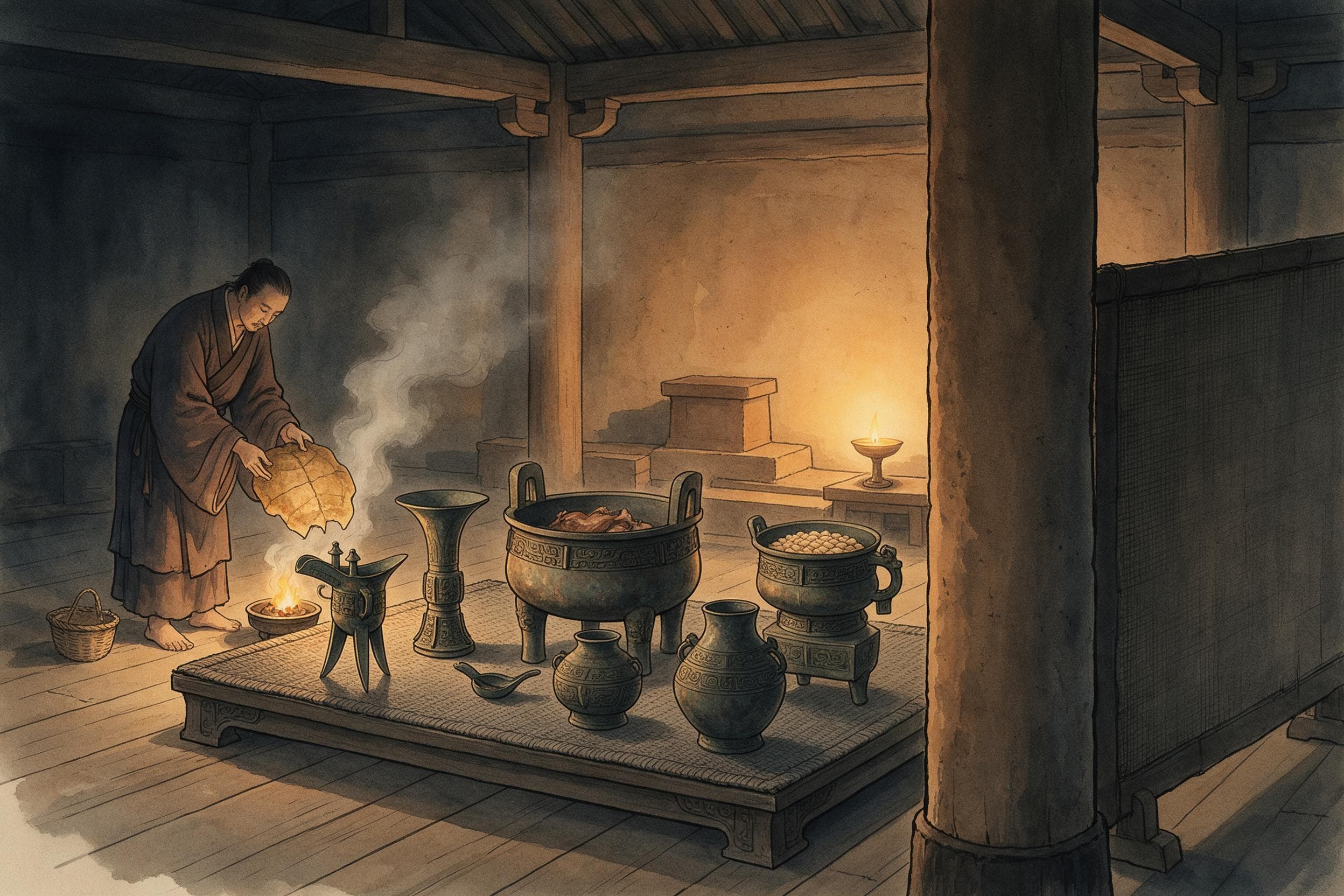
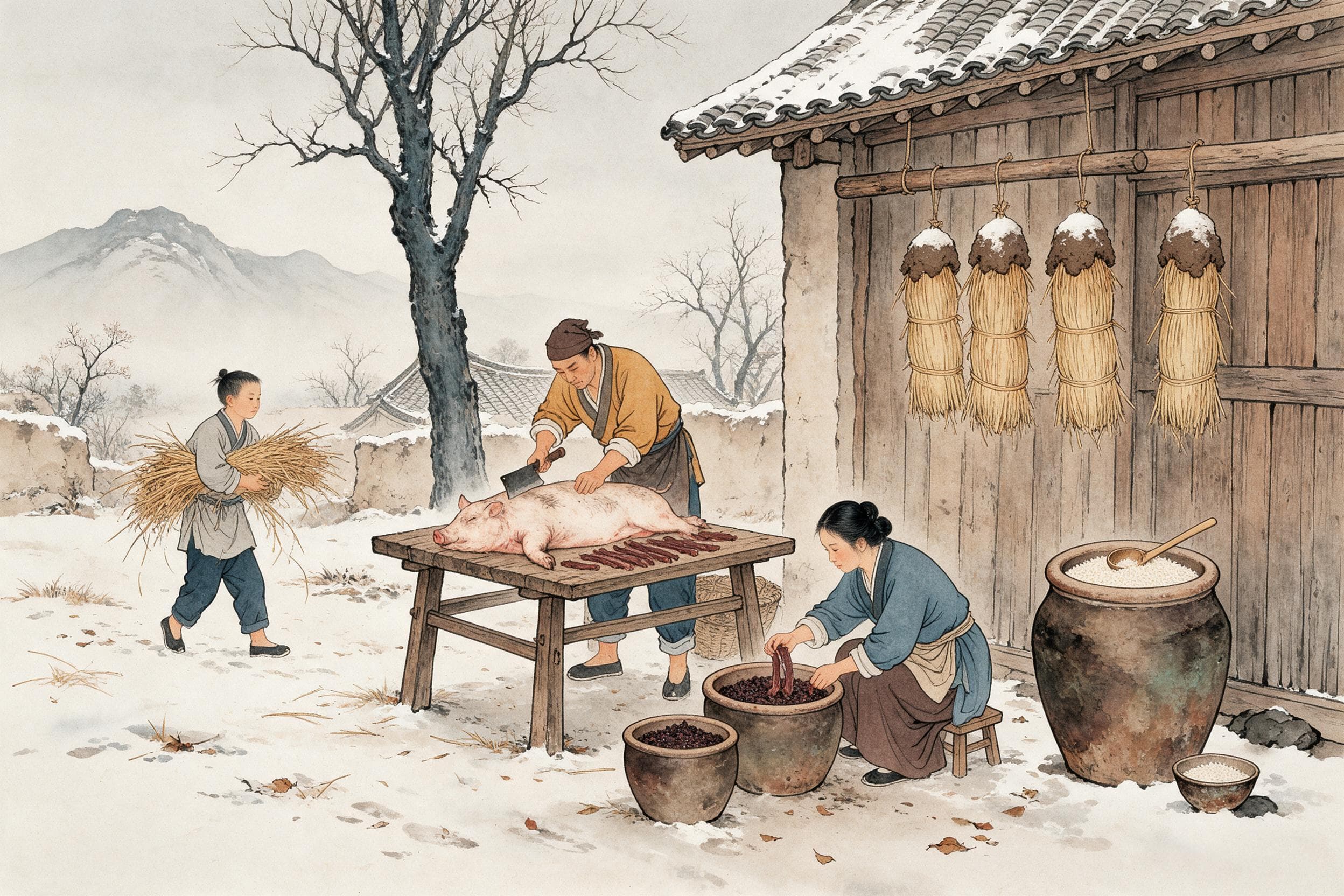
The recipe for face fat is four lines long. Use beef marrow; if there is too little marrow, mix in beef fat; if there is no marrow at all, plain fat will do. Steep clove and patchouli in warm wine, as for scented oil. Fry it the same way. “Add a little wormwood to bring out the colour.” Filter through cloth into a porcelain or lacquer cup and let it set. For a lip balm, blend in mature vermilion and wrap it in green oil. The structure is fat plus aromatic: an animal base, wine to draw out the scent, a slow fire to drive off the water.
The scented-oil recipe in the same juan describes how to judge the fire, and it is a piece of listening: put a burning splint into the oil — “if it hisses, the water is not gone; if smoke rises and there is no sound, the water is gone.” No thermometer; an ear. Whether the face cream was tested the same way the text does not say; it says only that the method is the same. One ingredient needs flagging. “Mature vermilion” is cinnabar, mercuric sulphide. Here it is a red pigment, not a medicine, and blending it into lip balm means putting a mercury compound on the mouth. The text carries no warning. That is not evidence that it was harmless; it is evidence that nobody knew.
Rouge: pressing a flower to half a hemp seed
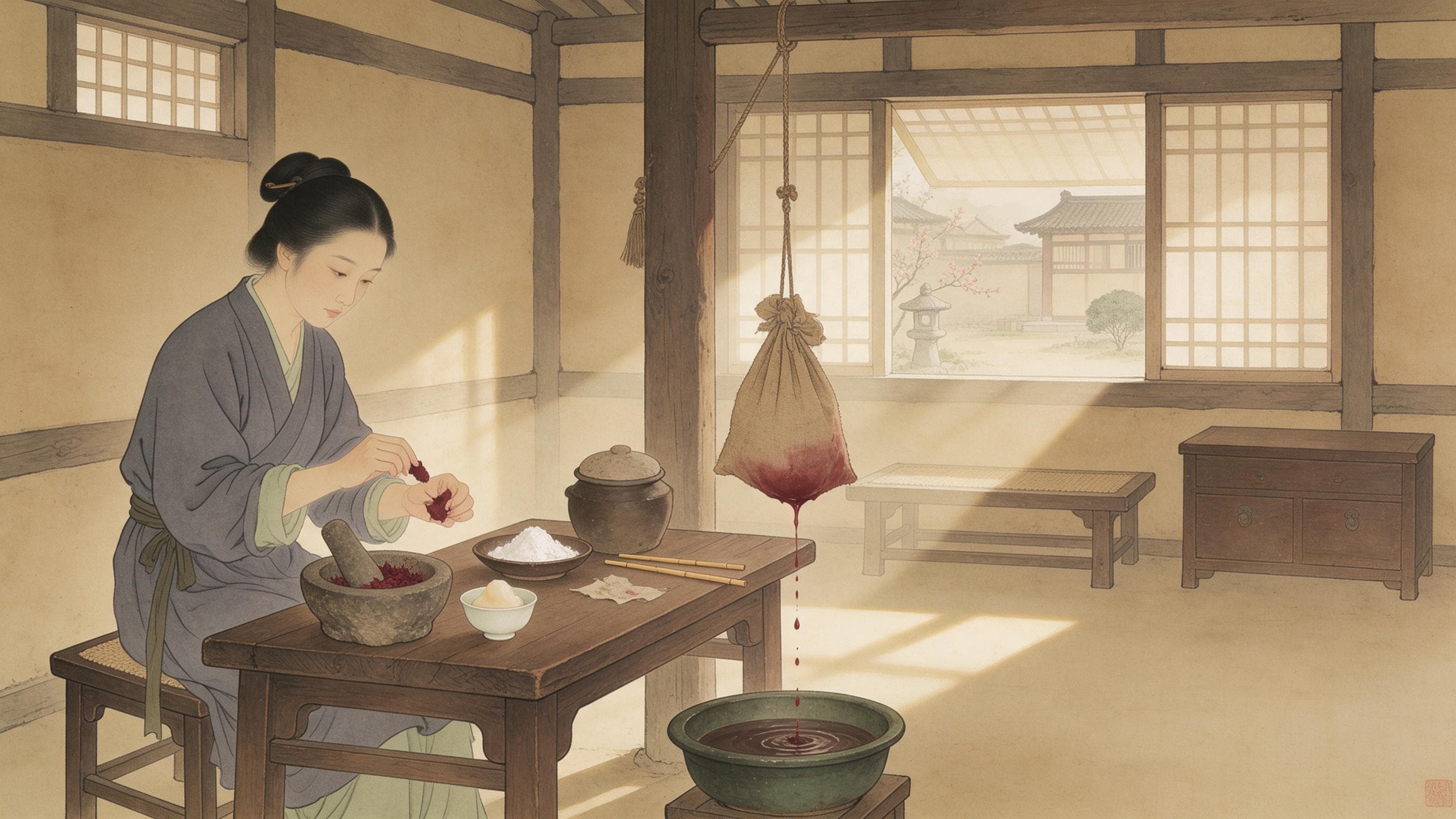
The rouge method is the most detailed passage in the juan. First, lye from ash: burn goosefoot, chenopodium and mugwort, pour hot water through the ash, and take the clear liquid. The first run is too strong — “thick and harsh, it kills the flower, useless, good only for washing clothes” — so use the third. Work the flowers in this lye a dozen times, until the colour is spent, and wring the pure liquor through cloth into a jar.
Then the mordant and the filler. Two or three sour pomegranates are broken open, the seeds crushed, mixed with a little very sour millet broth, wrung out and added to the flower liquor. Without pomegranate, good vinegar and broth will do; without vinegar, the sourest clear broth alone. Then “add white rice powder the size of a jujube”, with the note that too much powder turns the colour pale. Stir hard and long with clean bamboo chopsticks that carry no grease; cover until night; pour off the clear top; hang the thick part in a pointed silk bag; and when it is half dry the next day, twist it into small petals “the size of half a hemp seed” and dry them in the shade. A flower ends as a flake half the size of a hemp seed. The size is not arbitrary: one flake is one application, small enough to twist, easy to count, easy to wrap and sell.
Two roads to white powder
White powder was made two ways, and the difference is the raw material. The rice method takes grain: hulled millet first, foxtail millet second. The steeping is startling — a month in spring and autumn, twenty days in summer, sixty in winter, “do not change the water; it is best when it rots and stinks.” Then grind, filter, stir more than three hundred turns, settle, and draw off the water through cloth, bran and ash. The rough dull rim is shaved off and kept for coarse use; the centre, “round like a bowl, very like a duck's egg in its white gloss”, is called fenying, powder bloom. A separate recipe scents plain powder by standing plenty of clove in the powder box, because grinding aromatic dust into it or wetting it with scent “spoils the colour and wastes the spice.”
The other road is the purple-powder recipe: three parts rice bloom to one part hufen (胡粉), with the note that without hufen the powder “will not adhere to a person's face.” What was hufen? The Tiangong Kaiwu, a Ming technical compendium, describes the manufacture without ambiguity. A hundred catties of lead are melted, rolled into thin sheets, curled into tubes and packed in a wooden steamer with a bottle of vinegar above and below; the seams are sealed and a small fire is kept for seven days. A frost of powder forms on the lead and is swept out. “Throw hufen into a charcoal fire and it melts back into lead.”
Hufen, then, is lead white, basic lead carbonate — not a mineral powder but a lead compound grown on lead with vinegar vapour. Lead white is toxic: it enters through skin and breath, and cumulative exposure damages nerves and kidneys. That is a finding of modern chemistry and medicine, not a sentence from the Qimin Yaoshu, which cares only that the powder adheres. The same passage tints the purple powder with the juice of steamed mallows, re-steaming and re-dyeing if the colour is weak. The hand medicine is another compound entirely: a pig's pancreas, degreased, worked in good wine with mugwort leaves until the juice is slippery; fourteen peach kernels crushed and their juice added; clove, patchouli, sweetgrass and ten pieces of orange pip steeped in it. Wash the hands at night in fine bran water, dry them, apply — “it makes the hands soft and smooth, and they do not chap in winter.” The pancreas is what later centuries used to make a washing paste; its function here is inferred, since the text records only the result.
Who could afford it
The recipes differ widely in cost. Rice powder consumes grain and months of steeping. Safflower needs an acre and a hundred pickers a day. Marrow, clove, patchouli, sweetgrass and orange pip all have to be bought, and lead white has to be made by a specialist. Anyone using face fat, rouge and scented powder together was not the household that grew the flowers. The book never names its users; it only says how. From the materials and the labour, this belongs to households with spare money, servants and storage — an inference from cost, not a statement in the text.
Much else is missing: how much a batch made, how long it kept, what it sold for, whether anyone fell ill from the lead. Jia Sixie was interested in how a thing is made, not in who it hurts. The recipes survive. The consequences do not.
Sources & further reading
- 贾思勰《齐民要术》卷五「种红蓝花栀子第五十二」(附燕支、香泽、面脂、手药、紫粉、白粉)(Jia Sixie, Qimin Yaoshu, juan 5, “Planting Safflower and Gardenia”, with the appended cosmetic recipes) — The recipes quoted throughout: face fat, scented oil, rouge, rice powder and its bloom, purple powder with lead white, hand medicine, and the safflower labour accounts.
- 宋应星《天工开物》「附:胡粉」(五金第十四)(Song Yingxing, Tiangong Kaiwu, “Appendix: Hufen”, in the Metalwork chapter) — A later but explicit account of how hufen is grown on lead sheets with vinegar vapour and melts back to lead — the basis for identifying it as lead white.
- 《齐民要术》卷五(四库全书本,异文对照)(Qimin Yaoshu, juan 5, Siku Quanshu edition, for variant readings) — Unpunctuated Siku text; reads 蘭香 for 澤蘭香, 猪腹 for 豬脂, 葵子 for 落葵子 and 染米 for 梁米.