In 494 a southerner entered Luoyang, a city that had been the capital for only a few years. His name was Wang Su. He came from Langya; his father, Wang Huan, had governed Yongzhou for the Southern Qi, and he himself had been a secretary in the Qi court. That year he defected to the Northern Wei. His father had been killed by the Qi court 'not by due process', and Wang Su was said to nurse the grudge of Wu Zixu against Chu. That family history is the ground under everything he later said at the Wei court. Emperor Xiaowen valued his knowledge of the old dynasties and used to call him Master Wang.
1. Arriving in Luoyang: carp soup and tea
The Luoyang Qielan Ji (洛陽伽藍記, Record of the Monasteries of Luoyang) gives his first diet at court in two lines: he would not eat mutton or milk, but dined on carp soup and, when thirsty, drank mingzhi — brewed tea. Mutton and milk were ordinary food in Luoyang; he would not touch them. The court wits put a figure on his habit: they said he drank a dou at a sitting, and nicknamed him the leaking cup.
The nickname is mockery, not measurement. A dou is a grain measure, its modern equivalent depending on which standard was in use, but it was certainly not a teacup. The line may be a joke made at table rather than a tally, and what it reveals is simple: in Luoyang at that moment, drinking tea on that scale was itself a trait worth laughing at.
2. Some years later: milk gruel
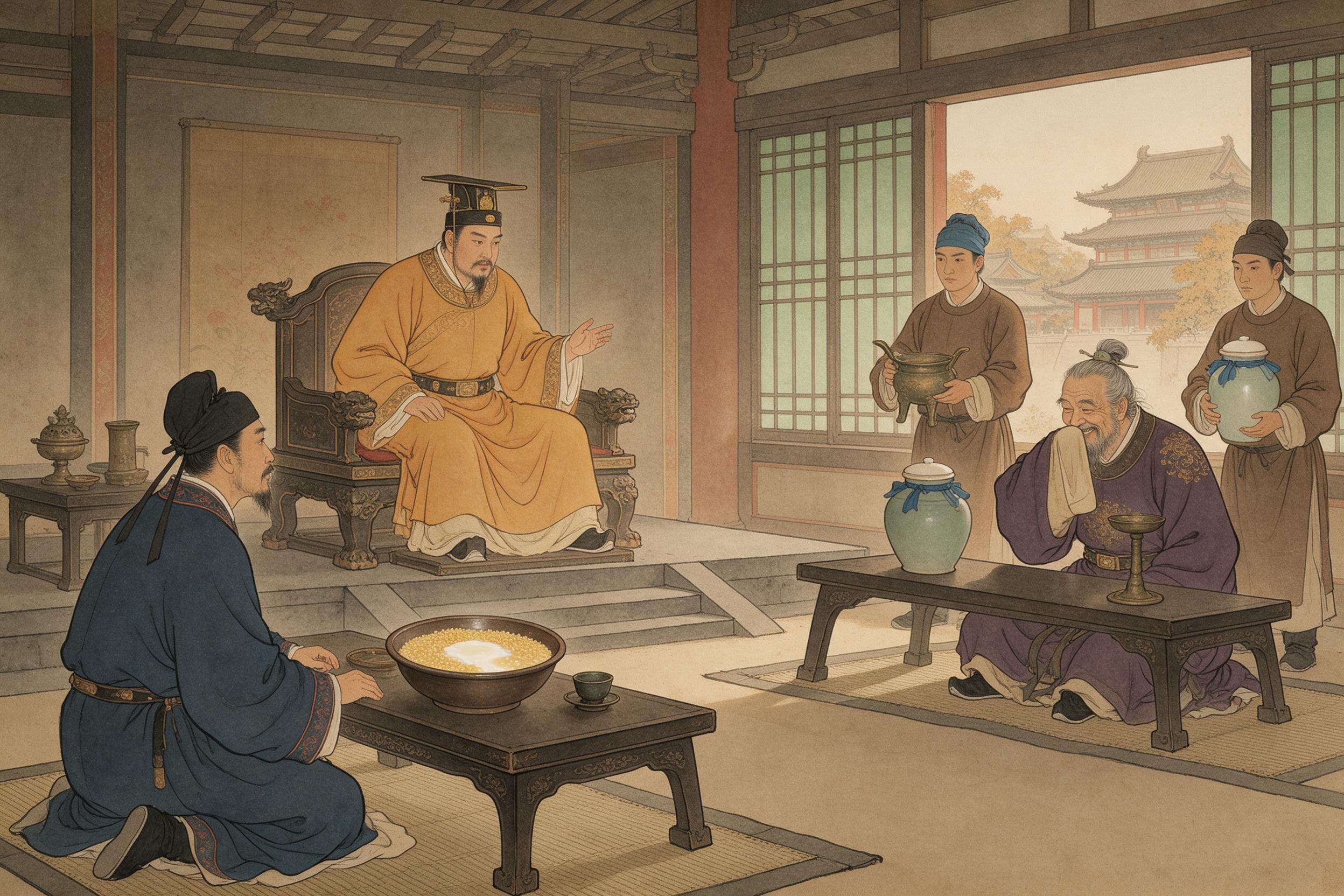
'Some years afterwards,' the text says, Wang Su attended a palace gathering and ate a great deal of mutton and lao zhou — millet gruel with milk curd. The emperor found it strange and asked him: 'These are the flavours of the Central Plains. How does mutton compare with fish soup? How does tea compare with milk?'
Wang Su's answer was carefully built: 'Mutton is the finest thing the land produces; fish is the finest of the waters. Tastes differ, and each is prized where it is known; but judged by flavour there is a clear order. Mutton is like the great states of Qi and Lu; fish is like the small state of Zhu Ju. Only tea is no good at all — it is fit to be the slave of milk.' The emperor laughed aloud.
The answer has to be read in its setting. He was a defector whose father had died at the hands of the southern court. Standing in the Wei hall, he raised the northern sheep to the rank of a great power, demoted his homeland's fish to a small one, and reduced his homeland's tea to a servant. That is a political statement as much as a tasting note, and a piece of self-mockery at the same time. It can be read as one man's palate changing; it is more exactly a man finding a way of speaking that worked in Luoyang. That is a reading, not what the text says.
3. How one answer became a nickname
The nickname was picked up by others. Prince Pengcheng, Yuan Xie, needled him on the spot: you do not value the great states of Qi and Lu, but you love little Zhu Ju. Wang Su answered that what one's own countryside prizes, one cannot help prizing. The prince told him to come to his house the next day, where he would be served Zhu Ju food — 'and there will be milk's slave too'. The text adds: 'From this, tea was again nicknamed the slave of milk.'
More nicknames followed. When the secretary Liu Gao began copying Wang Su's tea habit, the prince mocked him for preferring, to the eight delicacies of a lord, the 'water calamity of a house slave'. Later, when Xiao Zhengde, a nephew of the Liang emperor, came over to the Wei, the minister Yuan Cha offered him tea with a question first: how much water calamity did he take? Xiao did not understand, and answered that he had been born in a land of rivers but had never yet suffered a flood. The table roared.
Yang Xuanzhi also records the aftermath: from then on, at the banquets of the high officials, tea might be set out, but people were ashamed to touch it; only southern refugees who had come over to the north still liked it. That sentence needs care. It describes the fashion of one circle, not the whole north. Tea did not vanish from the north; in the circles this book describes, drinking it had become something that needed explaining.
4. What lao was: a measure of milk, a spoon of starter
The milk Wang Su ate has a method, in a farming manual of the same period. The Qimin Yaoshu (齊民要術), in its chapter on sheep, says cow's or sheep's milk will both make lao. The milk is simmered gently for four or five boils, strained into a clay bottle, and set with finished sweet curd as starter: 'to one sheng of scalded milk, half a spoon of curd'. Without curd, sour rice broth will do: 'to a dou of milk, one spoonful'. Once the starter is in, the bottle is wrapped warm — 'warm, a little warmer than the body' is the instruction — and 'by morning the curd is done'.
Two other forms were made for travelling. Dried curd was made in the seventh and eighth months: the skin lifted off warmed curd again and again, fried, sun-dried, rolled into balls the size of a pear — 'it will keep for several years, for a long journey'. Shaved into hot water it still tastes of milk; one ball can be boiled five times. Drained curd was hung in a cloth bag until the water ran out, then fried, dried and balled; the book says it tastes better than the dried kind, but that without frying it breeds insects and will not last the summer.
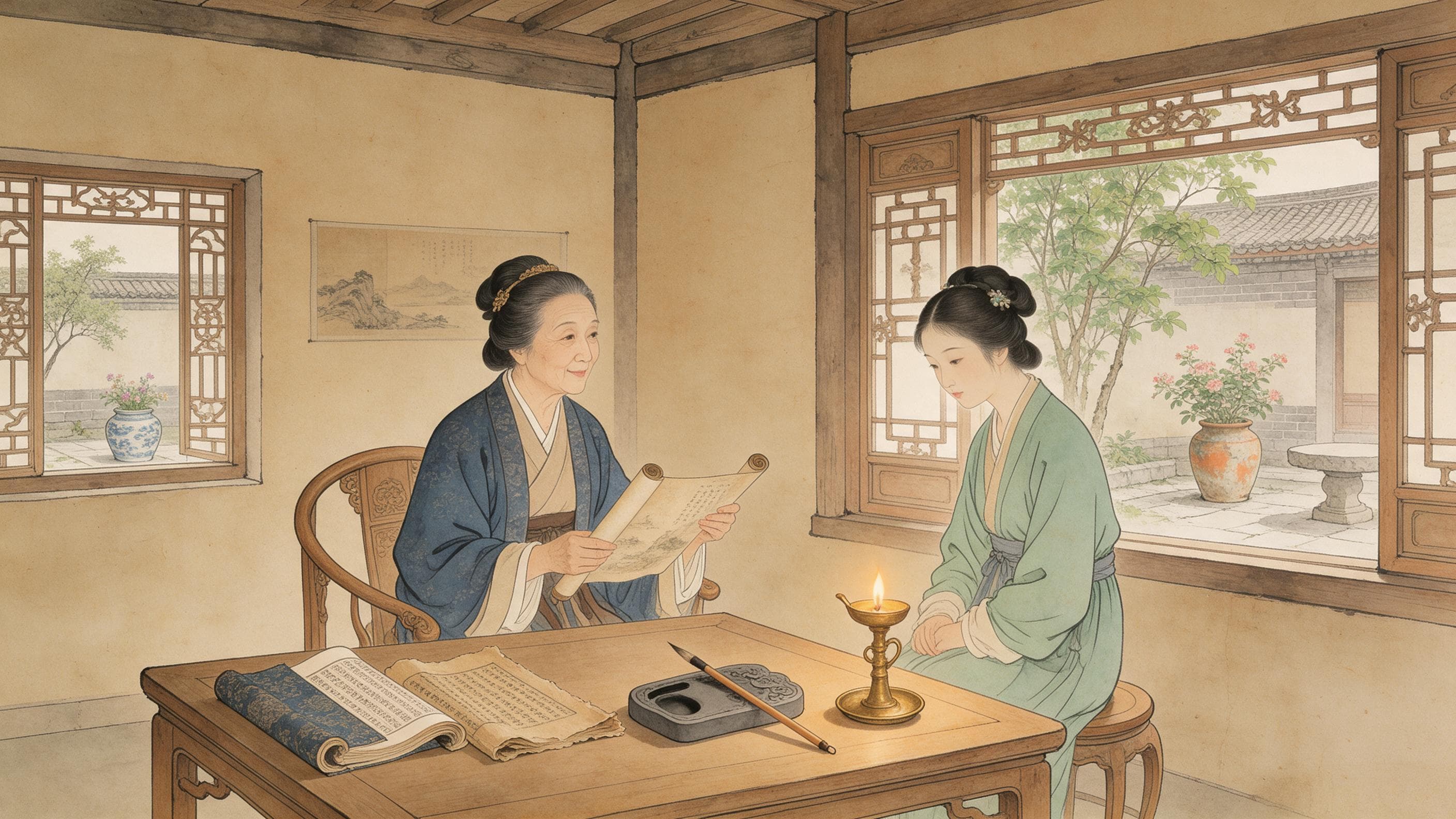
One item deserves its own line: dried mare's-milk starter. Take a little donkey's milk with mare's milk, let it curdle, take the sediment, roll it into a ball, dry it in the sun, and use it the next year to start a new batch. That is last year's culture kept for this year's milk. The book has no word for 'culture'; it says only, 'use this as the starter'. The same chapter admits that dried and drained curd, kept too long, go stale, and that it is better to make them fresh each year and use them up. They keep — but not for ever. There is also a method for beating butter out of the curd with a pierced wooden plunger, then frying it so that it will keep.
5. Wang Su was one man
The story comes from the Luoyang Qielan Ji, written in the middle of the sixth century by Yang Xuanzhi, looking back at the city in its great days. He is recording an old scandal everyone knew, not settling a question about northern and southern taste. Where the book touches food at all, it is food on show — at court gatherings, banquets and grants of favour, never at the kitchen stove.
So the safe conclusions are narrow. At the Luoyang court in the last years of the fifth century, mutton and milk were the respectable side and tea was the side that could be joked about; a southerner who had to make his way there had his taste questioned, his answer remembered, and the answer turned into a nickname. Whether southerners all drank tea, or northerners all drank milk, this book cannot say, and should not be made to say.
'Slave of the milk' outlived Wang Su. It began as a sharp remark at a banquet and ended up quoted for centuries as an old name for tea. It was never tea's proper name, only a joke that got written down — and a joke that gets written down stops being only a joke.
Sources & further reading
- 杨衒之《洛阳伽蓝记》卷三「报德寺」条(王肃条)(Yang Xuanzhi, Luoyang Qielan Ji, juan 3, the Wang Su passage) — The whole anecdote: Wang Su's southern diet, the emperor's question, the answer that gave tea the name 'slave of the milk', and the court fashion that followed.
- 贾思勰《齐民要术》卷第六「养羊第五十七」(附作酪、作干酪、作漉酪、作马酪酵、抨酥法)(Jia Sixie, Qimin Yaoshu, juan 6: 'Raising Sheep', with the dairy methods appended) — How lao was actually made: starter quantities, the warmth of the jar, dried curd for travel, and the dried starter kept from one year to the next.