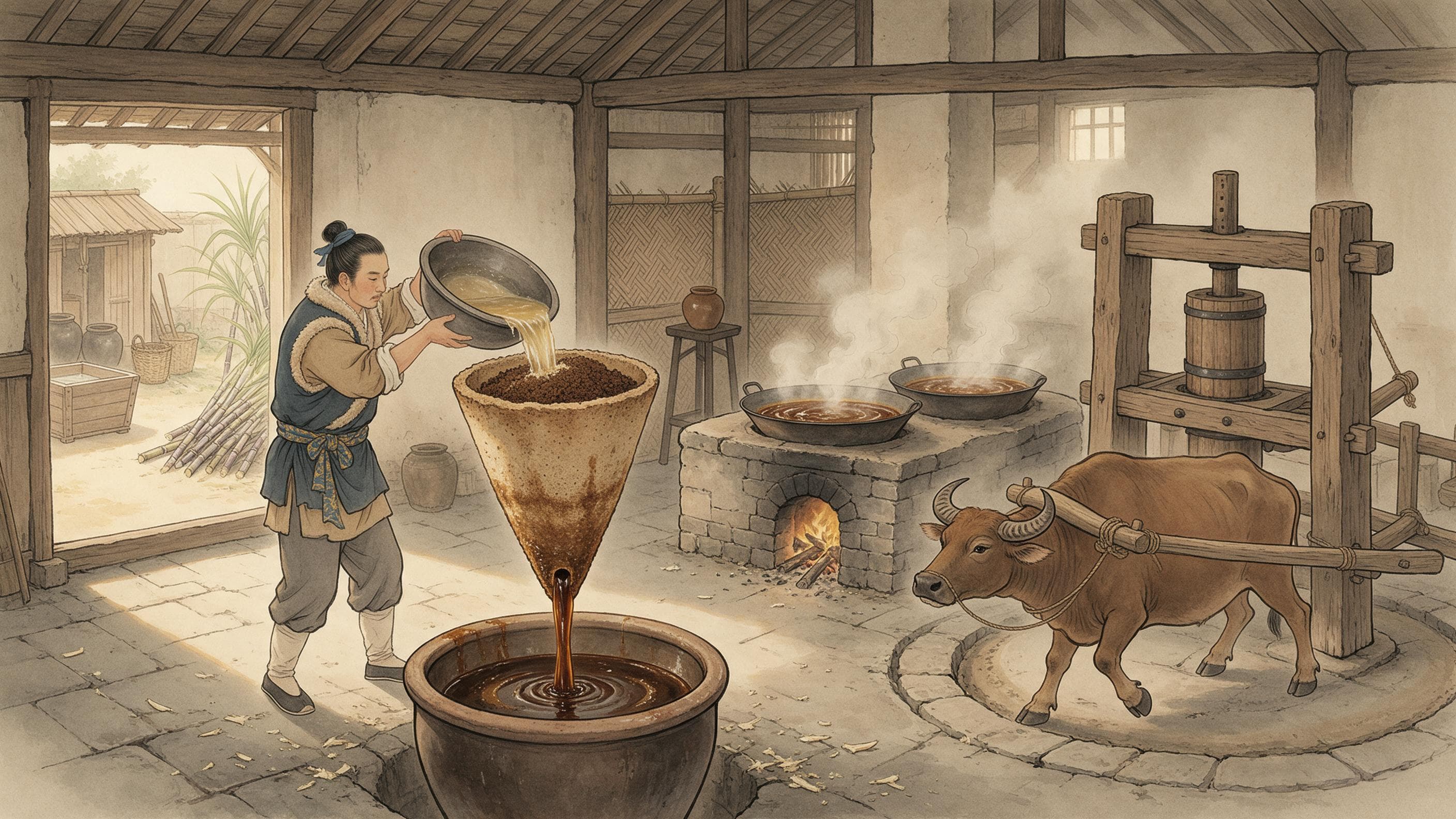
An inverted clay funnel, wide at the top and pointed at the bottom, with a small hole stopped with straw. This is the crucial piece of equipment in the Tiangong Kaiwu's chapter on making white sugar: the walin (瓦溜). Song Yingxing notes that it had to be ordered from a potter — not a jar pressed into service, but a purpose-made vessel. Dark sugar goes in, the straw is drawn, yellow mud water is poured over the top, and what collects in the vat below is the dark residue, while what stays in the funnel is white frost.
First, black sand
Before white sugar there is dark sugar. The preceding section describes the mill: two horizontal boards, five chi long, five cun thick and two chi wide, their ends pierced for posts set into the ground. The upper board takes two huge rollers, one three chi long and one four and a half, cut with teeth “male and female”, the seam to be “straight and round”. Cane is fed between them and an ox walks the circle; juice runs on the first pass, the crushed cane is fed back, and after three passes “the juice is exhausted”. The bagasse burns as fuel. Juice runs down a grooved board into a vat, and “for every shi (石, ten dou) of juice, five ge of lime are added.”
Then boiling. Three cauldrons stand in the pattern of the character for “quality”: the thick juice is gathered into one, and thin juice is added to the other two in stages. If the fire is too weak, “the sugar turns into stubborn sugar, and the stuff is useless” — a seized, unworkable mass. When the froth boils fine like soup and a pinch between the fingers goes sticky, “when it sticks to the hand, the sign has come”. The sugar is still “yellow-black”. It goes into a tub and sets into black sand.
The yellow mud goes on
The white-sugar section picks up from the black sand. The funnel is set on a vat; it is “wide above and pointed below, with a small hole in the bottom”. Straw plugs the hole, the black sand is poured in and left to set, then the plug is drawn and “yellow mud water is poured down through it”. The result is two sentences: “the black dregs go into the vat, and inside the funnel it all becomes white frost.”
The topmost layer, “five cun or so thick, of extraordinary whiteness”, is given its own name, yangtang (洋糖), and Song glosses it himself: “Western sugar is extremely white and fine, hence the name.” Lower layers are poorer — “the lower ones are slightly yellow-brown.” The same passage notes that the funnel was specially fired to order: its shape governs how the washing works, and an ordinary jar will not do. Why yellow mud water works is not explained. The modern account has two parts. Water carries the residual molasses down through the sugar mass and out of the bottom hole — the washing step that sugar technology calls affination. And fine clay particles in the muddy water percolate down with it and adsorb colouring matter, a crude earth filtration. Song gives the operation and the result, never the mechanism; the mechanism is later explanation.
Five grades, and something else
The washed sugar was then graded. “White sugar has five grades: stone mountain is finest, branch clusters next, then jar mirror, then small grains, and sand foot is the lowest.” The five names describe forms of cake or crystal, and the text does not describe them one by one; any reading of the names — a hard block, branch-like clusters, a slab like a mirror, fine grains, the sediment at the bottom — is inference from the words and should be labelled as such.
White sugar and rock sugar must be kept apart. They are not coarse and fine versions of one product but two different processes. White sugar comes from washing in the funnel and grading. Rock sugar takes “yangtang, melts it, clarifies with egg white, skims off the floating dregs,” watches the fire, then breaks fresh green bamboo into splints “cut an inch long and scattered in”. One night and “it forms natural ice”. The large crystals grow on the bamboo. The same passage adds that lions, elephants and figures could be cast — sugar carved into shapes, which is a different commodity again. The cane itself was graded too. The chapter on cane varieties says: “In making sugar from harvested cane there are three grades: frozen ice, white frost and red sand. The division of sugar grades follows the maturity of the juice.” South of the Five Ranges, where there is no frost, cane was left standing to make sugar frost; north of Shaozhou and Xiongzhou the October frost kills the cane, so it had to be cut early for red sugar. Whether a batch came out white or red was partly process, partly the calendar of frost.
What the page does not say
On Wikisource this page carries a proofreading mark of twenty-five per cent, and the text still mixes simplified and traditional characters. That state of the edition should be declared when quoting. As for output, cost, the size of a sugar works, how much one craftsman finished in a day, or the price of white sugar against dark — none of it is here. The Tiangong Kaiwu gives processes, not ledgers.
One error is easy to make: the yellow-mud washing was not Song Yingxing's invention. He recorded a method already described in Yuan times; calling the recorder the inventor is the commonest mistake in writing about this passage. As for “yang” in yangtang, Song's own gloss compares it to Western sugar's whiteness — an imported standard applied to a domestic grade, which does not make the sugar imported. What remains is a specific picture: a man in a sugar works draws the straw plug and pours yellow mud water over the top, then waits while the vat below fills with dark dregs and the funnel above grows white. The sweetness does not change. The colour does — and colour could be sold in five grades.
Sources & further reading
- 宋应星《天工开物》「造白糖」(甘嗜第六)(Song Yingxing, Tiangong Kaiwu, “Making White Sugar”, chapter 6, “Sweetness”) — The clay funnel and the yellow-mud wash, the top layer named yangtang, the five grades of white sugar, and the separate method for rock sugar.
- 宋应星《天工开物》「造糖」(甘嗜第六)(Song Yingxing, Tiangong Kaiwu, “Making Sugar”, chapter 6) — The two-roller cane mill, the triple pressing, the lime dose of five ge to the shi (石), and the three-cauldron boil.
- 宋应星《天工开物》「蔗品」(甘嗜第六)(Song Yingxing, Tiangong Kaiwu, “Cane Varieties”, chapter 6) — Three grades of sugar from cane — ice, white frost, red sand — tied to the maturity of the juice and to the frost calendar of the cane regions.