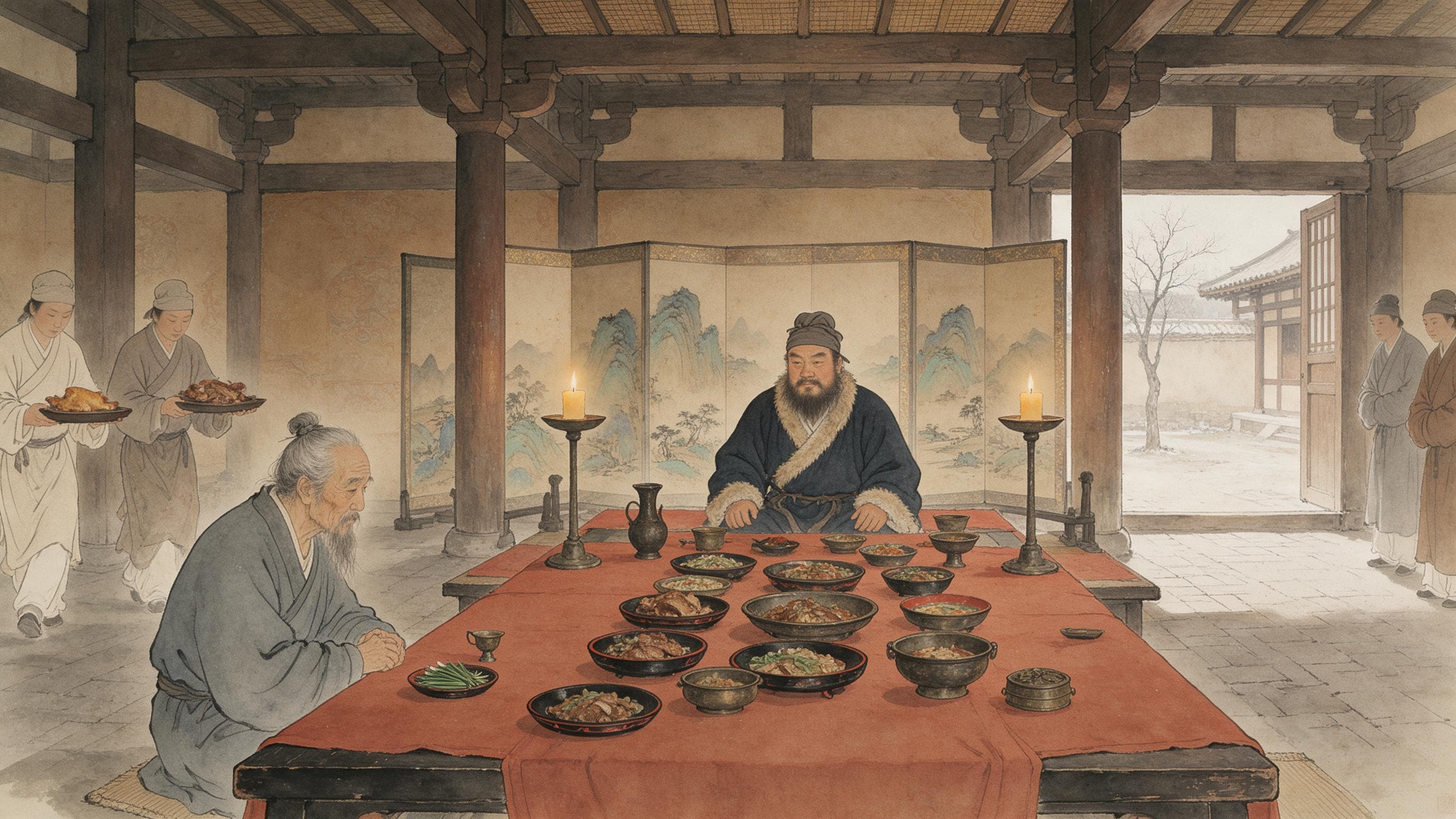
At the Prince of Gaoyang's table the dishes stood 方丈於前, spread a full zhang across. The chronicle says he 嗜口味,厚自奉養,一食必以數萬錢為限 — loved flavours, fed himself lavishly, and capped a single meal at tens of thousands of coins. The same man's mansion 匹於帝宮, matched the palace; his bamboo groves and fish ponds 侔於禁苑, rivalled the imperial park; he kept 僮仆六千,妓女五百, six thousand servants and five hundred singing women.
Two kinds of wealth: a zhang of dishes and a plate of chives
Li Chong, Marquis of Chenliu, understood that table. He said of it: 高陽一食,敵我千日 — one meal at Gaoyang's costs me a thousand days. Li Chong was not poor: he was Director of the Secretariat with the rank of minister, 亦富傾天下,僮仆千人, rich enough to tilt the realm, with a thousand servants. And yet 性多儉吝,惡衣粗食,食常無肉,止有韭茹韭菹 — close-fisted, badly dressed, eating coarse food, usually without meat, with nothing but chives and pickled chives.
On one side a zhang of dishes; on the other two plates of chives. The author sets the two kinds of wealth side by side and adds no comment of his own.
'Eighteen dishes at a meal' is a joke
Then comes the most malicious joke in the book. Li Yuanyou said to people: 李令公一食十八種, His Excellency Li eats eighteen kinds at one meal. Any listener would wonder: was he not supposed to be stingy? Where would eighteen dishes come from? Someone asked the reason, and Li Yuanyou answered: 二韭一十八.
It is a pun. 韭, chives, sounds exactly like 九, nine. Two kinds of chives are two nines; two nines are eighteen. The 'eighteen kinds' are a multiplication made out of two vegetables, not eighteen dishes. The chronicle continues: 聞者大笑。世人即以為譏罵 — the listeners roared, and people took it for an insult.
So read it as a joke, because that is what it is: not a menu, and not evidence that Li Chong really ate eighteen things. What it mocks is thrift carried to absurdity. A man 富傾天下, richer than the realm, whose table could be counted in chives, so that even the word 'many' is turned against him. It is also aimed at the prince: 敵我千日 puts luxury and stinginess on the same ruler.
How hard are six thousand, five hundred, a thousand?
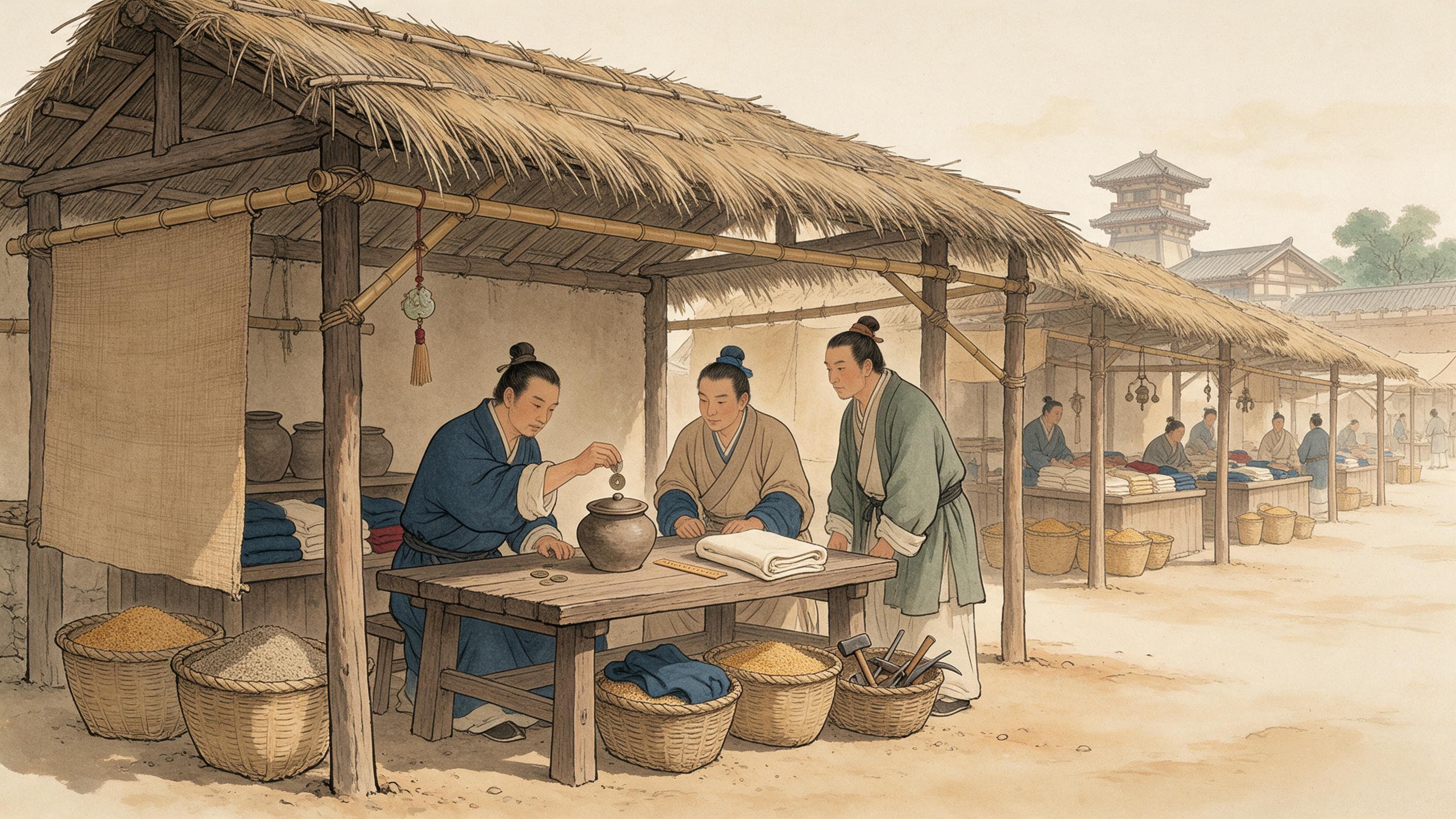
Numbers of this kind are rhetoric, not accounts. Yang Xuanzhi wrote after Luoyang had fallen, in Ye, remembering the Zheng'guang years of the 520s, and 僮仆六千,妓女五百 is followed at once by 自漢晉以來,諸王豪侈,未之有也 — since the Han and Jin there had never been such extravagance among princes. That is a superlative, a literary ceiling, not a household register. Li Chong's thousand servants is the same order of figure.
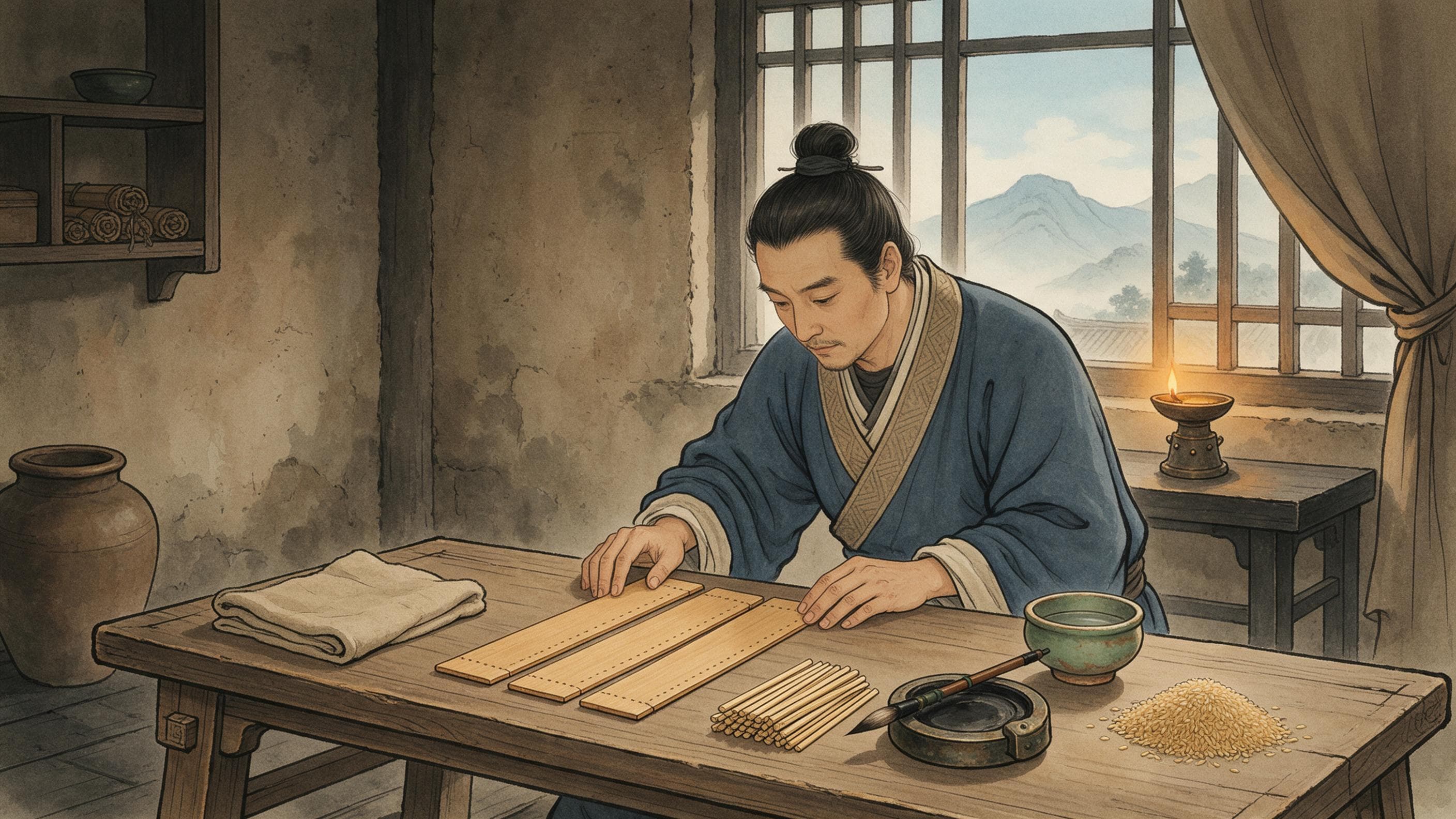
What can be taken literally: these households held retainers by the thousand and spent on banquets by the ten thousand coins. What cannot: that on a given day a given number of people ate a given number of dishes. The book keeps no ledger and the author did not intend to supply one.
The Wei Shu offers a mechanism instead of a figure. After the Heyin massacre of 528, 朝士死者,其家多捨居宅,以施僧尼,京邑第舍,略為寺矣 — the families of the slain officials mostly gave their houses to monks and nuns, and the mansions of the capital became monasteries almost without exception. The wealth did not vanish. It changed the name it was registered under.
How a mansion becomes a monastery
The Gaoyang Wang Monastery began that way. It was 高陽王雍之宅, the mansion of Yuan Yong, Prince of Gaoyang; after he was killed by Erzhu Rong the house was 舍宅以為寺, given up to become a monastery. One day a princely residence, the next a Buddha hall.
The fuller chain is in the first juan, at Jianzhong Monastery. It had been the mansion of the eunuch Liu Teng, 屋宇奢侈,梁棟踰制,一里之間,廊廡充溢。堂比宣光殿,門匹乾明門 — lavish beyond his rank, galleries filling a whole ward, its hall comparable to the Xuanguang Hall of the palace, its gate to the Qianming Gate, finer than anything the princes had. Under the regent Yuan Cha, Liu Teng was his chief adviser; in 526 the empress dowager retook power, had Yuan Cha and his party executed and 沒騰田宅, confiscated Liu Teng's lands and house, which she then gave to Yuan Yong. In 528, to make merit for Erzhu Rong, the Director of the Secretariat had it 題以為寺, inscribed as a monastery: 以前廳為佛殿,後堂為講室, the front hall became the Buddha hall, the rear hall the lecture room, gold flowers and jewelled canopies filling them. Liu Teng's summer retreat, the Cool Wind Hall, was still there, 淒涼常冷,經夏無蠅, cold and cheerless, without a fly all summer.
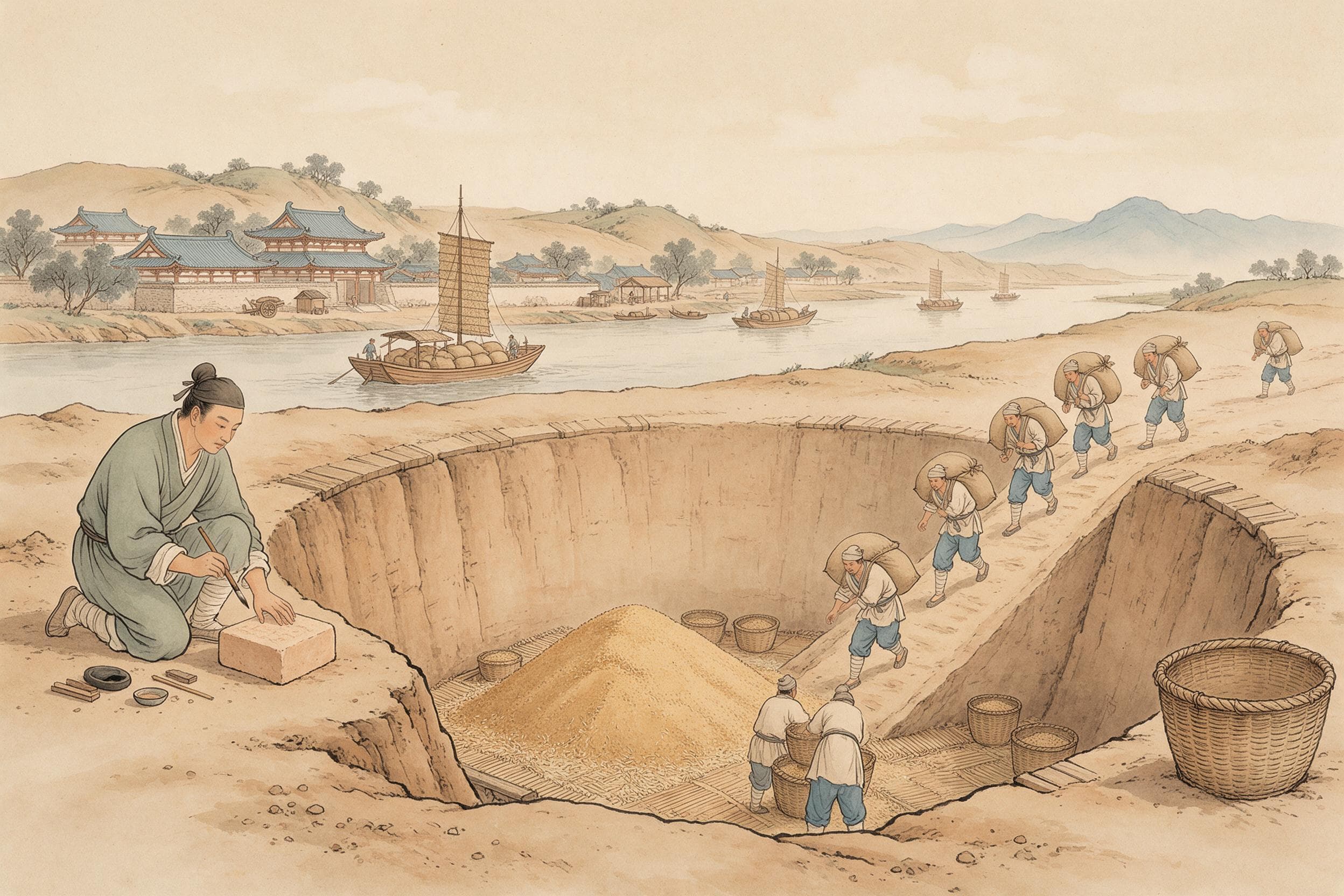
Confiscation, gift, donation, foundation: four steps, and one mansion had three owners and two names. This is not religious history. It is the history of property. There is a shorter version elsewhere: south of Datong Monastery, at the house of Gao Xianlüe, a red light was seen at night, and digging more than a zhang down they 得黃金百斤, found a hundred jin of gold, with an inscription: 蘇秦家金,得者為吾造功德, the gold of the Su Qin family; let whoever finds it make merit for me. Gao built the Zhaofu Monastery. When the regent Yuan Cha heard of the gold he sent to ask for some, and was given twenty jin. Money from the ground, money from the dead, money from the condemned: all of it flowed toward 'merit'.
Power: who could touch a monastery's property
Monasteries held property, property is power, and power attracts. The Yuanhui Monastery was founded by the vice-minister Wang Yi, who gave up his own house for it. In front of its Buddha hall grew a mulberry 直上五尺,枝條橫繞, five feet of straight trunk with branches sweeping round it, in five tiers, each with different leaves and fruit. The capital called it the divine mulberry, 觀者成市,布施者甚衆 — visitors made a market, donors were many. The emperor heard of it and disliked it, 以為惑衆, holding that it deceived the crowd, and ordered an official to cut it down. On the day it was felled, 雲霧晦冥,下斧之處,血流至地,見者莫不悲泣 — cloud and fog darkened, blood flowed from the axe cuts, and all who saw it wept.
A tree that could turn a crowd into a market and alms into a heap had stopped being a tree. It was a power, and what the emperor cut down was the market. Conversely, a monastery close to power was rich: the Hutong nunnery was founded by the empress dowager's aunt when she took vows, and its nuns were 帝城名德,善於開導, of the capital's best reputation, going into the palace to preach to her, 其資養緇流,從無比也, their support of the clergy without equal. The Zhaoyi nunnery was founded by eunuchs, of whom the book says: 宦者之家,積金滿堂, in the eunuchs' houses gold filled the halls.
So the money in these pages has to be read two ways: the zhang of dishes on the prince's table, the chives on Li Chong's; a mansion turned into a monastery, alms heaped under a tree. The author had no ledger, only jokes and juxtapositions — one table spread a zhang wide, one plate of chives; one princely residence, one Buddha hall. In his book numbers are not there to be audited. They are there to be remembered.
Sources & further reading
- 楊衒之《洛陽伽藍記》卷三「高陽王寺」(Yang Xuanzhi, Luoyang Qielan Ji, juan 3, "Gaoyang Wang Monastery") — Yuan Yong's six thousand servants and five hundred singers, his meals capped at tens of thousands of coins, Li Chong's chives, and the pun 二韭一十八 that turned 'eighteen dishes' into two kinds of leek.
- 楊衒之《洛陽伽藍記》卷一「建中寺」(Yang Xuanzhi, Luoyang Qielan Ji, juan 1, "Jianzhong Monastery") — The eunuch Liu Teng's over-grand mansion: confiscated in 525, granted to the Prince of Gaoyang, and in 528 converted into a monastery with its front hall as the Buddha hall.
- 魏收《魏書》卷一百一十四〈釋老志〉(Wei Shou, Wei Shu, juan 114, "Treatise on Buddhism and Daoism") — After the Heyin massacre of 528 the families of slain officials gave their mansions to monks and nuns, until the capital's great houses had almost all become monasteries.