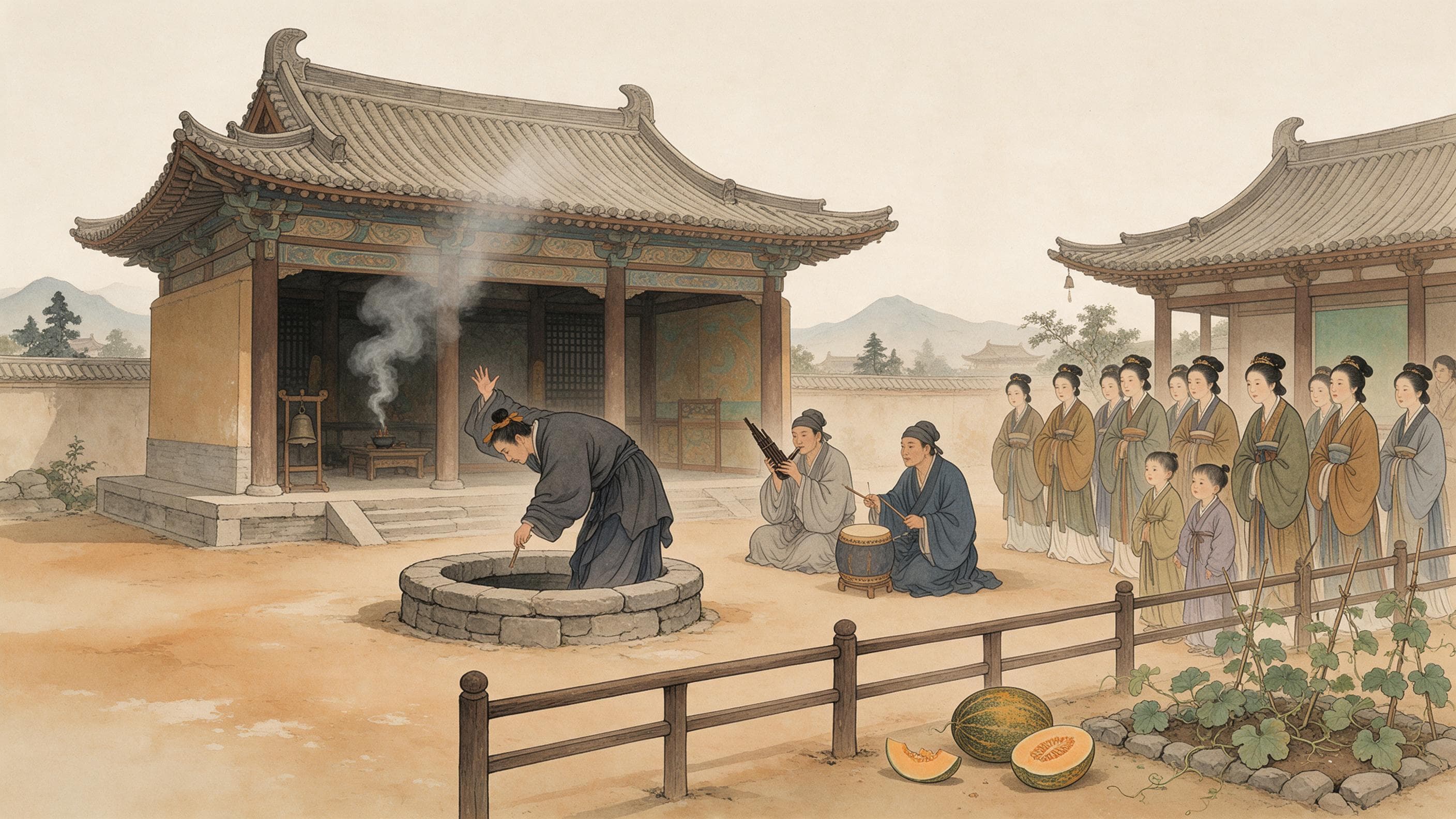
In the courtyard of Jingle Monastery in Northern Wei Luoyang, a performer worked between a small well and a patch of melon vines. First 剥驴投井 — the donkey is skinned and thrown into the well; then 植枣种瓜 — dates and melons are planted; and 须臾之间,皆得食之 — in a moment, both could be eaten. The audience of ladies and gentlemen 目乱精迷, their eyes dazzled and their wits confused. This was not street busking: it happened inside a Buddhist nunnery, before the society of the capital. The passage comes from juan 1 of the Luoyang Qielan Ji (Record of the Monasteries of Luoyang), and it is the most concrete account of Northern Wei illusion performance that survives.
A nunnery you could not enter
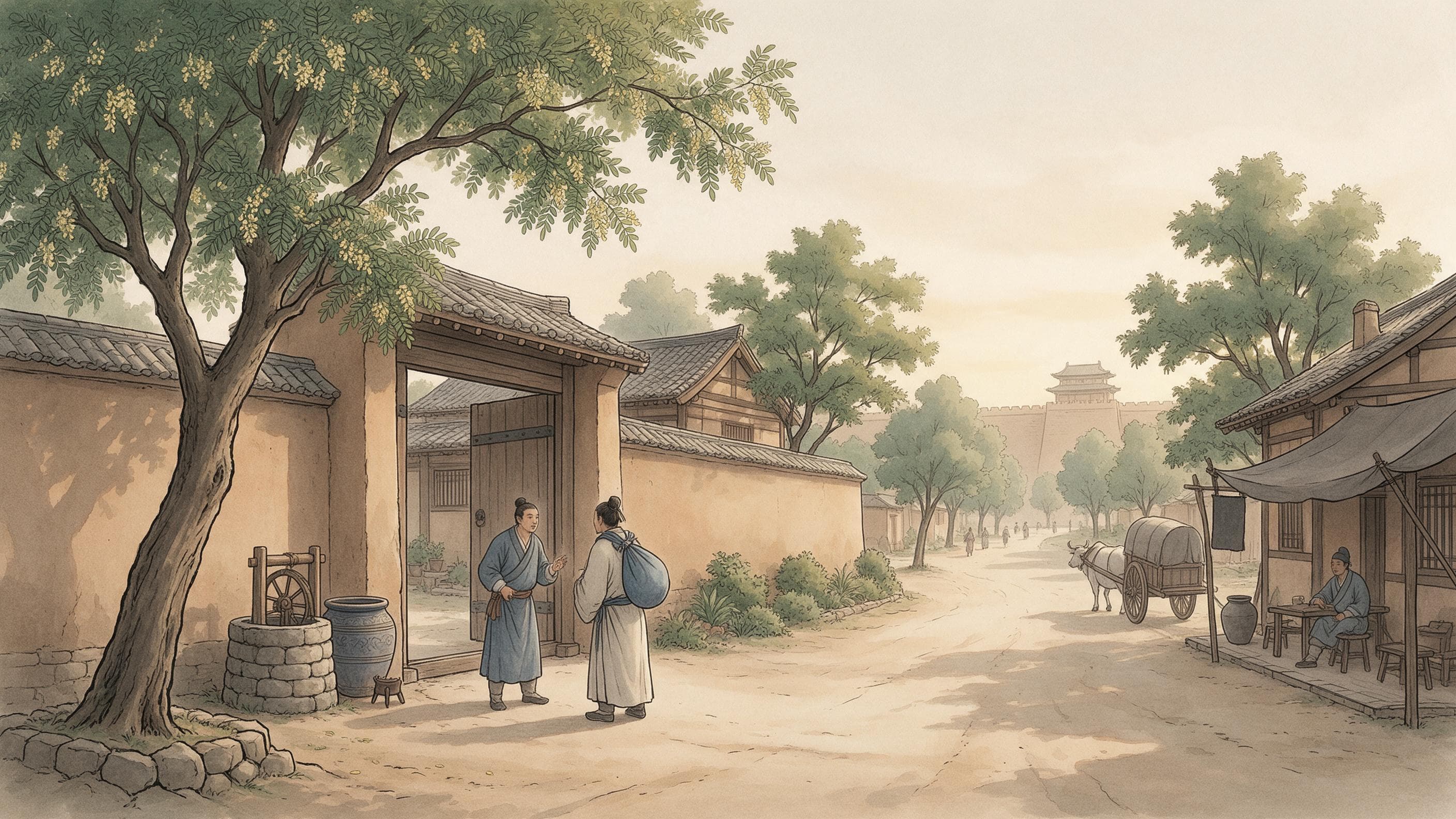
Jingle Monastery was founded by the grand tutor, Prince Xianwen of Qinghe, Yuan Yi. It began as a nunnery: at the six fasting days 常设女乐 — women musicians were regularly installed, with songs that circled the beams and sleeves that turned slowly. And because it was a nunnery, 丈夫不得入 — men were not allowed in, and those who did get in 以为至天堂, thought themselves in paradise. The turn came after the prince's death: 及文献王薨,寺禁稍宽,百姓出入,无复限碍 — the rules relaxed, and ordinary people came and went without hindrance. Later Prince Yuan Yue of Runan restored the place and 召诸音乐,逞伎寺内 — summoned musicians and let performers show their arts inside the grounds, with strange birds and beasts dancing in the hall. The illusions were not the monastery's own business; they were entertainment brought in after a prince's restoration — and more people could see them because a prohibition had loosened. The quarter around it is part of the story: west of the monastery stood the minister of state's office, east the mansion of the general Gao Zhao, north the ward of Yijing — the monastery sat among the capital's addresses of power. At the north gate of Yijing ward, the book notes, stood several mulberry trees with thick branches, and beneath them a sweet well with stone troughs and iron buckets, 供给行人,饮水庇荫 — supplying passers-by with water and shade, where many rested. Inside, a Buddha hall held the image carriage, 雕刻巧妙,冠绝一时 — carving whose skill was unmatched in its day; the halls ran in a ring, 曲房连接,轻条拂户,花蕊被庭 — linked chambers, light branches brushing the doors, flowers covering the courtyard.
Skinned donkeys and instant melons
The programme survives only as names: 飞空幻惑,世所未睹。异端奇术,总萃其中 — illusions of flight and deception such as the age had never seen; strange arts of every kind gathered there. 剥驴投井,植枣种瓜,须臾之间,皆得食之 — skin a donkey and throw it into the well, plant dates and melons, and in a moment all can be eaten. Read as a sequence, the three actions look like a trick of disappearance and return: first a cruel vanishing, then an impossible reappearance. How it was worked, the text does not say, and this article will not reconstruct it as 'really they used a hidden prop'. The point of an illusion is that it is not explained; a mechanical explanation would be rewriting the source. What can be said is why such acts belonged in a monastery: the great monastic festivals were the city's public theatre, and an illusion was one of the attractions that drew a crowd — the same book's account of the April image procession shows how large that crowd could be.
The same city's other wonders
The same juan gives another scene at Changqiu Monastery. On the fourth day of the fourth month the monastery's white elephant image went out — the monastery's three-storey pagoda, with golden discs and a jewelled finial, shone over the city, and the image it carried was a six-tusked white elephant bearing Shakyamuni in the air, a construction of gold, jade and a craftsmanship the book says cannot be described in detail. 辟邪师子导引其前 — lion-beasts led the way — and 吞刀吐火,腾骧一面;彩幢上索,诡谲不常 — sword-swallowing and fire-spitting, acrobatics and the high pole, tightrope walking on coloured banners, tricks without precedent; 奇伎异服,冠于都市 — strange skills and costumes unmatched in the capital. And where the image halted, 观者如堵,迭相践跃,常有死人 — the crowd stood like a wall, trampled one another, and people often died. So these were not quiet parlour shows but city spectacles that could crush a person. The image procession itself belongs to another article; what matters here is the 伎 around it: illusion and acrobatics were part of the monastic festival.
When the shows stopped
The Jingle Monastery passage ends abruptly: 自建义已后,京师频有大兵,此戏遂隐也 — after the Jianyi era (528, a reign that opened in crisis and was followed by years of fighting), the capital suffered repeated wars, and these shows simply disappeared. That sentence writes an ending for a whole urban entertainment: it depended on three things — noble money, monastic space, and an audience with the peace of mind to watch. The first two survived the chaos; the third did not. Yang Xuanzhi wrote his book when Luoyang was already in ruins; recording these illusions was a way of recording how lively the city had once been.
What the book can prove
The nature of the source needs stating. The Luoyang Qielan Ji is an Eastern Wei remembrance of Northern Wei Luoyang, organised monastery by monastery — the illusions are an episode inside a temple entry, not a performance record. Yang Xuanzhi wrote after the city's fall; the book is a monument to what had been lost, and every entry carries that double vision, the building as it was and the ruin it became. What is documented: that after Yuan Yi's death and Yuan Yue's restoration, Jingle Monastery brought in musicians and wonder-workers who performed donkey-and-melon illusions before the capital's ladies and gentlemen, who were dazzled; that Changqiu Monastery's April procession featured sword-swallowing, fire-spitting and tightrope walking; and that after 528 the wars ended such shows. What is not documented: the method, the performers' names, how often they performed, whether there was a charge, or how large the audience was. Nor does the book say anything about a link with Indian or Western-Region magic, so the common claim that such tricks 'came from India' is not repeated here. One question remains: how did skinned donkeys and instant melons actually work? Yang Xuanzhi does not say, and a thousand and a half years later there is only that phrase — eyes dazzled, wits confused — to guess from. That is also the honest position: the sources preserve the audience's astonishment, not the trick, and a history of entertainment sometimes ends with the audience's face rather than the performer's method. Nor does the record give a price, a poster or a programme — only a place, a crowd and a trick.
Sources & further reading
- 杨衒之《洛阳伽蓝记》卷一·景乐寺、长秋寺 — 景乐寺「至于六斋,常设女乐」「以是尼寺,丈夫不得入」「及文献王薨,寺禁稍宽,百姓出入,无复限碍」「召诸音乐,逞伎寺内」「飞空幻惑」「剥驴投井,植枣种瓜,须臾之间,皆得食之」「士女观者,目乱精迷」「自建义已后,京师频有大兵,此戏遂隐也」;长秋寺四月四日像出「吞刀吐火,腾骧一面;彩幢上索,诡谲不常」「观者如堵,迭相践跃,常有死人」
- 杨衒之《洛阳伽蓝记》卷三·景明寺(行像与百戏的上下文) — 以景明寺四月八日行像的盛大场面作对照,说明幻术与杂技是寺院节庆的一部分;行像本身另有专文,本篇只作背景