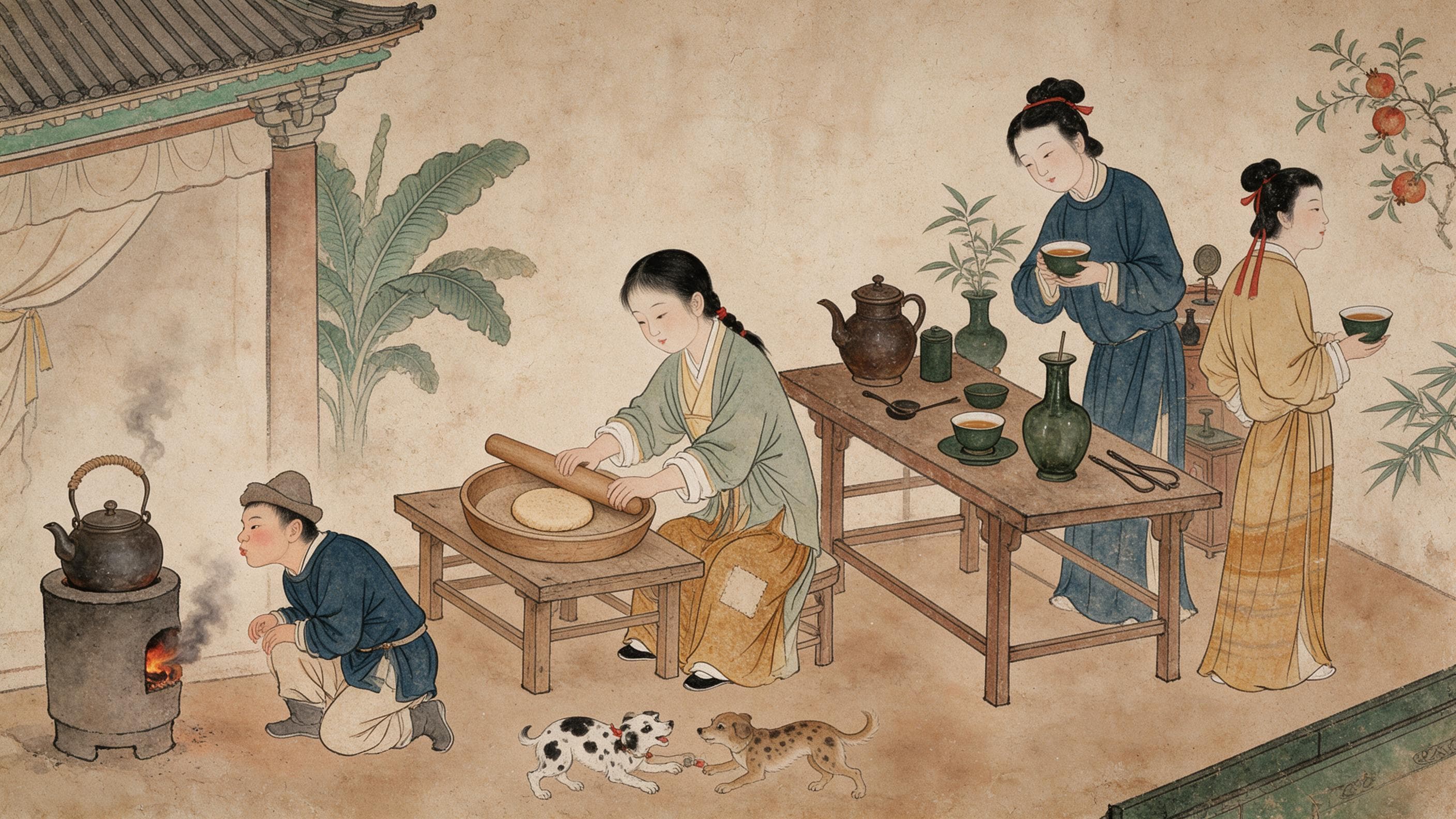
On the wall of a Liao-dynasty tomb at Xuanhua in Hebei, a whole sequence of movements is painted. A girl in Han Chinese dress sits sideways at a tea roller, head down, grinding tea, a neatly patched repair visible on her right knee; on the ground beside her is a tray with a round tea cake waiting to be ground. Next to her a smaller child dressed in Khitan style kneels, cheeks puffed out, blowing hard at the wind stove under the kettle. Behind the boy an adult male servant, also in Khitan dress, reaches out both hands as if to lift the finished pot from the stove. On the table behind them stand pots, cups, saucers, bottles and tongs; two small spotted dogs leap about at the table's foot. Two adult maids in Han dress carry filled tea cups, stepping carefully, apparently on their way to the rear chamber to serve the master.
One picture, person by person
The mural is the Preparing Tea picture in the tomb of Zhang Kuangzheng, at Xuanhua, which was Guihua prefecture of the Liao just inside the frontier, now Zhangjiakou in Hebei. What repays attention is not the refinement of the vessels but the people and their clothes: the grinder and the cup-bearers wear Han dress, the fire-blower and the pot-lifter wear Khitan dress, all in one tomb chamber. That is more than the phrase 'Liao custom' can carry — it is a cross-section of one household's hospitality in a multi-ethnic official family. And nobody in the painting is drinking: the tea is being prepared, carried, about to be delivered. The dogs are running; no one has touched the table. The patch on the girl's knee is the detail that makes the whole thing feel lived in: a mended garment painted into a tomb.
Who was buried here
Nine tombs were excavated at Xuanhua Xiahuali between 1974 and 1993; seven contained epitaphs, spanning twenty-four years, all late Liao. The occupants were Han Chinese nobles within the Liao realm. The highest in rank was Zhang Shiqing, styled in office as a right-palace attendant, with the titles of collator of the National Academy, concurrent censor and cloud-rider; the tomb chambers follow Tang custom, a clear case of Han nobles in Liao territory using the Guanzhong burial system. The nine tombs hold over three hundred square metres of murals; Zhang Shiqing's alone has 87.5 square metres and 206 human figures. The subjects are not only tea: there are processions, ensembles, sutra preparation, banquets, Khitan children dancing, children skipping rope, lotus ceilings and painted star maps. So the caution stands: these are the tombs of a Han official family under Liao rule, and the pictures show their hospitality, not the daily life of Khitan herders.
The tea set has a Tang genealogy
The vessels in the painting are not a Liao invention. Scholars have compared them: the preparing-tea mural on the south-east wall of Han Shixun's tomb M4 (Liao Tianqing first year, 1111) shows a ewer, tea bowls and saucers whose combination matches the tea set painted in the Tang tomb of Lady Cui at Wangmu village (buried 904); and the Baoshan Liao tomb carries a Tianzan second-year (923) inscription, the earliest dated Khitan noble tomb yet found. The ewer is the 注子, the bowl the 茶碗, the saucer the 茶托; the names themselves are Tang names. The equipment and the gestures came down from the Tang and were still being painted in Liao graves. One restraint: preparing-tea pictures cluster in officials' family tombs; tea was a mark of status and hospitality, not the water everyone drank daily.
The painting has no menu
Mural painting shows vessels, gestures and staging; it gives no list of dishes, and this article does not invent one. To connect the picture with institutions and the economy one must go to the Liao History's chapter on food and money: the frontier prefectures kept price-stabilising granaries which, following ancestral law, 出陈易新,许民自愿假贷,收息二分 — issued the old grain and took in the new, lent to those who asked, and charged two parts in ten; in 995 the court ordered community granaries in every circuit, where in autumn each household put in grain according to its harvest and the community office recorded the list. The same chapter notes that at Chunzhou a dou of millet cost six cash, and gives the exchange rates set by Yali — one cart of millet for a sheep, three for an ox, five for a horse, eight for a camel. These are general figures for Liao, not Xuanhua prices, and must not be written as local ones. As for the claim, made by some researchers, that the Zhangjiakou trade route begins in the Liao period, that is an inference and should be marked as one.
How to read a tomb wall
Several lines must be kept. First, this is funerary imagery with an idealising tendency: it shows the scene the tomb owner wished to leave behind, not necessarily what happened on a given day. Second, the tomb count should use the institute's figure of nine excavated; reports that say ten should not be mixed in. Third, Zhang Shiqing's death and burial years could not be checked here against an accessible epitaph, so no dates are given; the datable anchors are Han Shixun's 1111 and Baoshan's 923, both supported by published research. Fourth, cremation rites and dharani coffins are burial customs and must not be generalised into 'all Liao people cremated'. Fifth, the Han and Khitan dress appearing together speaks of this city and this kind of official household, not of Khitan herders or of Liao as a whole.
What is documented is the picture itself: a session of hospitality broken into grinding, blowing the fire, lifting the pot, carrying cups and laying out vessels, performed by people in Han and Khitan dress; a tea set and set of gestures that connect back to the Tang; and a tomb owner who was a Han official at Xuanhua in the late Liao, as the epitaphs, burial system and mural subjects all indicate. What is not documented is the menu of that meal, its cost, who the guests were, or whether the master really entertained this way on that day — the painting gives a composition, not an account, and a document of aspiration as much as of custom. One question is more interesting than the rest: was this tea laid out for the dead to enjoy, or for the living who came to sweep the tomb? The two little dogs are still leaping under the table, and nobody in the picture has picked up a chopstick.
Sources & further reading
- 河北省文物考古研究院《宣化下八里辽代壁画墓群》 — 1974—1993年发掘9座辽晚期墓,7座有墓志,时间跨度24年;壁画总面积300余平方米,张世卿墓87.5平方米、人物206个;题材含出行图、散乐图、备茶图、备经图、宴乐图、契丹儿童舞、儿童跳绳图、垂莲藻井、彩绘星图;墓主为辽境汉族贵族,沿关中葬制;张世卿官衔右班殿直、检校国子祭酒兼监察御史、云骑尉
- 武淑萍、郝静《从宣化辽墓备茶图看张家口堡》,《光明日报》2013年3月30日第12版 — 张匡正墓《备茶图》人物与器物细节:汉服女童膝上打补丁碾茶、地上盘子与待碾茶饼;契丹装小童鼓腮吹风炉;契丹装男侍取炉上茶壶;桌上壶、盏、瓶、夹、宗、扎;两只小花狗;两名汉服女侍捧盏送茶
- 唐雪梅《辽人茶事源流的考古学观察》,《故宫博物院院刊》2023年第9期(中国历史研究院转载) — 宣化韩师训墓M4(辽天庆元年1111)东南壁备茶图;其注子、茶碗、茶托与唐王母村崔氏墓(904)茶器组合相同;宝山辽墓天赞二年(923)题记为最早纪年契丹贵族墓
- 脱脱等《辽史》卷五十九·食货志上 — 沿边诸州和籴仓「出陈易新,许民自愿假贷,收息二分」;统和十三年诏诸道置义仓,社民随所获户出粟、社司籍其目;「春州斗粟六钱」;雅里自定粟价(粟一车一羊、三车一牛、五车一马、八车一驼)