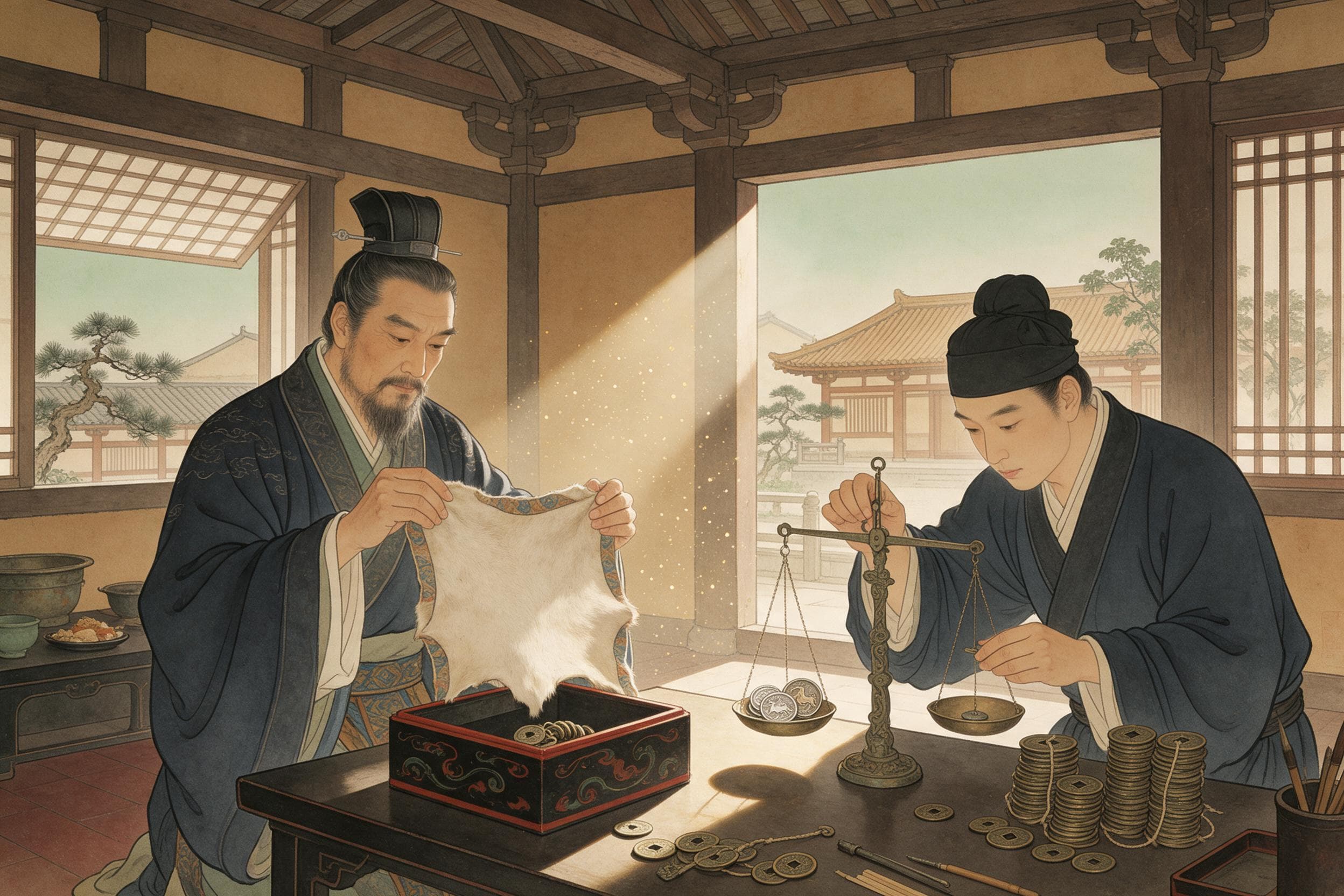
The imperial parks held white deer, and the privy treasury held silver and tin. In the reign of Emperor Wu, with the frontier wars draining the granaries, someone in the government looked at those two facts and saw money. A square foot of white deer hide, trimmed with painted silk, was declared a 皮幣 — a hide note — and given a value of 400,000 coins. It was not a coin and nobody spent it in a market. The rule was narrower and harder: when princes and imperial clansmen came to court, to congratulate, to enquire, to present gifts, they had to lay one of these hides under the jade they offered, and only then would the ceremony proceed. A piece of leather, worth what a deer hide is worth, was made the price of admission to the throne.
The hide, and the man who said it made no sense
The Shiji records the objection, and it is the best sentence in the whole episode. Yan Yi, a minister known for honesty, was asked about the new note and said: the princes come to court with a green jade worth a few thousand, and the hide laid under it is worth 400,000 — 本末不相稱, the trunk and the branch do not match. The emperor was displeased. Zhang Tang, the harsh chief justice, had a grudge against him; when someone reported that Yan Yi had discussed the decrees with a guest and said nothing, only pursed his lips slightly, the case was framed as 腹誹 — whispering in the belly — and he was condemned to death. The Shiji adds that from then on there was a statute against thought crime, and the high officials learned to flatter.
Silver with the price written in the design
The same year brought the second experiment. Silver and tin were alloyed into three denominations, and the value of each was fixed by its shape and its animal: a round piece weighing eight liang, with a dragon, called 白選, worth 3,000; a smaller square one with a horse, worth 500; a smaller oval one with a turtle, worth 300. The state also melted down the old half-liang coins and cast three-zhu coins, and made counterfeiting of the precious-metal pieces a capital crime. The law was explicit. The results were not ambiguous either: the Shiji says the clerks and commoners who illegally cast the silver pieces were beyond counting.
The reason is not mysterious, and the Shiji states it without commentary. If a piece of silver-tin alloy is declared to be worth three thousand bronze coins, the metal inside it is worth a fraction of that; anyone who can cast one makes the difference. The state had created a coin whose profit margin was the crime. Within five years the government pardoned officials and commoners condemned to death for illegal coining — tens of thousands of them — and still, the text says, fewer than half gave themselves up, while the rest of the empire was, roughly, minting: 天下大抵無慮皆鑄金錢矣. And the outcome is recorded in four characters: 歲餘,白金終廢不行 — after about a year the silver money was abolished and ceased to circulate.
The coin that got lighter, and the rim that stopped it
The third experiment was technical and, for a while, more successful. The old half-liang had been reduced in practice to a four-zhu coin of the same name; the government melted it for three-zhu pieces, found them too light and too easy to fake, and then cast the five-zhu coin with a raised rim all round — 周郭其下 — so that no one could shave the edge and pocket the filings. Clipping, 磨取鋊, was the commonest fraud in a coinage whose value was its metal, and a rim was the answer: any coin that had been shaved no longer matched its neighbours.
The fourth experiment tried a token instead. The capital's mint produced the 赤側, the "red-edged" coin, and decreed that it passed for five; taxes and official payments would accept nothing else. That is a fiat value, five times the metal, and the market behaved as markets do: within two years the Shiji reports the red-edged coin had fallen in value, people found clever ways to use it, it was inconvenient, and it too was abolished. The government's final move was to end the competition altogether: all provincial and princely mints were forbidden, the casting was concentrated in the three offices at Shanglin, and earlier coins were recalled and melted for their copper. The Shiji then gives the reason the ban held — 計其費不能相當 — for private coiners the cost of making a coin no longer matched what it would buy. The state did not win by decree; it won by making forgery unprofitable.
The other money: a loan at ten times the interest
Money also existed outside the mints. When the seven kingdoms rebelled in 154 BCE, nobles and marquises riding to join the campaign needed loans, and the professional lenders of Chang'an refused: the outcome in the east was undecided, and they would not risk capital on it. One woman, Wu Yan, put up a thousand gold at ten times the normal interest. The rebellion was crushed in three months; within the year her interest had come to ten times the principal, and with it she became as rich as the capital region. The Shiji tells the story in a few lines and without moralising, but the point is structural: credit was a business of judging risk, and the biggest risk of the decade paid the biggest return. Her money was not a state instrument at all.
What kind of document this is
Two cautions about the source. First, the Shiji's chapter on the balanced standard is not a neutral ledger; Sima Qian plainly disliked the fiscal machinery he describes, and his account of Emperor Wu's administration is shaped by that dislike, which is why it preserves the story of Yan Yi and the belly-whisper statute. It is evidence of what was done and of how a contemporary judged it, and the two should be kept apart. Second, the numbers are official figures quoted at second hand — 400,000 coins for a hide, 3,000 for a silver piece — and they must not be converted into modern money: no reliable price series exists to make that calculation honest.
What the episode shows is a state discovering, one failed instrument at a time, what money is. Hide notes worked only where the throne could compel their use, and only once a year. Silver failed because the face value was too far above the metal. The token coin failed because the decree lasted two years and the market lasted longer. The five-zhu with its rim survived because it solved a physical problem rather than an accounting one, and centralisation survived because forgery stopped paying. Put the four experiments side by side and they read as a sequence of lessons about trust — where it can be manufactured, and where it cannot.
Sources & further reading
- 《史记》卷三十·平准书 (Shiji, vol. 30, "The Balanced Standard") — The white-deer-skin note at 400,000; the three silver denominations at 3,000, 500 and 300; the 3-zhu and 5-zhu recoinages; the red-edged coin at five; Yan Yi's objection and death; the counterfeiting amnesties.
- 《史记》卷一百二十九·货殖列传 (Shiji, vol. 129, "The Money-makers") — Wu Yan, the moneylender who put up a thousand gold when the other lenders refused, at ten times the interest, during the Seven States rebellion.