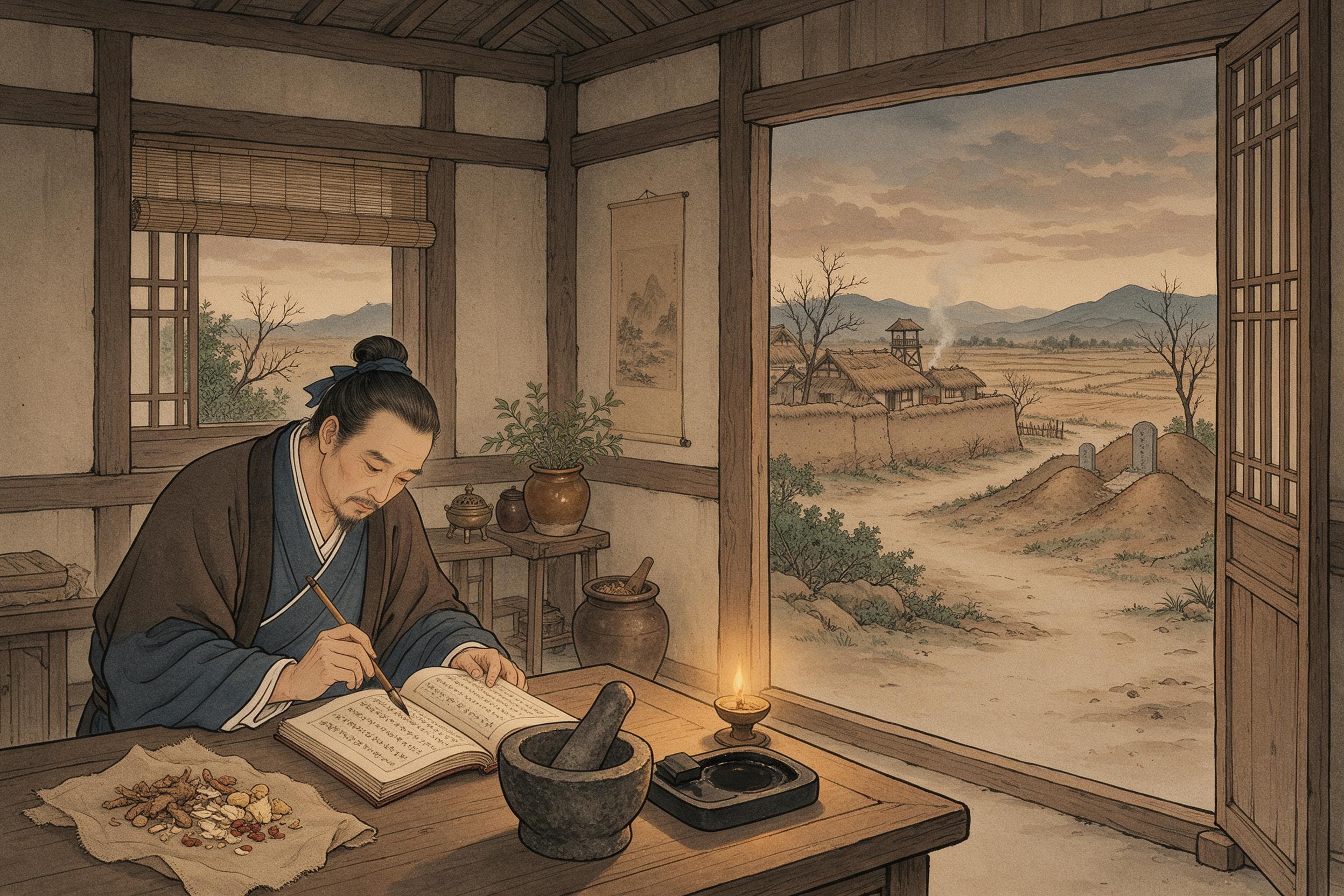
Begin with a household ledger. In the preface to his Treatise on Cold Damage, Zhang Zhongjing says his clan had once been large — 'more than two hundred of us'. Then: 'since the Jian'an era began, not yet ten years, and of the dead, two parts in three; of those, seven in ten died of cold damage.' Two hundred people, under a decade, two thirds gone. He wrote the sentence to explain why he wrote a book, and the three figures weigh more than any description could. The book that came out of it is not a chronicle of plague but a manual of judgement and treatment.
A household ledger
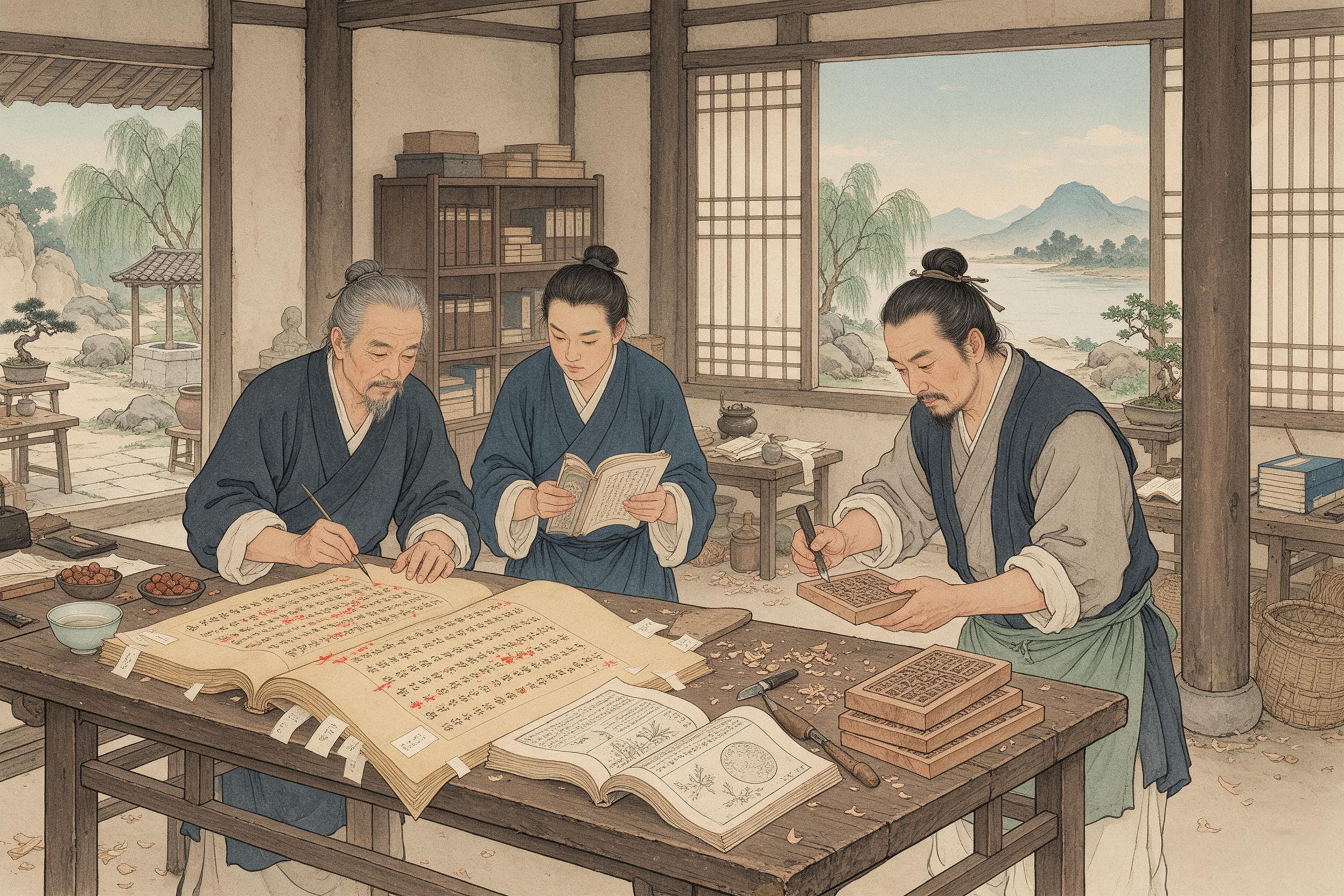
What follows is the motive: 'Moved by the losses of the past, grieved that sudden deaths could not be saved, I sought out the old teachings and gathered the many prescriptions', drawing on the Basic Questions, the Nine Fascicles, the Eighty-One Difficulties and other works, adding his own pulse diagnosis, to make the Treatise on Cold Damage and Miscellaneous Diseases in sixteen fascicles. The text read today is the Song edition, edited by Wang Shuhe in the Jin, corrected by Lin Yi and others in the Song, and reprinted by Zhao Kaimei in the Ming: not what a Han author held in his hands. The copy on Wikisource is marked unproofread.
Zhang himself has no biography in the standard histories. The Song editors' preface says so in as many words — 'Zhang Zhongjing has no biography in the Han History' — and falls back on a later Name Doctors' Record. This article therefore gives no life of him: no dates, no birthplace, no office. What is certain is the book he left and the ledger he wrote into it.
Judgement before the prescription
The preface contains a passage of very specific abuse. 'Doctors nowadays do not think to seek the meaning of the classics... each inherits a family technique and follows the old ways from start to finish. They ask a few questions, and in a moment prescribe a decoction.' Then the diagnostic charge: they take the inch pulse and not the foot, they hold the hand and not the foot, they do not compare the three pulse positions at the wrist, neck and ankle, and they count the beats for less than fifty. His quarrel was not with medicine but with deciding too fast. His last line is that to tell death from life is truly difficult — and that is exactly what he demanded of a physician.
The same preoccupation opens the Essential Prescriptions of the Golden Coffer. 'The superior physician treats illness before it forms': seeing disease in the liver, he knows it will pass to the spleen and fortifies the spleen first. 'The thousand maladies do not go beyond three routes' — affliction of the channels entering the organs; the limbs, the nine orifices and the blood vessels, blocked and failing to pass; and injury from sex, blades, insects and beasts. He also gives the handling: at the first heaviness in the limbs, use guided exercise, breathing, needling and moxa, ointment massage, and do not let the nine orifices close; in food and drink, regulate cold, heat, bitter, sour, pungent and sweet. The opening also has a frame: 'People live by wind and qi; wind can grow all things and harm all things, as water can float a boat and overturn it.' Among the things to avoid it lists breaking the law and the injuries of beasts — even a punishment wound counts as a cause of illness. It is a framework for sorting and then treating, not a list of prescriptions.
A poet's scene
The other man writes differently. Cao Zhi's 'On the Qi of Pestilence' fixes its date in the first sentence: 'In the twenty-second year of Jian'an, a pestilential qi spread: every household had the pain of a corpse, every room the grief of wailing. Some families died to the last person; some clans were wiped out.' This is a scene, not an account book.
Then comes observation and explanation. He records that some said the pestilence was the work of ghosts and spirits. He says those who caught it were 'the sons of coarse cloth and bean leaves, the people of bramble huts and thatch doors', while in the households of high halls and rich food, of sable furs and thick mattresses, 'such cases were few'. His own explanation is that yin and yang are out of place and cold and heat come at the wrong season; of the common people who hung talismans to ward it off, he says it is laughable. These are his judgements, not data: that the rich were rarely ill is an impression from the epidemic, and cannot become 'the rich did not fall ill'.
Two epidemics, not one
The most important point: these two records are not the same event. Zhang writes of 'not yet ten years since the Jian'an era began' — Jian'an 1 is 196, so roughly 196 to 205. Cao Zhi names Jian'an 22, which is 217. More than ten years apart. They cannot be merged into one outbreak, and Zhang cannot be made a witness to the one Cao Zhi described. The only joint statement the texts allow is that in the last years of the Eastern Han, epidemics came again and again. 'Since the Jian'an era began' is itself slightly ambiguous — from the first year, or merely during the era — but on either reading it falls within ten years of 196, and so well before 217.
Two words need care. First, 'cold damage' is an old disease category covering febrile illnesses generally, not the modern disease called typhoid; this article uses no modern diagnosis and offers no modern medical explanation. Second, neither set of numbers is hard: Zhang's two hundred, two thirds and seven in ten are his own estimate, and Cao Zhi's 'few rich households' is a literary observation. Neither is treated here as statistics.
What the two passages can say
One man took his family's deaths and made a book of them: what he wanted was the order of diagnosis, the classification of disease and a way to act. The other took a scene and a social observation and made an argument: what he wanted was a sentence that would hold a city's wailing, and then an explanation. Together the passages show that epidemic disease was part of ordinary life in that generation; neither shows how many died, how often it came, or which year was worst — the material does not contain it. Nor does either text offer any way of stopping an epidemic from spreading: one gives classification and treatment, the other explanation and mockery. Between the two epidemics lie ten-odd years; between the two texts lies a whole way of writing.
Sources & further reading
- 《伤寒论》(宋本;晋王叔和编次、宋林亿校正、明赵开美校刻;维基文库,页面标 25% 未校对) — Zhang Zhongjing's preface: his clan once numbered more than two hundred; in the years since the Jian'an era began, not yet ten, two thirds had died, seven in ten of 'cold damage'. He therefore sought the old teachings and wrote the sixteen fascicles. He attacks contemporary doctors who 'each inherit a family technique and follow the old ways from start to finish', who 'ask a few questions, and in a moment prescribe a decoction'. The Song editors' preface states that Zhang has no biography in the Han History and that even they had to cite a later Name Doctors' Record.
- 《金匮要略》(维基文库,页面标 50% 未校对) — The same physician's framework: 'the superior physician treats illness before it forms' — seeing liver disease, know it will pass to the spleen and fortify the spleen first; 'the thousand maladies do not go beyond three routes' (affliction of the channels entering the organs; the limbs and nine orifices and blood vessels; and wounds from sex, blades, insects and beasts); at the first heaviness in the limbs, use guided exercise, breathing, needling and moxa, ointment massage; and regulate food and drink in cold, heat, bitter, sour, pungent and sweet.
- 曹植〈说疫气〉(《全三国文》卷十八,清严可均辑;维基文库) — In the twenty-second year of Jian'an a pestilential qi spread: 'every household had the pain of a corpse, every room the grief of wailing'; some families were wiped out entirely. He records that some said the pestilence was the work of ghosts and spirits; that those who caught it were 'the sons of coarse cloth and bean leaves, the people of bramble huts and thatch doors', while rich households were few among them; and his own explanation — yin and yang out of place, cold and heat at the wrong season — with contempt for those who hung talismans against it.