The slip is 23.5 centimetres long, 2.8 wide and 0.3 thick, and weighs 4.66 grams. It came out of a frontier site labelled A8 Pochengzi, in the Edsen-gol region of what is now Inner Mongolia, and its face is covered with short entries that look like handwriting practice and are in fact a register. Each entry begins with a rank, gives a name, then millet — 粟 — in the measure 三石三斗三升少, then a month, then two characters: 自取, collected by himself. Fifteen or so men, and the grain they carried away. The catalogue describes it first by size and mass, which is how a wooden document is usually described: not by what it says but by how much it weighs.
A ledger on four and a half grams of wood
The format barely varies: 令史 (a clerk), 鄣卒 (a watch-post soldier), 尉史 (a deputy clerk), 鄣卒 again. The names are Kong Shengzhi, Xu Chong, Zhao Wangsheng, Wang Nu, Li Shouwang, Yue Shengzhi, Yi Nan, Meng Yanshou — and at the end, 施刑 Tao Shengzhi, a man with a penal status. The last line closes the account: 右奉食吞远, 'on the right, provisions for Tanyuan'; a second edition of the text gives 令史延年食吞远 instead. Tanyuan seems to be the posting these men belonged to, though the slip itself does not explain the word. Nor is the reading settled: the two standard transcriptions differ on individual characters — the same officer appears as 郭当 in one and 郭常 in the other, the same soldier as 马定 and 厉定 — so a reader of the slip is also reading an editor's judgement.
The slip is printed in two standard corpora, the 合校 at page 40 of its first volume and 居延汉简(壹) at page 82, and its transcription is released under a research licence. What is quoted here, then, is an edition's reading, not a photograph of the wood; the find spot, the dimensions and the weight come from the catalogue's excavation record, not from the slip itself.
Three shi, three dou, three sheng, and a little
The ration is 粟三石三斗三升少: three shi, three dou, three sheng, and the last character, 少, marking a fraction the slip never spells out. The units are capacity: ten sheng to a dou, ten dou to a shi. It is the same figure for the clerk, the deputy clerk and the watch-post soldier, and the same formula recurs again and again across the Juyan slips, which makes it the standard monthly grain issue rather than one unit's private arrangement. On this slip the phrase is written out fifteen times, character for character; only the last line breaks it. No conversion into litres, kilos or modern money is offered here: the slip gives a measure, not a price, and no price appears anywhere on it.
Only one man draws a different amount, and he is the last: 施刑桃胜之, millet three shi — no dou, no sheng, no 'little'. Whether that is his status or a partial month, the slip does not say. But the one line that differs is also the only line with a different status, as though a clerk were copying from a standard list and stopped at this entry for a reason the wood does not give.
Four kinds of men on one list
The register carries at least four statuses: 令史, a clerk; 尉史, his deputy; 鄣卒, a soldier of the watch-post; and 施刑, a man serving under a penal status. On this slip the clerks and the ordinary soldiers draw the same ration, and the man with the penal status draws less. That is an observation, not an explanation: no regulation on the slip accounts for the difference, and the rest of the Han ration system is not written here. The list is also small: some sixteen names on one store's books, a handful of clerks among the soldiers — a garrison seen at the scale of a single issue day. Four statuses crowded onto one piece of wood make the slip a social map of a very small place.
The same day, month after month
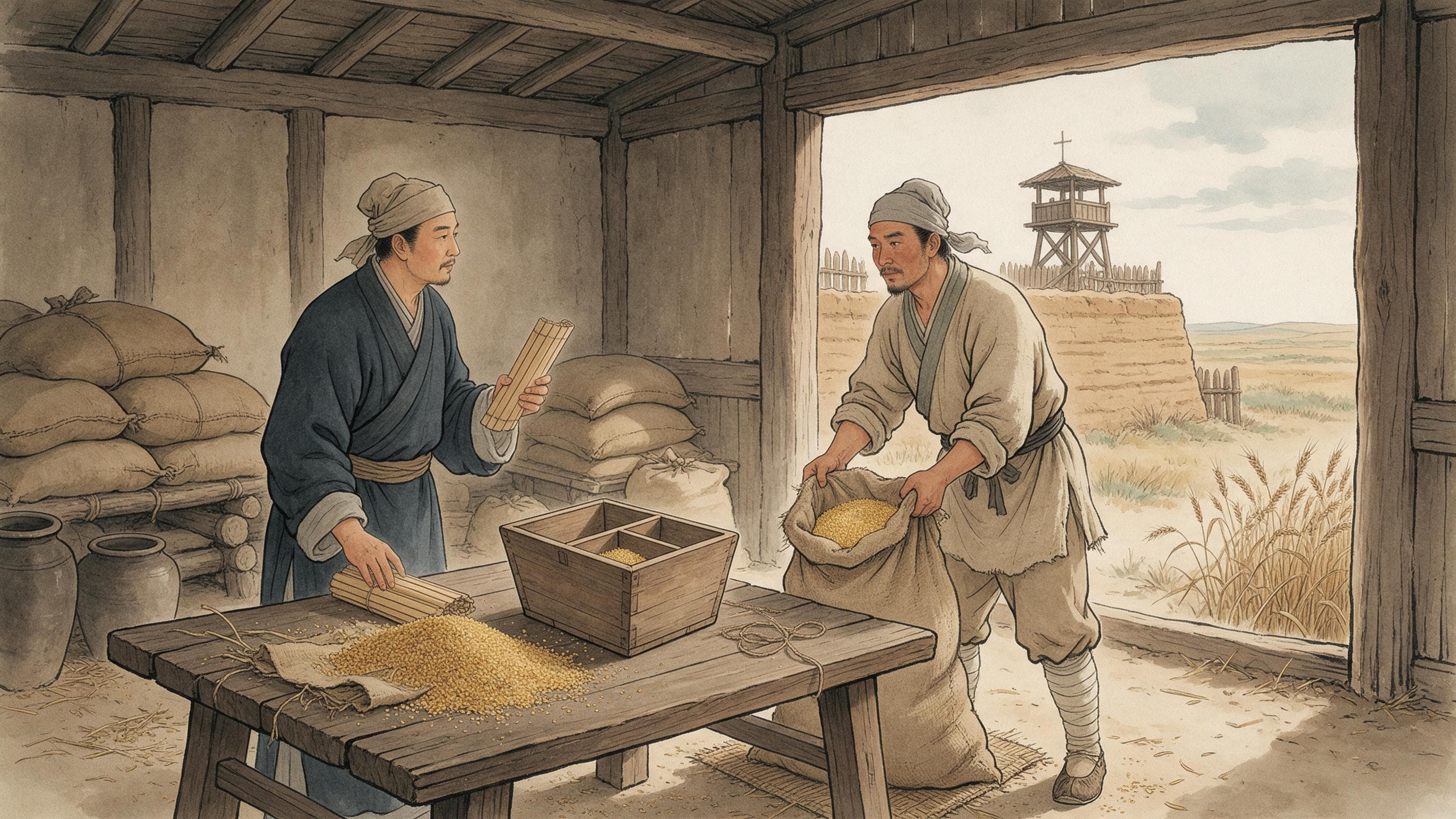
The dates cluster. Most of the watch-post soldiers' entries read 十月癸酉, the guiyou day of the tenth month — a date in the sexagenary cycle, ten stems against twelve branches, repeating every sixty days, so 癸酉 names one particular day and not a season. Yue Shengzhi draws on 十一月戊子; the clerks Guo Dang and Guo Chong on 十二月戊申 and 丙午; the man under penal status on 十一月庚子. The same day recurring that often means this is not a dribble of individual requests but an issue day: on one guiyou in the tenth month, a dozen men came to the store and took their grain. Each line ends 自取, collected himself, so the register records receipt, not delivery; a clerk writing 自取 beside each name was placing the receipt on the man, not on the store. Whether they came at dawn or after noon is not recorded.
One slip, one post, one season
The limits are sharp. What the slip does say is that in the tenth to twelfth months of one year, a set of men at A8 Pochengzi drew their monthly grain to a single standard, on one issue day, in person, and that a clerk wrote it down on a piece of wood still weighing 4.66 grams. What it cannot say is much larger: it is one slip from one post in one season, not the diet of the Han army; family rations, cash substitutions, extra issues and rewards are absent; nor does it record what the grain was carried in or whether anyone signed. Nothing in the catalogue's description mentions a seal, a signature or a tally on the wood. The men's daily life — patrols, night watches, letters home — is not on it at all. A single slip cannot carry an argument; it can only carry a transaction.
The names survive, though: Kong Shengzhi, Xu Chong, Zhao Wangsheng, Wang Nu, Li Shouwang, Yue Shengzhi, Yi Nan, Meng Yanshou, Tao Shengzhi. Two thousand years ago a frontier clerk wrote them on a narrow board to keep an account, and the account is still readable: who drew how much millet, in which month. This is what an empire's bookkeeping sometimes looks like — no speeches, no sentiment, just line after line of a rank, a name, a measure and a date. A register is a peculiar document: it does not narrate, it enumerates, and the clerk's repetitions of one standard are the state's own voice, a standard repeated until it becomes a fact. The slip survives as a receipt for millet issued to named men at a named post — and as proof that a frontier army counted grain down to the sheng and then added a fraction. One question the wood cannot answer: after the grain was carried away, who checked the ledger?
Sources & further reading
- 中央研究院數位典藏與學習聯合目錄「漢簡(簡號:026.021)」 — 释文(《合校》《居延汉简》两本互见)、简形制(长23.5、宽2.8、厚0.3厘米,重4.66克)、出土地内蒙古阿拉善盟额济纳河流域A8破城子、著录于《合校》上册页40与《居延汉简(壹)》页82;释文部分为CC BY-NC-ND 3.0 TW授权,本稿仅作研究引述,不使用其图像
- 《居延汉简甲乙编》电子全文(殆知阁) — 同一份廪食名册的另一版本释文(孔胜之、徐充、乐胜之、桃胜之等行),用于与联合目录释文对读;两本个别字有异(如「郭当/郭常」「马定/厉定」)