In the Tang statutes, a load had a price before anyone agreed to carry it. One hundred jin moved one hundred li cost one hundred wen. Over mountain roads and steep passes the same load fetched one hundred and twenty. A cart carrying a thousand jin was rated at nine hundred. The figures come from the Tang Liudian (唐六典), the Sixfold Statutes of Tang, an administrative code completed around 738, in the section that sets freight rates for everything the government moved by land and water. These are official rates, not market wages, and the gap between the two matters. Still, they record something rare: a state writing down what physical work was worth.
The register came first
Before any of these numbers applied, the state had already placed a person in a category. The same juan sorts the population into four kinds: shi (士), those who study letters and arms; nong (農), those who work the fields; gong (工), craftsmen; and shang (商), merchants, defined as people who slaughter, sell and trade. Then one sentence closes the door: households of craftsmen and merchants may not enter the shi. A living was not a private choice that the government taxed afterwards. It was assigned, and the assignment carried a ceiling.
Households were registered on a three-year cycle and graded by property into nine ranks; an annual accounts book went up through the province to the Board of Revenue. In 734 the register counted 8,018,710 households and 46,285,161 people, a figure the code quotes with its date attached. Adult men, and younger men from eighteen, were entitled by statute to one hundred mu of land — a norm, not a guarantee. The same juan defines kuan xiang (寬鄉), districts with land enough to allot, and xia xiang (狹鄉), districts where the allotment fell short. How strictly the four-kind rule was enforced in daily life is another question, and the code cannot answer it.
One man's year, in cloth
For an ordinary registered household the annual bill came in four parts. Rent: two shi of millet for each adult male. Cloth: two zhang each of damask, tabby silk or coarse silk, according to what the district produced; households paying in hemp cloth added a fifth. Labour: twenty days a year, two more in a leap year. And if the state had no work for him, it took the labour in silk instead — three chi a day, a fifth more in cloth. Twenty days bought out at three chi comes to sixty chi; silk was counted in bolts of four zhang, forty chi, so a man's twenty days were worth one and a half bolts.
Extra service had its own rates. Fifteen added days cancelled the cloth levy; thirty cancelled rent and cloth together. Across all of it, the total obligation was not to exceed fifty days. On paper, a household could trade time against goods, and the same office that collected the goods set the exchange rate.
What the page cannot show is what actually left the threshing floor. The statute gives the legal amount; surcharges, conversion rates and local additions are not recorded here, so the real burden was presumably heavier than two shi and two zhang — how much heavier, this source does not say.
What a load was worth
The freight table is the most concrete thing in the code. A pack of a hundred jin over a hundred li: one hundred wen. Mountain slope or dangerous pass: one hundred and twenty. A cart at a thousand jin: nine hundred. The arithmetic is worth doing. The same thousand jin divided into ten pack-loads would have cost a thousand wen; a cart did it for nine hundred, and that saving is why carts existed. The section even fixes how far a day's work should stretch: a horse seventy li, a walker or donkey fifty, a cart thirty — distances the state used to schedule deliveries.
It also shows the state as a buyer. Grain and goods taken by purchase were to be valued "according to dearness and cheapness, balancing the goods of the empire for the people's benefit" — the language of a fair price, in a document written by the office that set the prices. The administration did not treat market and state as opposites; it treated the market as something to be measured, graded and, where necessary, requisitioned.
What the rate table does not tell us is what a porter kept. These are official freight rates for government cargo; whether private employers paid the same, and what share went to the man under the pole, is unknown. No wage slip survives.
The season in the ledger
Craftsmen were counted on a different principle. The code gives the two great metropolitan workshops: the Palace Workshops (少府監) with 19,850 artisans, and the Directorate of Construction (將作監) with 15,000, recruited from the provinces for strength and skill, with a warning against hiding the able to fill a place with the clumsy, or avoiding heavy work for light. Craftsmen's sons were first in line for vacancies; "once a man has entered the artisan register, he may not enter any other category"; and the finest hands, those whose work served the palace, could not pay money in place of service.
How a day was counted depended on the month. The three summer months and the seventh counted as long work; the three winter months and the first as short work; the second, third, eighth and ninth as medium. A day in June and a day in December were both spent from light to dark, but the ledger did not count them as the same amount of work — presumably because daylight set the working day, though the code does not explain itself. What is missing is the wage. The code shows the state hiring men for cash: in 736 it opened the palace treasury to hire labour for three dykes on the Gu and Luo rivers. It never says what a hired man was paid for a day.
A market that opened at noon
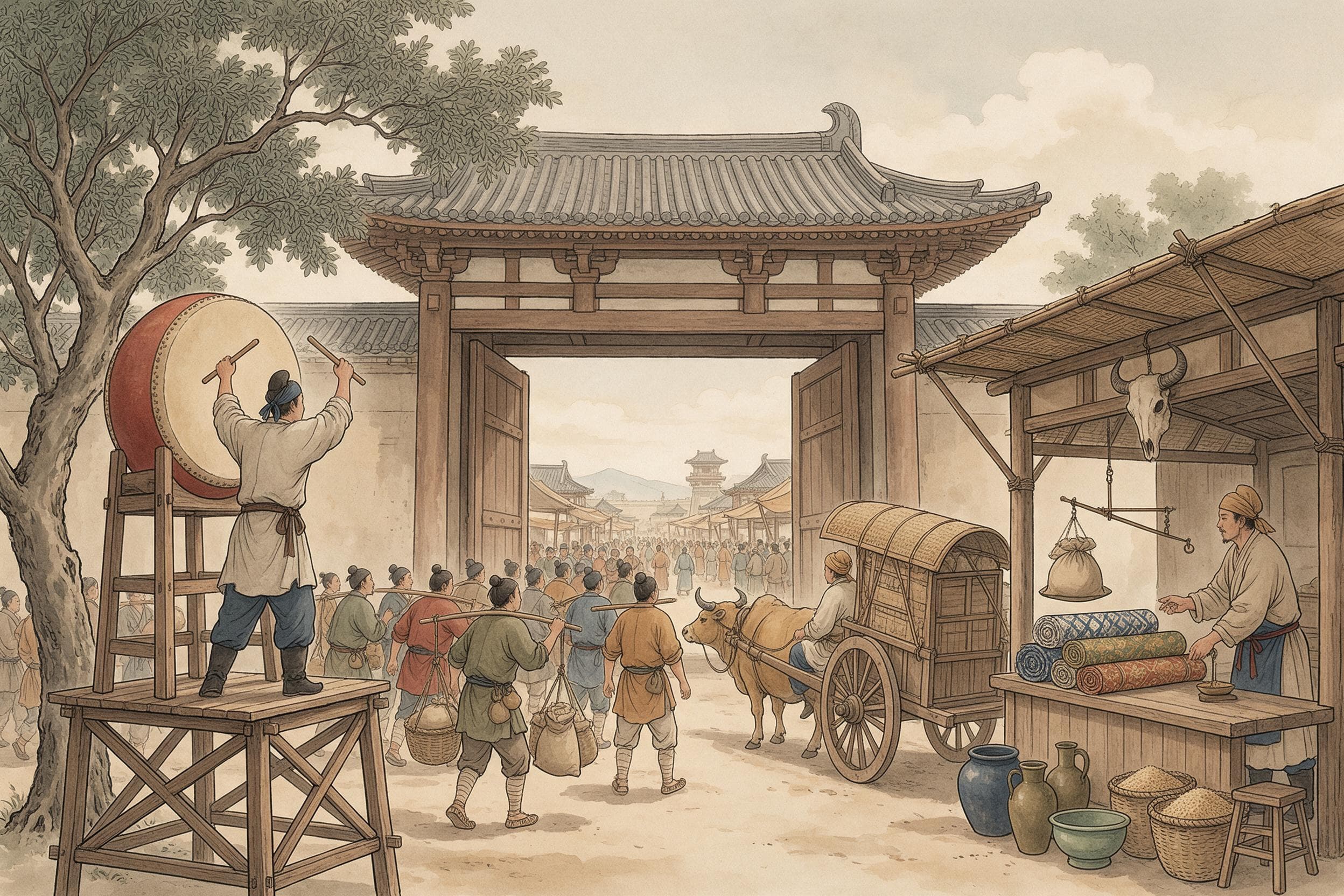
The markets of the two capitals ran on a clock of sound. At noon, three hundred beats on a drum and the crowd gathered; seven ke (刻) before sunset, three hundred strokes on a gong and the crowd dispersed. Inside, goods were graded into three price classes — fine, middling and coarse — and official valuation followed the grade. Every eighth month the weights, scales and measures, public and private, were brought to the market office to be checked and sealed. Goods sold false or short were confiscated; cloth that fell short of measure went back to its owner. Sales of slaves, cattle and horses required an official verification and a written contract.
The city was laid out to match: the two markets filled the space of four wards, in a grid of a hundred and ten. A market that opened at noon and closed at dusk was a half-day institution — and that is exactly what the code describes, the rule rather than the practice. Whether the markets of Chang'an opened at noon every day, and whether buying went on before the drum, this source does not say. Three hundred years later in Kaifeng the bakeries were already at work at the fifth watch; the gap between the two capitals is one of the things a code cannot settle.
The last piece of evidence is a poem. Bai Juyi's "The Charcoal Seller" (賣炭翁) gives an old man whose cart holds more than a thousand jin of charcoal; a palace buyer takes it and ties half a bolt of red gauze and one zhang of damask to the ox's horns as the price. Bai's preface says the poem is about the palace market (gongshi, 宮市), and it is mid-Tang material from the reign of Emperor Dezong — literature, not a price record; the textiles are not a market quotation. But it shows what the statutes cannot: a rate table is only as good as the officer standing beside it. The code could price a load, count a season and grade a household. It never wrote down what the man under the pole took home.
Sources & further reading
- 李林甫等《唐六典》卷三《尚书户部》(Li Linfu et al., Tang Liudian, juan 3, Board of Revenue) — The four classes of subjects, nine grades of households, land allotment, rent–cloth–labour, and the land-and-water freight rates.
- 李林甫等《唐六典》卷七《尚书工部》(Li Linfu et al., Tang Liudian, juan 7, Board of Works) — Artisan quotas in the Palace Workshops and Directorate of Construction, the hereditary artisan register, seasonal reckoning of work, and hired labour.
- 李林甫等《唐六典》卷二十《太府寺·两京诸市署》(Li Linfu et al., Tang Liudian, juan 20, Court of the Imperial Treasury, Markets of the Two Capitals) — Noon drum and sunset gong, three price grades, the annual sealing of weights and measures, and contracts for slaves and livestock.
- 白居易《卖炭翁》,《白氏长庆集·新乐府》(Bai Juyi, "The Charcoal Seller", New Yuefu) — Literary scene of the palace market, used for atmosphere only, not as price evidence.
- Denis Twitchett, "The T'ang Market System", Asia Major 12.2 (1966): 202–248 (Denis Twitchett, publications list) — The author's publication list; the article itself is not on this page, but the entry gives the full citation for further reading.