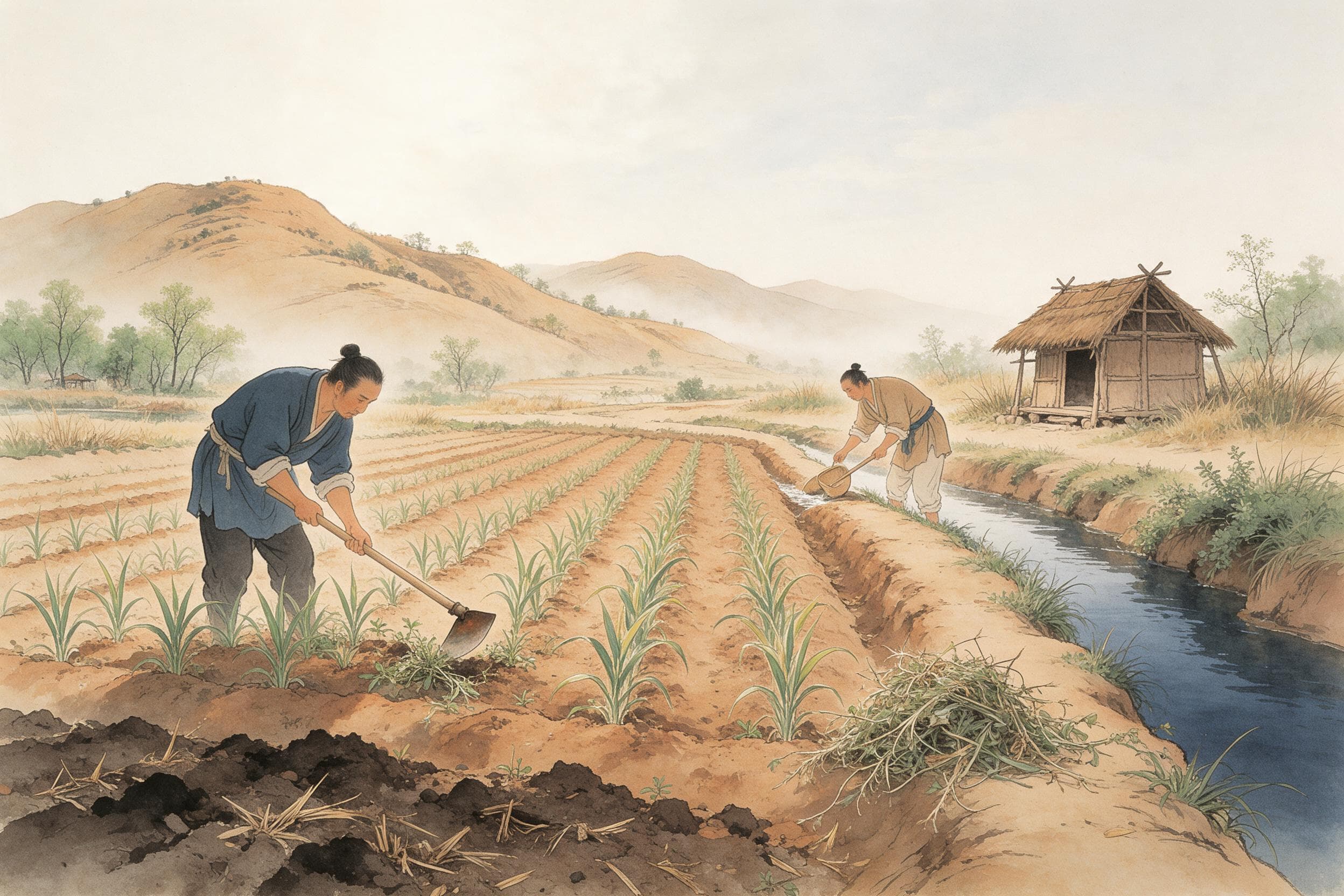
Start with a hoe in a field. The Zhou hymn Liang Si describes the work before the harvest: "Its hoe is sharp; with it they cut the weeds; the weeds rot and the millet flourishes." Two lines carry a whole logic of soil care: weeds were cut not only so they would stop stealing nutrients, but so that they would go back into the ground.
Weeds as fertiliser
The verbs are exact: hao (薅), to pull or cut; xiu (朽), to rot in place; mao (茂), to flourish. This is the most direct early record of cutting weeds to rot as fertiliser, from the Zhou hymns, dated roughly to the Western Zhou or early Spring and Autumn. The preface calls the hymn a sacrifice of thanks to the earth god after harvest, so it is farm work in poetry, not an agricultural manual.
One poetic line cannot carry a system, but it can show one thing: people already understood that weeds were not simply enemies. Left in the field, they were useful for the next season.
Land as something adjustable
The chapter opens with a string of questions put into the mouth of Hou Ji, the culture hero of farming: can you turn a hollow into a ridge? Can you hide what is bad and welcome what is moist? Can you keep the soil still while the drains work? Can you stop the weeds from spreading? Can you make the whole field catch the cool wind? The questions are rhetorical, but they set the agenda of the chapter: water, salt, weeds, wind and the size of the grain.
The late Warring States Lüshi Chunqiu, in the chapter "Working the Land", turns this into a principle: "The great rule of ploughing: the hard should be made soft, the soft made hard; the rested should be worked, the worked rested; the poor should be made rich, the rich made poor; the tight should be loosened, the loose tightened; the wet should be dried, the dry wetted."
The same chapter says it more plainly still: "Land can be made fertile, and can be made exhausted." Fertility stops being a gift of nature and becomes something to manage — direction set by the farmer, method set by observation.
How deep, and how to check
The method was repetition: "Five ploughings and five hoeings, done thoroughly. As for the depth of planting, the dark soil must be reached. Then the great weeds do not grow, and there are no pests." The test of deep tillage is that the lower, moist subsoil is brought up; the result is clean fields and fewer insects.
The tools are given dimensions: a plough six chi long and eight cun wide, to make the furrow; a hoe handle one chi with a blade of six cun, for thinning the crop. Those figures are Warring States, not Spring and Autumn. But "five ploughings" and "reach the dark soil" already say clearly what these farmers wanted: fertility was not only at the surface, and turning the soil was how to bring it up.
Kill the weeds by season; burn, then water
The Zhouli gives the weed-killer, Ti Shi (薙氏), a four-season schedule: in spring, when the weeds sprout, cut them; at the summer solstice, mow them close to the ground; in autumn, when they set seed, cut them again; at the winter solstice, turn them under with the plough. The calendar is itself the method: never let the weeds mature, never let them seed, and put them back into the soil.
Zheng Xuan's Han-dynasty commentary adds a step: "If you want it to transform, burn the weeds you have cut, and then water the ground, and the soil will be harmonious and fine." Fire gives ash; water ripens the soil. That is the closest the sources come to a described method of "transforming" earth — and it belongs to the Zhouli's ideal offices, not to Spring and Autumn fields.
What cannot be put in
Three things are left out because no quotable original could be opened for this piece: the Zhouli chapter on the "agriculturalist" and its "method of transforming soil" (the pairing of hard soils with cattle and red soils with sheep, known only from secondary paraphrase); the reading of that method as soaking seed in animal-bone broth, which is a later interpretation and disputed; and the archaeology of the iron plough, for which no formal report was available.
The dates must also be kept apart: the Shijing hymn is Western Zhou to early Spring and Autumn; the Zuo Zhuan records Spring and Autumn events but was compiled later; the Zhouli is a Warring States ideal of offices; the Lüshi Chunqiu is a late Warring States summary of agronomy. They cannot be blended into "how people farmed in the Spring and Autumn period".
What does stand is this: early Chinese farmers managed fertility with a technique of observation and timing — weeds left to rot in the field, soil treated against its own condition, deep ploughing to bring up the subsoil, cut weeds burned and then watered so the earth would "transform". There was not yet a manure regime, and not yet a farming manual: the land was fed by timing rather than by carts of dung. But the idea of feeding the land was already in a hymn, in a code of offices and in a summary of agronomy.
Sources & further reading
- 《诗经·周颂·良耜》(Shijing, Zhou Hymn, "Good Plough") — The line 'the hoe cuts the weeds; the weeds rot and the millet flourishes', in a hymn the preface calls a harvest sacrifice.
- 《吕氏春秋·任地》(Lüshi Chunqiu, "Working the Land") — The five pairs of soil conditions to be adjusted, 'land can be made fertile and made exhausted', five ploughings and five hoeings, the subsoil test, and the dimensions of plough and hoe.
- 《周礼注疏》卷三十七·秋官·薙氏 (Zhouli Zhushu, juan 37, "Ti Shi") — The four-season schedule for killing weeds, and Zheng Xuan's note that burning the cut weeds and then watering them makes the soil 'harmonious and fine'.