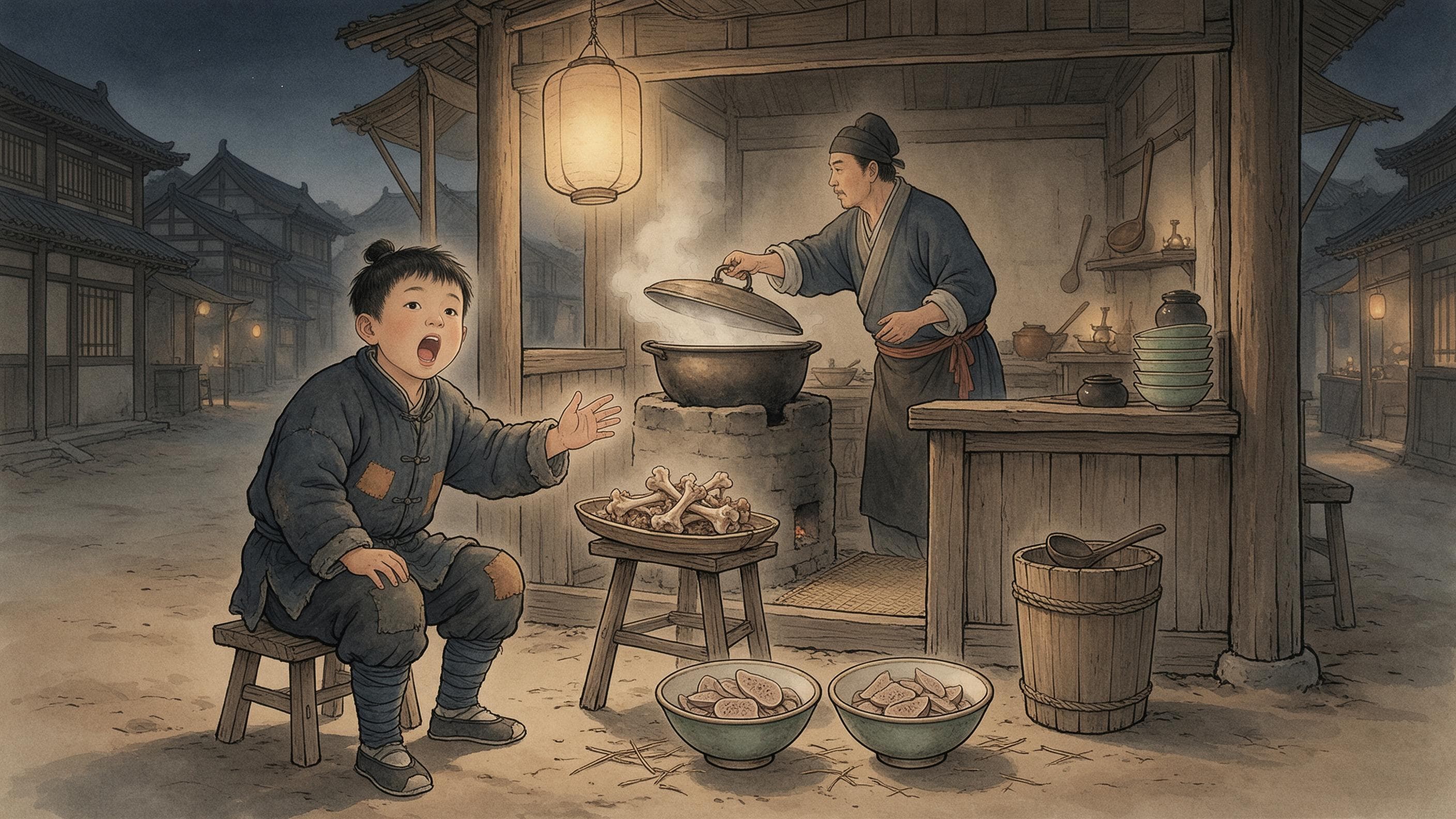
Before daylight in the last decades of the Northern Song, a boy sat at the door of a gourd-soup shop in Kaifeng calling out that there were bones to be had. The shop sold hu geng (瓠羹), soup made from bottle gourd; the cry was rao gutou (饶骨头), bones thrown in, and beside him now and then appeared guan fei (灌肺, stuffed lung) and chao fei (炒肺, fried lung). It is one line in Meng Yuanlao's Dongjing Meng Hua Lu (东京梦华录), and it says what a menu cannot: breakfast in the capital around 1102 to 1125 was not cooked at home. It was a city trade that started in the dark.
The city woke to a wooden fish
What woke Kaifeng was not a rooster. At the fifth watch, runners from the monasteries struck iron plaques or wooden fish and walked the lanes assigned to them, announcing dawn; those bound for court or market rose at the sound, and the gates, bridges and markets were already open. The fifth watch began around three in the morning by the watch system's arithmetic — an extrapolation, since the book gives no clock time.
Nor was the morning market a separate event. The night trade ran until the third watch and reopened at the fifth, and in the busiest quarters never closed. At the Panlou market the sequence is recorded: used clothes and curios at the fifth watch; at first light sheep's heads, tripe, kidneys, game, crab and clams; then craftsmen buying seasoning; and only after the morning meal did the sweets come out. Breakfast sits between daybreak and that meal.
A hundred ovens before daylight
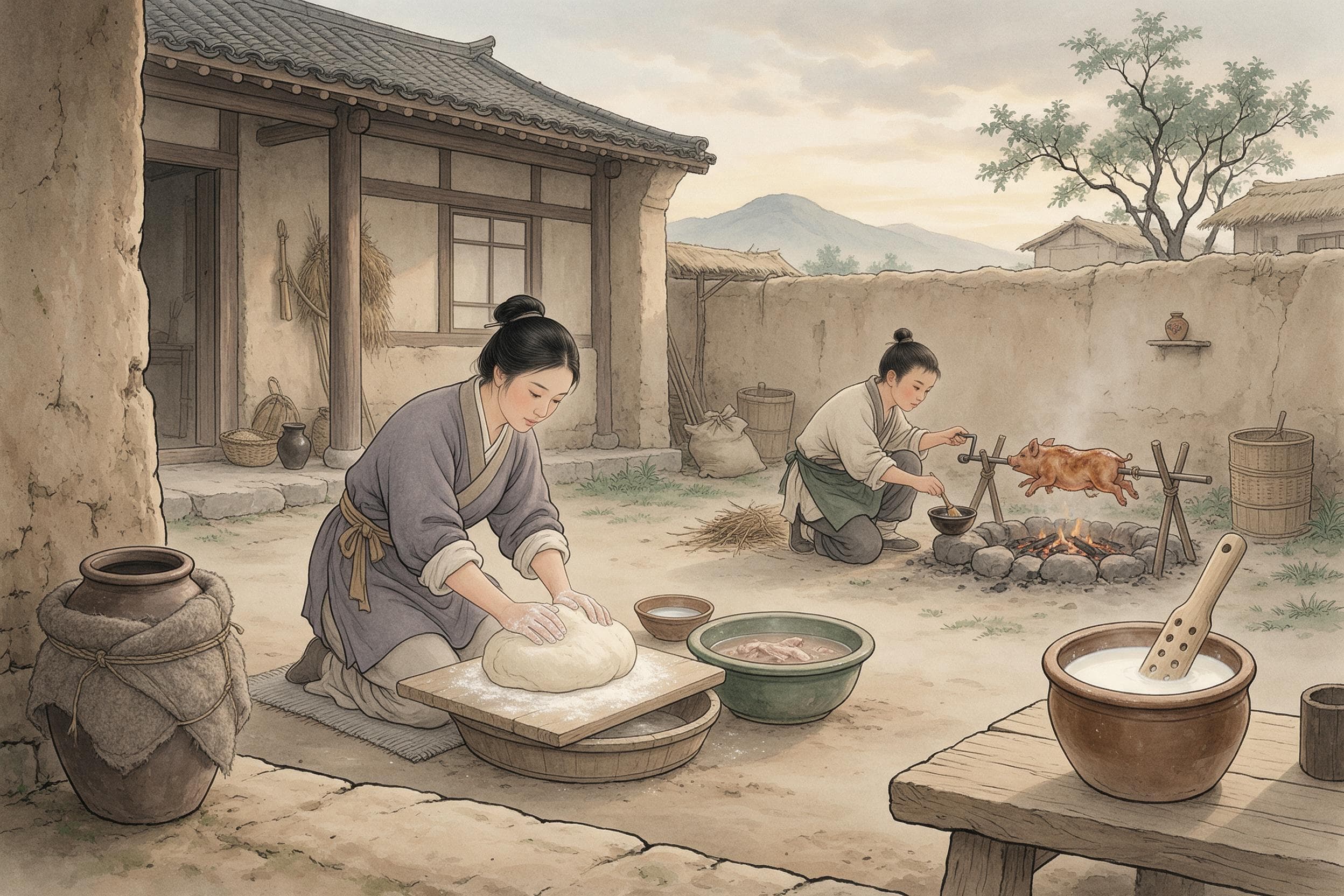
Bakeries propped it up. Meng divides them into oil-cake shops, selling steamed cakes, sugar cakes and layered trays, and hu bing (胡饼) shops selling a longer list of oven breads named by shape and cut. Bing was the umbrella word for wheaten food, with a dozen named kinds at least — and the signs did not match the goods, since the shops called oil-cake were the ones selling steamed and sugar cakes.
"Each board took three to five men to roll the dough, cut the patterns and load the ovens. From the fifth watch the sound of boards being set up could be heard near and far." — Meng Yuanlao, juan 4
The Zhang family by the Temple of the Martial King and the Zheng family by the Huangjian Monastery each ran more than fifty ovens; another passage gives the Zheng oil-cake shop at Desheng Bridge twenty-odd. Whether the two Zhengs were one house cannot be settled, so they should not be merged.
A bowl, a name, a price
Named shops lined the Imperial Street and Zhou Bridge: Wanglou Shandong Plum Blossom Buns, the Li family's incense shop, Old Woman Cao's meat pies, Li Si's fen cha (分茶, a large food shop), and the Lu family's buns west of the corridor. The meaning of "Shandong" there is unclear and is left standing. Further out, the Shi family's gourd soup and the Wan family's buns were called the best in the capital. Since 2018 the bridge itself has been excavated, and its stone revetments carry carved seahorses and cranes, as the book says — one of the few claims in it that archaeology can check.
Prices survive too. In the big food shops, soup and meat came in pale blue glazed bowls, bi wan (碧碗), at ten cash a bowl; half noodles and half meat was a he geng (合羹), a half portion a dan geng (单羹). The morning wine houses kept lamps burning, sold wine at no more than twenty cash a portion, and served rice, porridge and dianxin (点心). That last word matters: dianxin already meant morning-market food here, closer to "a bite with your drink" than to a pastry.
The nearest figure for the small food itself is the Zhou Bridge night market, where buns of goose, duck, chicken, rabbit, tripe, lung or eel, plus chicken skin, kidneys and chopped chicken, went at no more than fifteen cash apiece — a night price, an upper limit, not a breakfast bill.
And the money is where modern arithmetic goes wrong. Kaifeng counted in mo (陌), nominally a string of a hundred cash; officially it held seventy-seven, on the street seventy-five, in the fish, meat and vegetable trade seventy-two. On one street the "hundred" was shorter at the butcher's than at the bakery, and a string never delivered what its name promised.
Stack those up and a bowl of soup with a portion of wine lands between ten and twenty cash — an estimate, since no meal total is recorded. The book supplies the contrast too: outside the palace's East Gate, a new pair of aubergines or gourds could fetch thirty to fifty strings, bought up by the palace kitchens. That was rarity for officials, not what a carter paid.
Bread by another name
The word chui bing (炊饼) needs care. Wu Chuhou's Qingxiang Zaji records that since Emperor Renzong's personal name, Zhen (祯), sounded close to zheng (蒸, steamed), "within the inner court and above and below, steamed cakes are now called chui bing." The subject is the palace. In Meng's Kaifeng book the word is always zheng bing (蒸饼), sold by the bakeries and stocked overnight in the markets, and chui bing never appears. The palace avoided a taboo sound and later notebooks carried the substitute word; it cannot be pushed back onto every bakery in Kaifeng.
Buns and steamed breads already had separate names: baozi (包子) and mantou (馒头) sit side by side as shop names, so the capital distinguished two kinds of filled wheaten food; what went inside is not recorded, and Lin'an sources cannot fill the gap. Stuffed and fried lung were cheap offal. Whether the "oil cakes" were deep- or pan-fried is an inference from the name.
Who fed the city by sunrise
The trade was fed through the city gates. Flour was weighed into cloth bags, a bag called a wan (宛), and hauled in from mills outside the walls by ox-cart, mule or donkey "without a break until daylight." Pigs came in each night in herds of ten thousand or more, driven by a dozen men. Fruit was wholesaled at the guozi hang (果子行) outside the Zhuque Gate. Breakfast was priced at the gates and on the canal docks.
Tax policy pushed it down further. Transit tax ran at twenty cash per thousand, market tax at thirty; in 1108 the capital's gates were ordered to exempt clothing, grain, poultry, fish, vegetables, fruit, firewood, charcoal and pottery, and in 1125 oil, charcoal, flour and cloth.
Three kinds of people ran the business. Bakeries were workshops; the fen cha, gourd-soup shops and wine houses were fixed premises, and with seventy-two licensed great wine houses in the capital, everything else was a jiao dian (脚店) buying wine wholesale; below that, hawkers. Merchants paid a guild levy in place of official requisitions, hiring went through guild elders and matchmakers. Women appear by name: Old Woman Cao at the meat pies, and the jun zao (焌糟) women with blue patterned sashes and high coiled hair, changing the soup water and pouring wine among drinkers. Most stallholders were probably small city households or migrants, though that is inference.
Meng admitted the limits himself: the capital was vast, there were places he never visited, and hearsay left gaps. The gaps show. Porridge appears only as "rice and porridge," with no varieties — the seven-treasure porridge is Southern Song Lin'an. Food shops did serve noodles, but the morning record lists rice, porridge, snacks, wine, gourd soup and lung, and never a dawn bowl of noodle soup. What went into the buns, how stalls were policed, who paid for the ground in front of a shop: unwritten. Which leaves a plain question. The three or five men rolling dough at the fifth watch — where did they eat their own breakfast that day?
Sources & further reading
- 孟元老《东京梦华录》卷三·天晓诸人入市、都市钱陌、雇觅人力 — 报晓、早市品类与开张顺序、短陌折算、行老雇工的第一手记载
- 孟元老《东京梦华录》卷四·饼店、食店 — 饼店品类与五更开工的规模、分茶食店的碧碗与「每碗十文」
- 孟元老《东京梦华录》卷二·御街、州桥夜市、东角楼街巷、饮食果子、酒楼 — 御街—州桥字号店、夜市熟食单价、正店与脚店分级
- 吴处厚《青箱杂记》卷二·俗语承讳 — 「蒸饼」因避仁宗讳在内庭改称「炊饼」的出处
- 脱脱等《宋史》卷一八六·食货志下八·商税、市易 — 过税/住税税率、京师城门免税、免行钱
- 国家文物局「考古中国」:北宋东京城州桥遗址(2022年9月28日发布) — 州桥石壁浮雕印证《东京梦华录》「石壁雕镌海马水兽飞云之状」