At Yinxu, the late Shang capital near present-day Anyang in Henan, tomb 49 at Baijiafen West, area B, was a small pit grave. It held 385 shells. It was not a royal burial: the excavation report classes it among the small and medium tombs it calls commoners' graves. The shells were grave goods, put into the ground with the dead.
From 385 to 6,800
Shells were not rare in such graves. Of 939 small and medium tombs in the western district of the cemetery, 340 had shells buried in them; of 302 small and medium tombs excavated between 1958 and 1961, 83 did. These are two separate batches with two separate totals, and the report does not add them together; 340 of 939 and 83 of 302 are also not one percentage. The report does not even say whether all 385 in tomb 49 were cowries. What the figures do show is plain: in a commoner's grave, shells were worth burying.
The largest count from the site comes from a very different grave. Fu Hao's tomb, the burial of a consort of King Wu Ding, yielded more than 6,800 shells — a figure taken from the excavation report as the press reports it, not from a page of the report itself. Set beside 385 from tomb 49, the two numbers mark the distance between a small grave and a royal one; the report draws no such comparison, so the link is inference, not record. It also says nothing about the shells' condition, their source, or how they were arranged in the tomb. Those blanks stay blank. The same site, the same object, and a gulf between two graves. Yinxu is inland, and the shells are marine; how they reached the capital is a further blank.
The peng and the king's gift
Shells were counted, and the unit was the peng. Oracle-bone and bronze inscriptions use the word in counting shells; Wang Guowei argued that ten shells made one peng. That is a cited opinion rather than a settled figure — scholars have counted differently — and this article does no more than record his. What matters is narrower: a peng was a unit for counting shells, and shells could be numbered by it. The word appears in oracle-bone inscriptions and in bronze inscriptions, which is why the unit is treated as a real measure of shells rather than a later guess.
The clearest use of shells is reward. The inscription on the Shusi Ding, a vessel of the late Shang, records that in the ninth month, on the day bingwu, the king, in the great hall of the ancestral temple, awarded Shi Sizi twenty peng of shells, and that Shi Sizi had the vessel cast to honour his father. The inscription records the gift and the casting, not any value for the shells. A Western Zhou bronze, the Jubo Huan gui, records 'ten peng and four peng' — fourteen — used for making the vessel; it is an early Western Zhou object, useful only as evidence that shells could pay, and not to be counted as Shang.
The shell cast in bronze
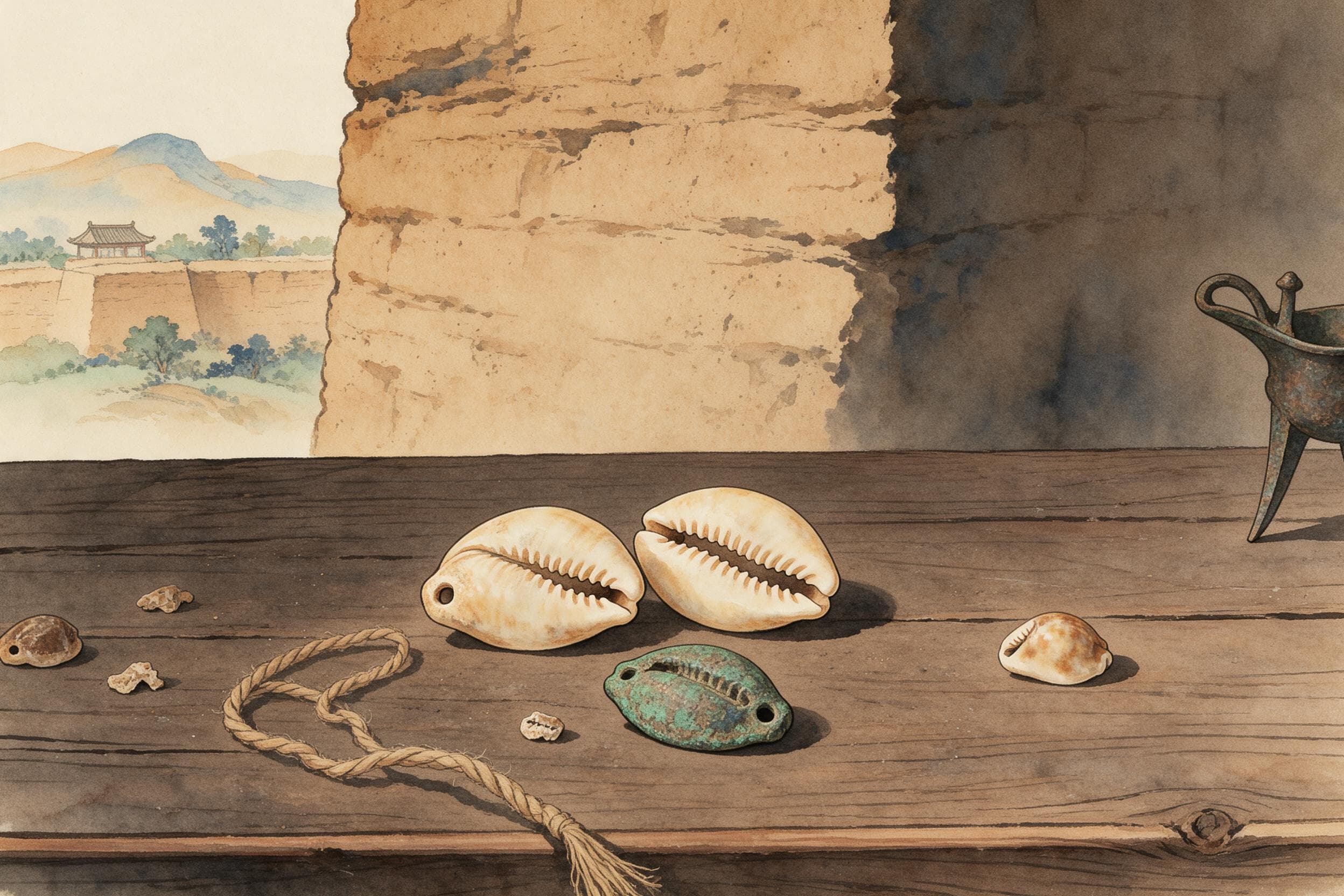
The shell was also cast in metal. The National Museum of China's note on a plain bronze imitation cowrie says such pieces occur in mid-to-late Shang tombs and copy several kinds of sea-shell; the hole at the back grew over time, from a small opening at one end — the 'small-hole' type — to a worn-back form. The piece illustrated on the museum's page is itself a Spring-and-Autumn object, not a Shang one. The note describes the change in the hole as an evolution over time, but gives no dates for it. The note adds that bronze cowries were used 'not only as money but also as ornaments'.
What the note does not give is a site, a number of tombs, or a number of pieces. No excavation report on a Shang bronze cowrie was available for this article; the museum note describes an object, not a site. So the sentence that can be written is that they appear, not that they were common: a bronze shell in a mid-to-late Shang grave shows the shape of a shell had been cast in metal by then; it does not show a workshop, a volume, or a currency. The museum page also makes a claim about priority for the type; that is left out here, because a ranking is not a count.
The Han look back
The written statements that treat shells as money come from much later. In the Shiji's chapter on the balance of the market, Sima Qian opens by saying that the currencies of shell, gold, knife and cloth go back so far that before the time of Gao Xin 'there is no record'; he lists shell and turtle-shell among the currencies of Yu and Xia, and says that Qin demoted 'pearls, jade, turtle-shell, shells, silver and tin' to ornaments and treasure, no longer money; the same passage describes Qin's two-tier coinage, gold by the yi above and the half-liang bronze coin below. That is a Western Han man describing remote antiquity, not a Shang record. In the Shangshu's 'Pan Geng, middle', the king rebukes officials who 'collect shells and jade' — a transmitted text, not a Shang original, but one that puts shells and jade in the same class of treasure.
From these pieces something can be said: shells were valuable, countable, given by kings, buried with the dead, and worth imitating in bronze — they carried part of the work of money, though no text measures what part. Whether they were legal currency, and whether ordinary buying and selling was priced in them, is debated, and the sources do not settle it. The question is left open here.
What the shells cannot tell us
What the sources never give is a price. There is no Shang record that anything — grain, cloth, a slave, a horse — was worth so many shells. No wage, no rate of exchange between shells and bronze, no account of a purchase made in shells. The purchasing power of a peng is not hidden somewhere in the evidence; no text states it. A price has to be written down; a grave records only a quantity. Nor is there a total for all the shells ever dug at Yinxu, or a source area for the sea-shells; both are missing from this article because no citable page for them was found.
So the account stops at quantities. 385 shells in one small grave; 340 of 939 and 83 of 302 graves with shells; more than 6,800 in a royal consort's tomb; twenty peng from a king's hand; a bronze shell that appears in a tomb but cannot be counted. Shells were counted, buried, awarded and imitated. What one peng could buy, the Shang did not write down — and the honest answer is that we do not know.
Sources & further reading
- 司马迁《史记》卷三十·平准书(太史公曰)(Sima Qian, Shiji, juan 30, 'The Balance of the Market') — Western Han retrospective on early coinage: shell and turtle-shell listed among the currencies of Yu and Xia, and demoted by Qin to 'ornaments and treasure, no longer money'; the same passage describes Qin's two-tier coinage. Not a Shang-period record.
- 《尚书·盘庚中》(Shangshu, 'Pan Geng, middle') — Pan Geng's speech rebuking officials who 'collect shells and jade'; a transmitted text, not a Shang original, but it pairs shells with jade as treasure.
- 李林、杨之甜〈看三千多年前「在商言商」〉,《河南日报》2024-11-09(中国青年报客户端转载页,非原刊版面)(Li Lin and Yang Zhitian, 'On business in Shang times', Henan Daily, 9 Nov 2024; reprint page on the China Youth Daily client, not the original print edition) — Archaeological reporting, not an excavation report: 6,800+ sea-shells from Fu Hao's tomb; 340 of 939 small and medium burials in the western district with shells; 83 of 302 excavated in 1958-1961; 385 shells from tomb 49 at Baijiafen West; shells counted in peng with Wang Guowei's ten-to-a-peng; the Shusi Ding inscription recording twenty peng awarded; the Western Zhou Jubo Huan gui with 'ten peng and four peng'.
- 中国国家博物馆·藏品·无文铜仿贝(National Museum of China, collection note on a plain bronze imitation cowrie) — Museum collection note, not an excavation report: plain bronze imitation cowries occur in mid-to-late Shang tombs and copy several kinds of sea-shell, the string-hole growing from a small opening to a worn-back form; the piece illustrated is itself a Spring-and-Autumn object. The page's 'earliest metal coinage' ranking claim is not used.