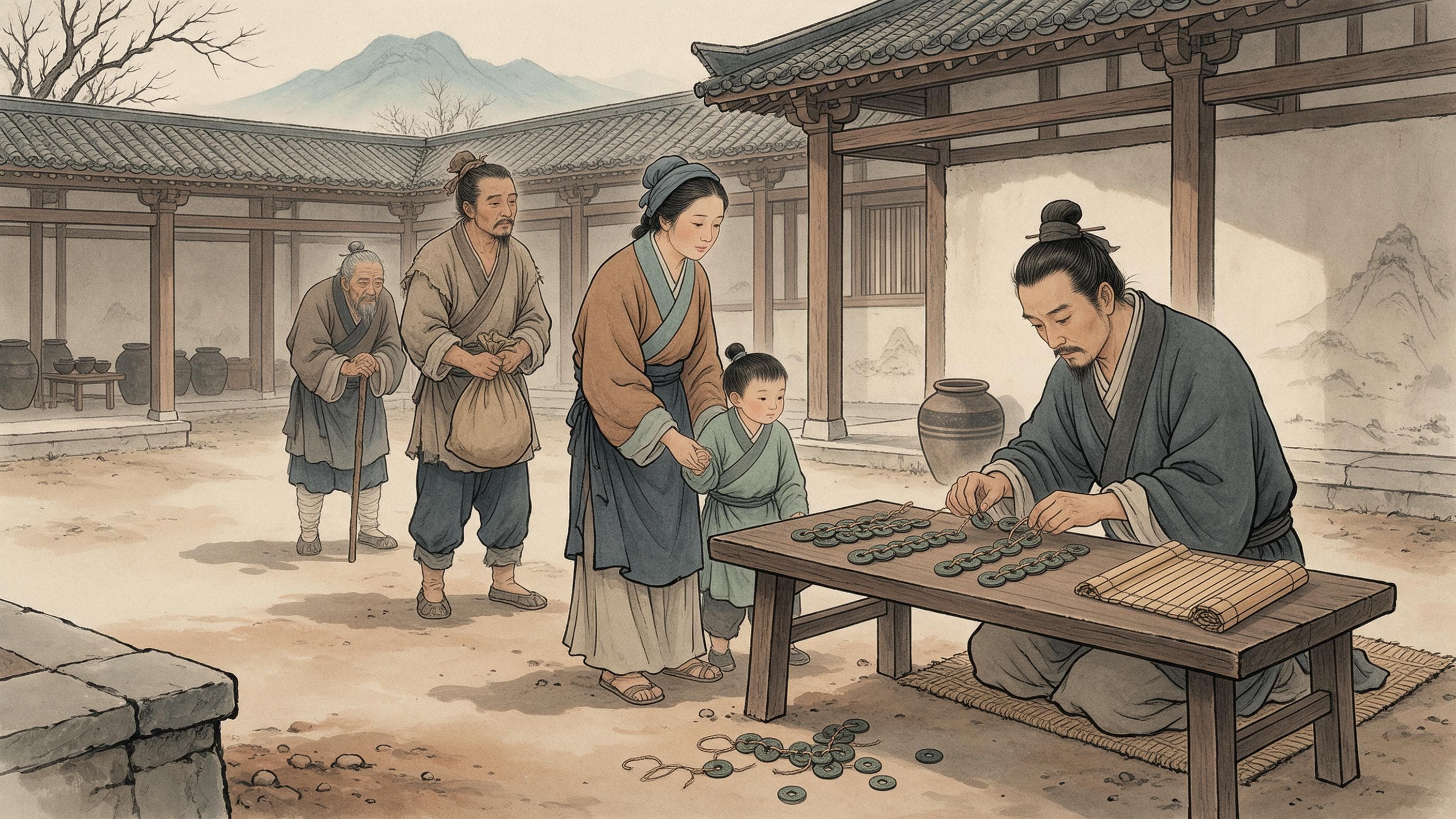
In the tenth month of 485 — so the Northern Song chronicle dates it — the Northern Wei court issued an edict to 'allot the fields of the realm to the people'. What followed was a table: 'For every male over fifteen, forty mu of open field; for a woman, twenty; for slaves, the same as free persons. For each ox, thirty mu, up to four oxen.' The state had written down who should have how much land, item by item, in rows that could be checked. Slaves were entered at the free standard, a detail the tax would treat quite differently the following year.
Forty mu, twenty mu, thirty mu
The table then doubles itself. 'The land granted is, as a rule, doubled; for land that must be rested three years, doubled again,' to provide for tillage and for the balance of return and regrant. Du You's gloss explains the name: land without planted trees was 'open field'. The Tongdian reads the purpose as 'tillage and fallow'; the Wei shu has only 'tillage'. The character differs, the meaning is the same. Whether 'doubled again' means three times the base or four, neither book says, and this article does not compute it.
Nor was the grant a promise. In districts where land was scarce the edict itself writes the discount: 'take the family's mulberry land as the principal holding; if still insufficient, grant no doubled field; if still insufficient, reduce each person's share within the household.' Land came back when the holder grew old or died — 'those who reach the tax age receive land; those exempted by age, and the dead, return it' — and slaves and oxen followed their presence or absence. Return and regrant came 'always in the first month'; a man who died just after receiving land, or who bought and sold slaves or oxen, waited for the following first month. The open field was lent, not given.
Mulberry land: fifty trees
Mulberry land followed a different logic. A man receiving land for the first time got twenty mu for mulberry, on which he was to plant 'fifty mulberry trees, five jujubes and three elms'; where the soil would not carry mulberry, one mu for elms and jujubes instead. The deadline was three years: 'if not finished within three years, take away the part not finished.' The twenty mu were not an extra grant — the edict says mulberry land 'counts within the doubled field' — which is the clause a careless reader turns into double allotment.
Mulberry land was also the one holding that stayed. 'All mulberry land is hereditary property, not returned at death'; it passed with the living household. A family with too much could 'sell the surplus', one with too little 'buy what is lacking', but no one might sell below his share or buy beyond it. Everything else was lent: the open fields returned, the hemp fields returned, and the mulberry plot was the exception that makes the rule visible. The permission to sell the surplus and buy the lack is a market in a narrow band around the share, not a land market.
Hemp, house plots, official fields
Hemp land was its own category, for districts that grew hemp rather than mulberry: ten mu for a man liable to tax, five for a woman, slaves at the free standard, all 'subject to the law of return and regrant'. The table also had rows for people who could not farm a full share: those over eleven and the crippled received half a man's field, those over seventy kept what they had, and a widow who remained unmarried received a woman's field even though she was exempt from tax. These are the units a household register lists — men, women, slaves, oxen — and the same units the tax would count the next year.
House plots were counted separately: three persons to one mu, five slaves to one mu. And the officials had their own table, not to be added to the villagers': a governor fifteen qing, a prefect ten, a deputy eight, a county magistrate and a commandery assistant six, handed on when one officer replaced another, and anyone who sold such land was punished under the statutes. The figures run from forty mu to fifteen qing, and each row is its own account.
The tax came a year later
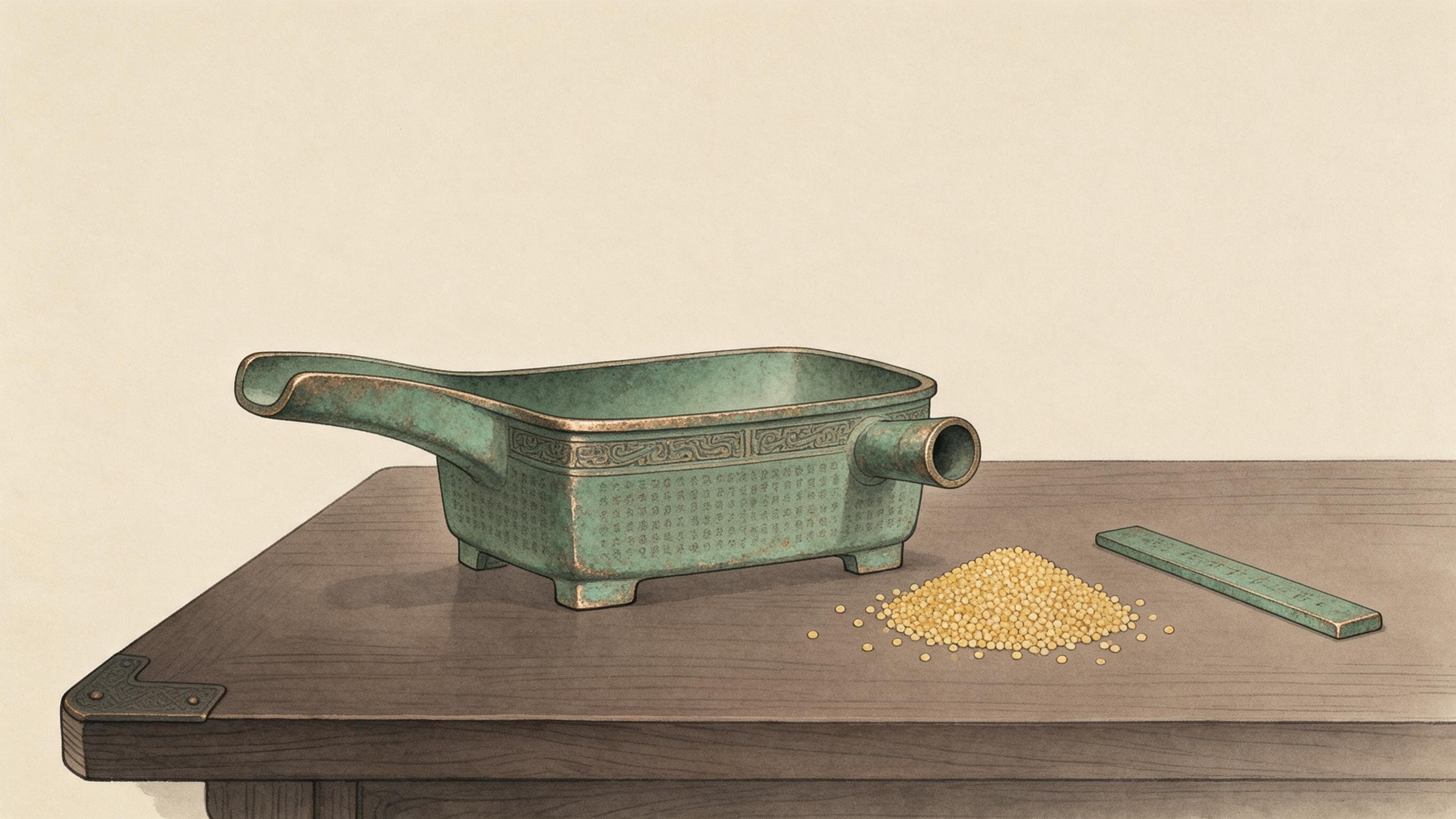
The tax came the next year, in a second document. In the second month of 486 the court 'first established the party, hamlet and neighbourhood chiefs and fixed the household registers'; with that came the new levy: 'for one man and wife, one bolt of silk and two shi of millet.' An unmarried man paid a quarter of that; eight slaves who ploughed and wove counted as four unmarried men; twenty oxen as eight slaves; in hemp-growing districts, one bolt of cloth instead of silk. The land edict and the tax edict are a year apart, and two documents. The levy falls on the couple, not on the field.
The same chapter sets the new figures against the old: before the change, a household had been assessed in nine grades and paid two bolts of silk, two catties of floss, one catty of silk thread and twenty shi of millet; now it added three bolts and two shi nine dou 'for the salaries of officials'. The increase was levied to pay officials, not to change the land schedule. Money is a separate line. Until Taihe, 'coin and goods did not circulate'; only in 495 was the Taihe five-zhu cast and current in the capital and the garrisons, and officials' salaries were reckoned at two hundred cash to the bolt of silk — an official rate, not a market one.
The account and the land
One thing the edict does not say is 'equal-field system'. The words jun tian do not occur in the Wei shu chapter at all; the edict's phrase is 'allot the fields of the realm to the people'. 'The equal-field system began here' is the Tang scholar Du You's summary, in the Tongdian; the chronicle that dates the edict to the tenth month is Northern Song, five centuries later. The name is later than the document.
What the documents give is a schedule, not a record of delivery. There is no register of who actually received forty mu, no household count, no account of how any district carried it out; the mu are left as mu, with no conversion. The land edict and the tax edict are two documents a year apart, and this article keeps them apart. What can be said is what the state wrote down: a man's forty mu, a woman's twenty, an ox's thirty, a mulberry plot that never went back, a return every first month, and a tax in silk and millet that arrived the following year. Whether the fields were measured out as written, the sources do not say.
Sources & further reading
- 魏收《魏书》卷一百一十·食货志(附卷七下·高祖纪下)(Wei Shou, Wei shu, juan 110, 'Food and Money', with juan 7b, Annals of Emperor Gaozu) — Main text of the 485 edict: 40 mu of open field for a man over fifteen, 20 for a woman, slaves at the free standard, 30 mu per ox up to four oxen; doubled fields for fallow; 20 mu of mulberry land with 50 mulberry, 5 jujube and 3 elm per man, heritable, forfeited if not planted within three years; 10/5 mu of hemp land; return and regrant always in the first month; official fields from 15 qing for a governor down to 6 for a county magistrate. The 486 household levy (one bolt of silk and two shi of millet per couple) is a separate document, as is the 495 Taihe five-zhu coinage. The annals, juan 7b (https://zh.wikisource.org/wiki/魏書/卷7下), record the second month of 486 when the party, hamlet and neighbourhood chiefs were first established.
- 杜佑《通典》卷一·田制上 (Du You, Tongdian, juan 1, 'Land System') — Tang compendium: contains the phrase 'the equal-field system began here', Du You's summary rather than the edict's own words; glosses open field as land without planted trees; explains doubled fields as provided 'for tillage and fallow and for the give and take of return and regrant' (the Wei shu reads 'tillage' where the Tongdian reads 'tillage and fallow').
- 司马光《资治通鉴》卷一百三十六 (Sima Guang, Zizhi tongjian, juan 136) — Northern Song chronicle, five centuries later: dates the edict to the tenth month of 485, records Li Anshi's proposal from which the discussion began, and notes the 486 three-chieftain household registration. Its use of 'equal-field' is the chronicler's wording, not the edict's.