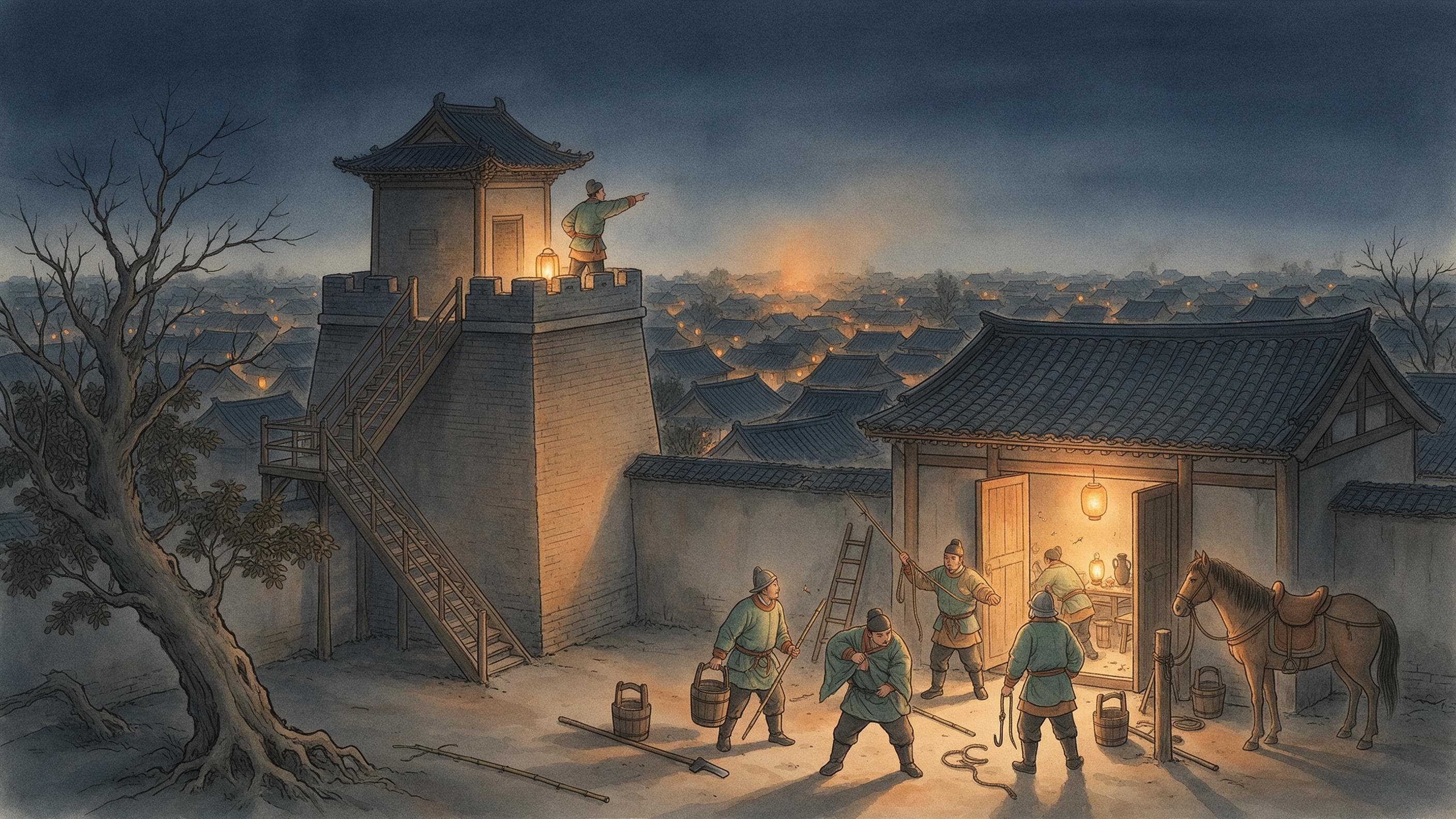
At the third point of the first watch, near eight in the evening by one reckoning, the great bell's last note died away over Beijing and the streets became illegal. Anyone walking after the sound had gone, or before the third point of the fifth watch, faced thirty strokes of the cane; in the middle watches, fifty. Only urgent official business, illness, childbirth or a death in the family excused a man. The rule is statute, not opinion, and it binds both sides: a night patrol that detained an innocent man as a curfew-breaker was punished in his place.
The bell that made the street illegal
The men who policed that boundary were not policemen. The five ward commands (五城兵马司) patrolled at night, and the palace kept the time: observatory officers measured the hours by water clock, changed the watch marker, beat the drum and used bell and drum to mark dusk and dawn. Patrols carried warrants — a shen (申, monkey) token for the imperial guards, five more of wood, metal, earth, fire and water for the five wards. Night duty was paid, but thinly: Wanping county kept five night watchmen at 7.2 taels of silver a year each, the prefecture one at twelve.
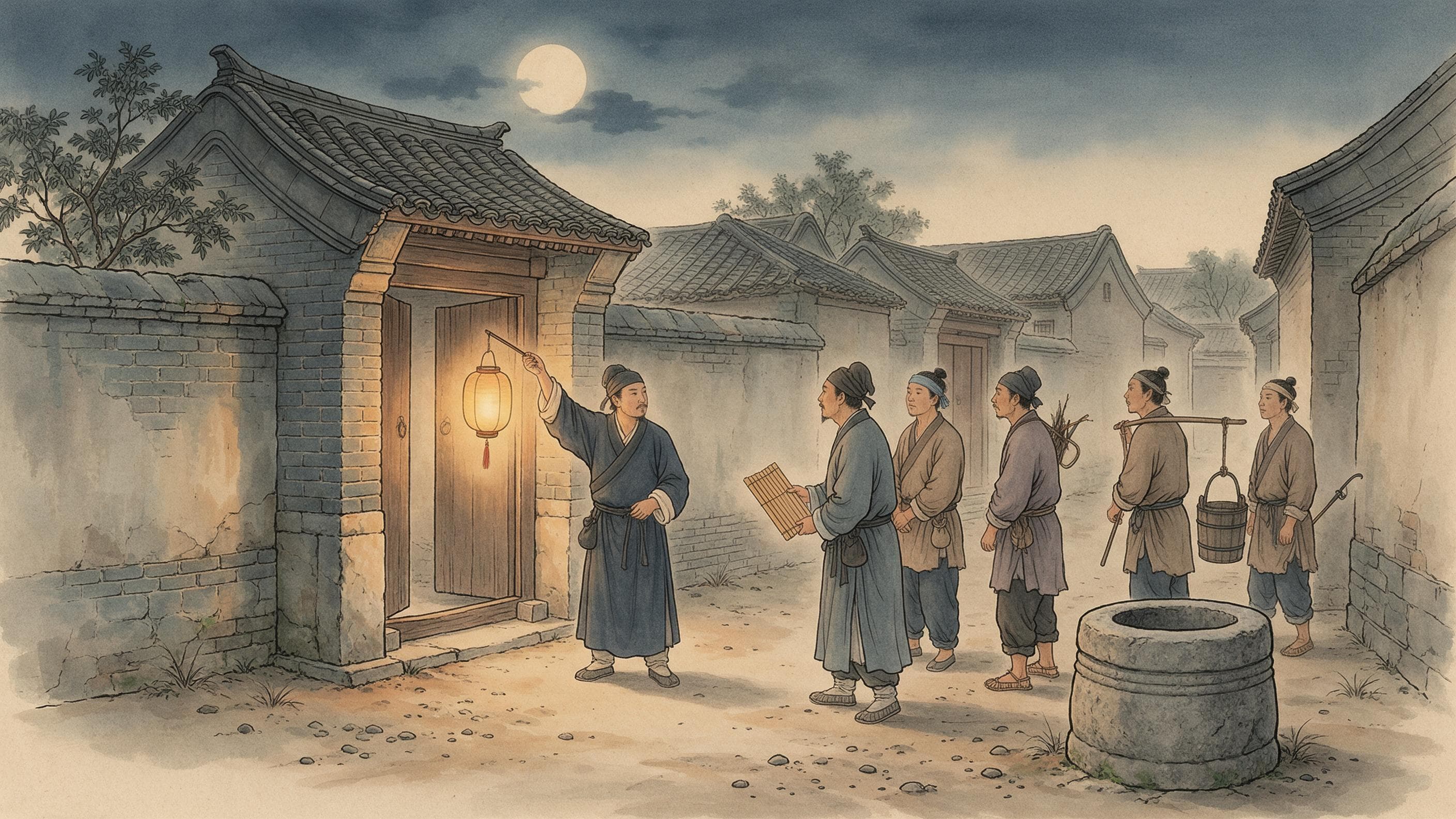
The ward headman's round
Below the offices the city was cut into wards (坊) and blocks (铺), each block keeping three to five fire watchmen under a ward headman, the zongjia (总甲). It was a census machine as much as a watch. Wanping's half of the capital alone held thirteen wards and 312 lanes, each registered under its ward, block and hutong name. The headman's duties are listed without romance: escort officials and guests at night, drive off noise and obstruction every morning, press for the house tax every month, and at each year's end urge the ditches cleared and the streets levelled.
Two administrations sat above him. The headmen answered to the five ward commands, while the people they policed answered to the county, and the magistrate could not even serve a writ on men posted in the near suburbs — two offices, one chain, constant friction. The same headman was the city's data source: when trade registers were compiled, the ward commands sent him to report who was in business and who had moved. Above it all ran a formal channel — monthly the prefect and the two magistrates read a proclamation to the ward elders at a bridge outside the palace, and in the tenth month one line was that bridges and roads must be repaired in season.
Shen Bang, Wanping's magistrate in the 1590s, recorded what the system did to its lowest rank. Local households no longer wanted the duty, so it passed to migrants and the unregistered until, in his words, the headmen of the capital were either rootless youths or petty beggars. They lived on customary fees: lamp oil money from each household every month, a writ fee on house deeds. Whether the oil money was a shared lighting bill or a private squeeze is unclear — he lists it as an abuse, yet the monthly per-household form looks like a public charge.
Eight hundred rooms and a half
The commercial city was built and rented out by the state. After Yongle moved the capital, shop-houses rose at the four gates of the imperial city and around the bell and drum towers: in Wanping's share, 801 and a half rooms and 16 and a half shops, all called langfang (廊房). Rents followed position, not the size of the trade — 443 large rooms at 45 strings of paper notes and 90 cash per quarter, 29 middle rooms at 31 strings and 62 cash, 329 and a half small ones at 30 strings and 60 cash. Merchants did not squat; they leased a box in a market the state had already placed at a gate.
Collection was farmed out to the tenants. One substantial resident per stretch became a rent headman, langtou (廊头), and thirty-one of them at a time rotated, drawing lots for chief and deputy and paying the quarterly rents into the imperial treasury. Goods paid duty at the gates. Merchants were enrolled in 132 guilds, rated in nine grades from nine qian of silver at the top to one at the bottom; Wanping's assessed quota was 2,663.4 taels. The five wards collected a house tax, the counties a deed tax, and street repairs came out of that deed-tax silver.
Labour was assessed the same way: one year Wanping owed 1,052 men of service, commuted to 3,836.6 taels, plus 197 hired men at 1,492.8 taels, in a list that includes sluice keepers, night watchmen, watch-post soldiers and water carriers. A city, in this accounting, is a schedule of names and wages.
Every three days, a scale
Market supervision was narrower than a modern reader expects and far more concrete. From 1368 the ward commands also ran the market offices: every three days they checked the street's grain measures and scales, registered the names of the brokers standing between buyer and seller, and kept an eye on prices, while the prefect was charged with levelling them. Nobody issued a licence or inspected a kitchen. The state made sure a peck of rice was a peck, that the broker crying a price had a name, and that someone watched the price itself.
Water from wells, fire by fire post
Water was channels, wells, carts and men. The Jade River ran from the Jade Spring hills through the palace and out of the city; the northwest lakes collected the springs. Palace and grain barges had first claim; lanes lived off wells, which survive in street names — Four-Eyes Well Lane, Water-Cart Lane, Flood Well Lane, High Well Lane, Spring Lane. The men who kept it wet were on the levy rolls: six lock-keepers on the upper Pingjin sluice at 7.2 taels each, ten at Guangyuan at four, water carriers for the yamen at twelve, two bucket men at the West Lake at 1.2 whose duties the sources leave vague. That sweet water was carted and sold while household wells served washing is a fair guess from the lane names, not a record.
Each block kept three to five watchmen — several hundred men across thirteen wards by establishment, an estimate, since no total survives. A Ming commentary put it plainly: fire posts and night watchmen in the lanes, watching one another for thieves. The statutes were more exact. In 1474 every water gate in the capital was given a fire post, water equipment and two soldiers to guard it; whenever a house caught fire, the ward's bowmen and fire squads were to come with tools, and every block's fire watchman, unless formally exempted, was enrolled for duty. Warnings to households came through the monthly proclamation, and every autumn the words were the same: be careful of fire and candles, patrol by night and check by day.
What the statutes never say is what a fire watchman carried, how many men the city had in total, or how waste was handled: the headman's duties stop at levelling the street, and night soil and rubbish have no office in these records. What they do show is a city with no budget and no works department — statutes that closed the streets, a chain of underpaid or unpaid headmen who did the walking, and a levy schedule that turned households and shopkeepers into the men who cleared ditches and carried water. Which leaves the question the files cannot answer: when the bell went quiet, who paid the man with the lantern?
Sources & further reading
- 申时行等《大明会典》卷一百六十六·夜禁(万历重修本) — 夜禁律条原文:一更三点钟声静后、五更三点钟声动前犯夜笞三十,二三四更笞五十;公务、疾病、生产、死丧不在禁限;巡夜人诬执犯夜者抵罪
- 《大明会典》卷一百五十九·工部十三·街道沟渠(四库全书一百八十卷本) — 成化十年条「京城水关每座盖火铺一,立通水器」,拨军二名看守;成化六年条街道桥梁损坏「即督地方火甲人等并力填修」;成化十五年添设员外郎专巡街道沟渠。注意:四库本与万历重修本卷号不同,不可混用
- 《大明会典》卷一百七十七·五城兵马司(四库全书一百八十卷本) — 「凡官民房舍火起,不分地方,各司督领弓兵火甲人等俱持器具救火」「凡各城坐铺火夫,除有例优免外,其余俱要编当」;弓兵每司额设八十名、一年更替
- 丘濬《大学衍义补》卷一百三十六 — 明人议论,非条文:「后世于里巷设为火铺、更夫,使之互相觉察以防盗贼」;「今制一更三点禁人行,五更三点放人行」
- 沈榜《宛署杂记》(万历二十一年自序,全书二十卷) — 「街道」条(坊铺编制、总甲火夫、胡同、总甲之苦)、「力役」条(更夫、水夫、闸夫、实役募役)、「廊头」条(廊房三等收钞、廊头轮值)、「铺行」「税契」条(行银九则、房号、税关);卷次依通行整理本,电子本按条切分无卷次
- 张廷玉等《明史》卷七十四·职官三(五城兵马司、顺天府、尚宝司、钦天监、宦官) — 五城兵马司「巡捕盗贼,疏理街道沟渠及囚犯、火禁之事」,并管市司、校斛斗秤尺、稽牙侩、时物价;钦天监「报更以鼓」;尚宝司六种权杖分给金吾卫与五城巡夜